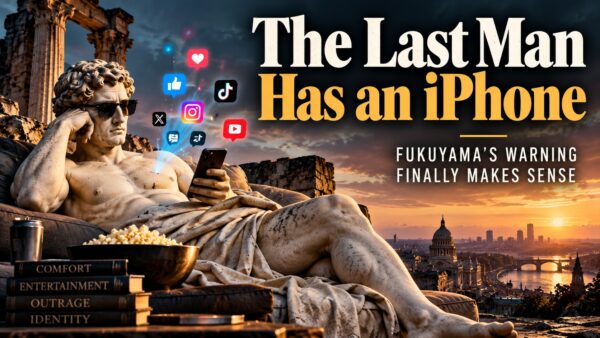
Francis Fukuyama may have written the most misunderstood political book of the last half-century.
In 1992, The End of History and the Last Man appeared after the Soviet Union collapsed, and apparently everybody read the title and skipped the book.
“End of history? What an idiot. There are still wars.”
Except Fukuyama never said wars would disappear.
He was talking about History with a capital H—the long ideological argument over how human beings should organize civilization.
For thousands of years we tried nearly everything: kings, emperors, theocracies, aristocracies, fascism, communism and military dictatorships. Most worked wonderfully if you happened to be the king.
The twentieth century eventually produced the championship round: fascism, communism and liberal democratic capitalism.
Fascism spectacularly removed itself from the tournament in 1945 (we think). Communism lasted another forty-six years before the Soviet Union essentially looked at its balance sheet and announced, “Well, this isn’t working.”
That left liberal democracy and market capitalism standing there holding the trophy.
Fukuyama’s question was simple:
What comes next?
Not what country becomes powerful next. Not whether another war happens. What fundamentally new political-economic system replaces liberal democracy?
More than three decades later, we’re still waiting.
China supposedly represents the great alternative, except China operates something resembling authoritarian capitalism while continuing to call itself communist because changing the stationery would apparently be awkward.
Russia offers nationalism and authoritarian capitalism. Iran offers Islamic theocracy. North Korea offers whatever North Korea is. An atheist hell hole.
None has produced a universal ideology that billions of ordinary people around the world are demanding their governments adopt.
That’s different from 1950, when communism genuinely competed for humanity’s imagination.
But that’s not even the most interesting part of Fukuyama’s book.
He spends much of the second half wondering whether winning might become our next problem.
Fukuyama reaches back to Plato and the Greek concept of thymos: humanity’s desire for recognition, dignity, honor and status.
Human beings don’t merely want food.
We want somebody to notice we’re eating better food than the guy next door.
Fukuyama describes two forms of this desire.
Isothymia: Recognize me as your equal.
That’s the democratic impulse—equal citizenship, equal rights and equality before the law.
Then there’s megalothymia:
Recognize me as better than you.
Alexander wanted it. Caesar wanted it. Napoleon wanted it. Politicians, billionaires, generals and athletes want it.
Civilization can’t eliminate that impulse, so liberal society attempts to channel it.
Instead of conquering Gaul, build the biggest corporation. Instead of invading your neighbor, beat him at football. Instead of becoming emperor, run for president.
Usually this works better than cavalry.
But then Fukuyama introduces Nietzsche’s Last Man.
Imagine humanity succeeds.
We’re wealthy. Safe. Comfortable. Food arrives at the door. The house stays 72 degrees. Nearly all recorded human knowledge sits inside a little rectangle in our pocket.
Congratulations.
We won civilization.
And somehow we’re miserable.
Because human beings don’t merely require comfort.
We require meaning. Purpose. Belonging. Struggle. Something larger than ourselves.
And if civilization removes meaningful struggles, humans possess an extraordinary ability to invent new ones.
Look around.
Political identity becomes tribal identity. Minor disagreements become existential threats. Social media may be the greatest thymos machine ever constructed:
Look at me.
Recognize me.
Follow me.
Validate me.
Tell me I’m important.
Fukuyama worried that the Last Man might become comfortable but spiritually restless—and eventually rebel against the civilization that made him comfortable.
That may be exactly what we’re watching.
The greatest threat to liberal democracy may not be some brilliant new ideology invented in Beijing, Moscow or Tehran.
It may be us.
People who inherited extraordinary prosperity, technology and political liberty—and became bored with it.
So we manufacture tribes, enemies, outrage and meaning.
For decades people mocked The End of History because history obviously didn’t end. Russia invaded Ukraine. China rose. Terrorists attacked America. Nationalism returned.
But much of it demonstrates the human impulse Fukuyama warned about:
Recognition.
Respect my nation.
Respect my religion.
Respect my identity.
Respect my grievance.
Respect me.
Maybe Fukuyama wasn’t predicting paradise.
Maybe he was warning us what would happen after we reached it.
Humanity climbed the ideological mountain, looked around and discovered there wasn’t another obvious mountain above it.
Then we immediately started arguing about who deserved credit for the climb.
Fukuyama may have been right.
We reached the End of History.
Then we got bored.
And apparently boredom is one hell of a dangerous political ideology.
If you enjoyed this article, then please REPOST or SHARE with others; encourage them to follow AFNN. If you’d like to become a citizen contributor for AFNN, contact us at managingeditor@afnn.us Help keep us ad-free by donating here.
Substack: American Free News Network Substack
Truth Social: @AFNN_USA
Facebook: https://m.facebook.com/afnnusa
Telegram: https://t.me/joinchat/2_-GAzcXmIRjODNh
Twitter: https://twitter.com/AfnnUsa
GETTR: https://gettr.com/user/AFNN_USA
CloutHub: @AFNN_USA