Russia Is Rattling Sabers Under the Sea—and NATO Is Watching
Most Army guys don’t spend much time thinking about the bottom of the ocean. We worry about bridges, roads, railheads, fuel dumps and whether somebody remembered to order enough toilet paper for the field exercise.
The Navy has another problem.
Apparently, civilization has left a significant portion of its nervous system lying unguarded on the ocean floor.
More than 99 percent of international data traffic touching Britain travels through undersea fiber-optic cables, according to the British government. Banking, commerce, military communications, internet traffic and the endless stream of cat videos holding Western civilization together all eventually depend on very long strands of glass running beneath the oceans.
Russia knows this.
And lately Russia has been reminding NATO that it knows.
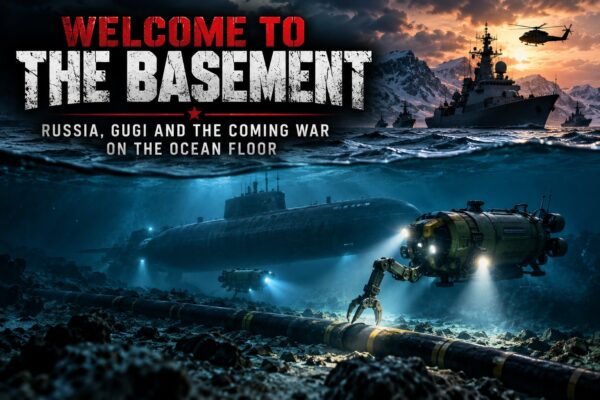
In April 2026, Britain publicly revealed that it had spent more than a month tracking an unusual Russian operation in the North Atlantic. An Akula-class attack submarine appeared, while two specialized Russian submarines belonging to GUGI—Russia’s Main Directorate for Deep-Sea Research—operated elsewhere around critical underwater infrastructure.
GUGI sounds like someplace you’d send a college intern to count shrimp.
It isn’t.
The British government describes GUGI’s specialized vessels as designed to survey underwater infrastructure during peacetime and potentially sabotage it during conflict. Britain responded with a frigate, helicopters, P-8 maritime patrol aircraft and allied forces. The RAF alone flew more than 450 hours monitoring the operation.
Translation from military bureaucratese: Russia went snooping around the basement, and NATO followed it around with a flashlight.
Then the story became even more interesting.
Reuters reported in September that Britain, Norway and the United States had disrupted another Russian operation near Svalbard earlier in the year. Western officials said Russian deep-sea submersibles were simulating deployment of technology capable of disabling undersea fiber-optic cables.
No cable was cut.
No war started.
But somebody was apparently practicing.
That distinction matters.
Militaries practice things they may someday need to do. The United States practices bombing targets it has absolutely no intention of bombing tomorrow. Russia rehearses missions it may never execute. That’s called contingency planning, not necessarily preparation for Armageddon.
But it’s also saber rattling.
Except the saber is several thousand feet underwater.
The technology is admittedly pretty cool.
GUGI operates specialized submarines, deep-diving vehicles and increasingly sophisticated unmanned underwater systems. Instead of imagining “The Hunt for Red October”, imagine a submarine functioning as an underwater mothership. It gets into the neighborhood and smaller vehicles go downstairs to examine what’s sitting on the seabed.
Welcome to underwater drone warfare.
For an old Army guy, the easiest way to understand this is simply to recognize that the seabed is terrain.
Cables are lines of communication.
Cable landing stations are transportation hubs.
The Greenland-Iceland-United Kingdom gap is key terrain.
Deep-sea vehicles are reconnaissance assets.
And GUGI appears to be conducting something remarkably similar to Intelligence Preparation of the Battlefield.
Suddenly this starts sounding familiar.
Anyone who has participated in serious Cold War-style war games knows what happens early in a major conflict: communications get attacked. Headquarters disappear. Satellites get jammed. Networks go down. Bridges get cratered. Everybody discovers that the PowerPoint slides were slightly optimistic.
Undersea cables belong on that target list.
Cutting one cable probably accomplishes very little. The international telecommunications network contains considerable redundancy, and accidental cable breaks happen regularly.
But simultaneously disrupting multiple carefully selected cables during a larger military operation is another matter entirely.
The objective wouldn’t necessarily be turning off the Internet.
It would be creating friction.
Slow the financial system. Complicate military communications. Force traffic onto alternate networks. Confuse commanders. Create uncertainty. Make governments wonder whether the cable failure was an accident, sabotage or the opening move of something much larger.
Dead Carl, aka Clausewitz, would recognize the concept immediately.
So would any Army Battalion/Squadron S-3.
The reassuring part of this story is that NATO apparently wasn’t asleep.
Britain publicly told Moscow, essentially, “we see you.” British ships and aircraft tracked the Russian operation around the clock, while allied forces helped identify the other vessels. Britain’s defense secretary later described Russia as “probing, testing, and mapping” in the North Atlantic.
That may actually be the most important part of the story.
Russia is demonstrating capability.
NATO is demonstrating detection.
Russia says, “We can wreck your cables.”
NATO answers, “We know where you are.”
Neither side necessarily wants to pull the trigger. That’s deterrence doing its strange little dance.
But underneath all the geopolitical chest-thumping is a fascinating technological revolution occurring largely outside public view. Autonomous underwater vehicles, deep-diving submarines, seabed sensors, fiber-optic networks and anti-submarine warfare are turning the ocean floor into another contested military domain.
Land. Sea. Air. Space. Cyber.
And now increasingly, the deep-sea basement.
The next war may begin somewhere almost nobody can see—three thousand meters underwater, with two unmanned machines staring at each other beside a fiber-optic cable carrying half the world’s memes and cat videos.
Welcome to twenty-first-century warfare.
If you enjoyed this article, then please REPOST or SHARE with others; encourage them to follow AFNN. If you’d like to become a citizen contributor for AFNN, contact us at managingeditor@afnn.us Help keep us ad-free by donating here.
Substack: American Free News Network Substack
Truth Social: @AFNN_USA
Facebook: https://m.facebook.com/afnnusa
Telegram: https://t.me/joinchat/2_-GAzcXmIRjODNh
Twitter: https://twitter.com/AfnnUsa
GETTR: https://gettr.com/user/AFNN_USA
CloutHub: @AFNN_USA