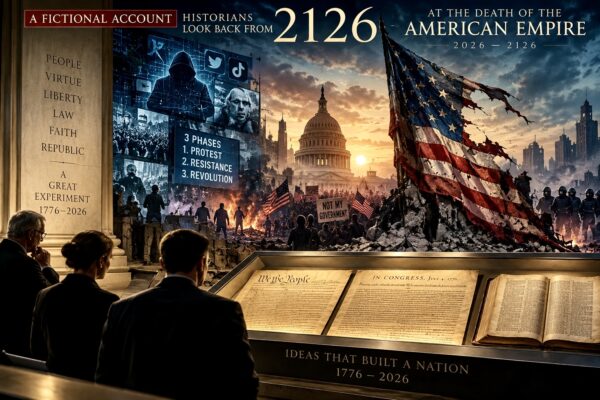
This is a work of fiction…and a warning: From The Rise and Fall of the American Republic, published in 2126 by the North American Institute of Military History (NAIMH)
Historians generally agree that the United States of America WAS one of the most extraordinary political experiments in recorded human history. Founded in 1776, the republic survived a civil war, two world wars, economic depressions, nuclear brinkmanship, terrorism, pandemics, and politicians who occasionally demonstrated the intellectual capacity of a turnip.
What it could not survive, apparently, was its own success.
For more than 250 years, Americans enjoyed freedoms that previous civilizations could scarcely imagine. They possessed unprecedented wealth, extraordinary technology, abundant food, and the constitutional right to tell their government to go pound sand.
And somehow, it wasn’t enough.
The American experiment rested upon a revolutionary proposition: government derived its legitimate authority from the consent of the governed. Abraham Lincoln later immortalized the concept as government “of the people, by the people, for the people.”
It sounded magnificent.
Unfortunately, the Founders had overlooked one small engineering defect.
The people were human.
The Biblical Foundation of an Unofficial Christian Nation
America was never constitutionally established as an official Christian nation. Its Constitution prohibited religious tests for federal office, and the First Amendment rejected the establishment of a national religion.
But that did not mean its founding philosophy emerged from a moral vacuum.
The Founders drew upon Enlightenment political thought, English constitutional traditions, classical philosophy, natural law, and religious ideas deeply influenced by Christianity.
Their Declaration of Independence appealed to a Creator who endowed human beings with unalienable rights. The colonists’ plea for independence from the British monarchy was not merely an argument about taxation. It was a declaration that kings were not gods and that legitimate government existed to protect rights rather than dispense them as royal favors.
This was a radical proposition in an age of hereditary monarchy.
Christian moral philosophy contributed an important insight: human beings possess inherent dignity, but they are also morally fallible. No king, president, legislature, or popular majority can safely be trusted with unlimited authority.
The Founders’ constitutional solution reflected that suspicion of concentrated power. Separate institutions, competing interests, checks and balances, and protections for individual liberty were intended to restrain human ambition.
James Madison understood the problem particularly well. His famous observation in Federalist No. 51 asked what need there would be for government if men were angels.
The answer, unfortunately, was that men were not angels.
Not in 1787.
Not in 2026.
And certainly not in the years that followed.
The Disease of Prosperity
Military historians have long recognized a recurring pattern among successful civilizations. Hardship can encourage cooperation. Cooperation creates stability. Stability permits prosperity. Prosperity can produce comfort. And comfort sometimes produces generations who mistake inherited civilization for a naturally occurring phenomenon.
The Romans experienced their own struggles with wealth, factionalism, and civic decline, although their history was far more complicated than any simple cycle.
Americans, naturally, believed themselves immune.
By the early twenty-first century, citizens who had never experienced starvation complained about grocery selections. People enjoying extraordinary civil liberties sometimes described ordinary political defeat as tyranny. Political disagreements became existential threats. Neighbors who had peacefully coexisted for decades suddenly regarded one another as enemies of civilization.
The republic had not run out of resources.
It had run out of perspective.
The Christian virtues that had helped shape generations of American civic life—humility, restraint, forgiveness, charity, personal responsibility, and love of neighbor—were increasingly difficult to reconcile with a political culture that rewarded outrage and humiliation.
These were not exclusively Christian virtues, nor had Americans ever practiced them consistently. But their philosophical and psychological value was timeless.
A society requires trust. Forgiveness permits reconciliation. Humility restrains arrogance. Personal responsibility makes liberty sustainable.
When these qualities disappear, no constitution can manufacture them.
The Revolution That Required No Invasion
For generations, American military strategists had prepared to defeat foreign enemies. They developed aircraft carriers, nuclear submarines, stealth bombers, satellites, and weapons capable of delivering extraordinary destruction anywhere on Earth.
They had prepared for another Pearl Harbor.
Instead, the decisive battlefield was a smartphone.
In this fictional historical account, the mechanism that eventually dismantled the republic was neither particularly new nor especially complicated.
It became known as the color revolution.
Originally associated with popular movements challenging entrenched governments, the method involved three broad stages: protest, resistance, and revolutionary political transformation.
These methods had sometimes helped populations challenge authoritarian rule. But in America’s final political crisis, rival factions adopted similar methods without agreeing upon a legitimate constitutional outcome.
First came the protests.
Every institution was declared corrupt. Every election became suspect. Every disagreement became evidence of tyranny. Algorithms rewarded outrage, while political entrepreneurs discovered that frightened citizens were extraordinarily profitable.
Then came strategic noncompliance.
Economic boycotts, strikes, institutional obstruction, and organized resistance gradually transformed political disagreement into a struggle over the legitimacy of government itself.
The method exploited the republic’s dependence upon voluntary cooperation.
Finally came the revolutionary crisis.
In this imagined history, competing political coalitions no longer agreed upon who possessed legitimate authority. Elections continued, but their results increasingly failed to settle anything. Institutions fractured along ideological lines. Constitutional safeguards remained written on parchment while public confidence in them evaporated.
Nobody needed to invade Washington.
The Americans were perfectly capable of dismantling their own republic.
The Strategic Failure
In hindsight, the failure was not primarily military.
It was psychological, philosophical, and spiritual.
The American defense establishment understood the instruments of national power: diplomatic, informational, military, economic, financial, intelligence, and law enforcement.
What its leaders failed to appreciate was that these instruments ultimately depended upon a functioning national identity.
An army can defeat an invading force. It cannot manufacture mutual trust among millions of citizens.
A constitution can establish limits upon government. It cannot compel citizens to exercise restraint.
And a republic cannot survive indefinitely when political factions begin treating electoral defeat as justification for destroying the institutions they hope someday to control.
The irony was magnificent.
Americans spent generations warning the world about authoritarianism while increasingly demanding extraordinary government power whenever democracy produced an outcome they disliked.
Each faction insisted (believed) it was saving the republic.
Each considered the other an existential threat. Their enemy…
And each helped destroy the constitutional framework that permitted them to disagree in the first place.
The Museum of Antiquity
Today, in the year 2126, visitors to the North American Museum of Antiquity can examine surviving copies of the Declaration of Independence, the Constitution, and the Holy Bible.
Three documents displayed together, representing different but intersecting intellectual traditions.
The Declaration proclaimed rights that government did not create.
The Constitution established a system intended to restrain the exercise of political power.
The Bible taught enduring lessons about human nature: pride precedes destruction, a house divided against itself cannot stand, and human beings are called to love their neighbors rather than merely defeat their enemies.
These principles were not identical, nor did every Founder interpret them in the same way. Yet together they help explain the moral and political vocabulary of the American founding.
Historians now recognize the profound irony.
The Americans possessed access to thousands of years of philosophical and religious reflection on human weakness. They studied the fall of empires. They understood the dangers of concentrated power. Their own Founders had designed a government specifically because human beings could not be trusted to behave like angels.
And still, they repeated the ancient pattern.
Their technological achievements advanced at astonishing speed.
Their capacity for wisdom did not necessarily follow.
The Final Historical Assessment
Modern historians caution against describing the American collapse as an inevitable consequence of prosperity. Wealth did not destroy the republic. Nor did protest itself. Peaceful resistance had helped create and improve American democracy throughout its history.
The fatal development in this imagined account was the transformation of political opposition into permanent institutional warfare, accelerated by information technology and an increasingly unforgiving culture of tribal loyalty.
The color revolution was not some magical foreign invention. It was a collection of political techniques that could be used for liberation or destabilization, depending upon the objectives and circumstances.
In this American tragedy, those techniques became destructive because competing factions no longer sought merely to govern within the constitutional system.
They sought to defeat the system whenever it favored their opponents.
The republic did not fall in a single dramatic afternoon.
It simply became ungovernable.
For two and a half centuries, the American experiment endured. Its founders had understood that liberty required more than parchment, elections, and eloquent speeches. It required citizens capable of placing enduring principles above temporary political victories.
The United States possessed enough military power to destroy the world several times over.
But not enough wisdom to keep from destroying itself.
And perhaps the most haunting exhibit in the Museum of Antiquity is a simple inscription beneath those three ancient documents:
They understood that human beings were imperfect. They designed a government to restrain that imperfection. They inherited a moral tradition that warned them about pride, envy, greed, and hatred.
Then they convinced themselves that those warnings applied only to their enemies.
Thus ended the great American experiment—not with foreign tanks rolling down Pennsylvania Avenue, but with millions of citizens convinced that burning down their own constitutional house was the only way to save it.
The historians of 2126 eventually gave the phenomenon a familiar name.
Human nature.
And on the museum wall, beneath the ruins of a once-great republic, another ancient warning remains:
“Pride goeth before destruction, and an haughty spirit before a fall.” — Proverbs 16:18 (KJV)
Excerpt
For more than 250 years, America survived wars, depressions, pandemics, and politicians with the intellectual capacity of a turnip. What it couldn’t survive was its own success. In this fictional account from historians of 2126, the great American experiment collapses not from foreign invasion, but from prosperity, tribalism, and a color revolution that weaponized liberty against itself. Though never officially a Christian nation, America was built upon principles deeply influenced by biblical wisdom, human dignity, and moral virtue. Its Founders understood the dangers of human nature. Its descendants forgot. The nation possessed enough military power to destroy the world several times over, but not enough wisdom to save itself. History didn’t repeat itself. Human nature did.
If you enjoyed this article, then please REPOST or SHARE with others; encourage them to follow AFNN. If you’d like to become a citizen contributor for AFNN, contact us at managingeditor@afnn.us Help keep us ad-free by donating here.
Substack: American Free News Network Substack
Truth Social: @AFNN_USA
Facebook: https://m.facebook.com/afnnusa
Telegram: https://t.me/joinchat/2_-GAzcXmIRjODNh
Twitter: https://twitter.com/AfnnUsa
GETTR: https://gettr.com/user/AFNN_USA
CloutHub: @AFNN_USA