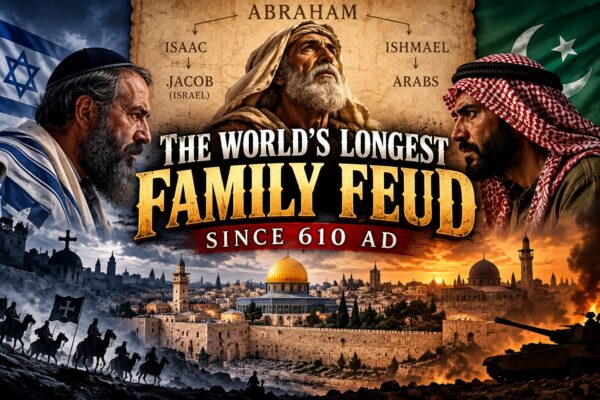
Somewhere around 610 AD, a fellow named Muhammad began preaching in Arabia, and the world’s most dysfunctional family reunion acquired an entirely new argument.
Fourteen centuries later, we’re still trying to figure out who gets the inheritance, who speaks for the patriarch, and who has the legitimate claim to the family property.
Welcome to the Abrahamic family feud. Population: billions. Peace negotiations: ongoing. Thanksgiving dinner: absolutely out of the question.
The story begins with Abraham, the patriarch claimed by Judaism, Christianity, and Islam. According to Genesis, Abraham had two sons who would become central to the competing ancestral traditions of the Middle East.
Isaac, born to Sarah, became the father of Jacob, later called Israel. Ishmael, born to Hagar, became associated with the ancestry of Arab peoples, particularly in Islamic tradition.
Two sons. One father. Different mothers. Different inheritances.
What could possibly go wrong?
Now, before the geneticists start throwing laboratory equipment, let’s establish something. Modern population genetics confirms that many Jewish and Arab populations share ancient Middle Eastern ancestry. Ashkenazi Jews, for example, have identifiable genetic ancestry patterns, as do populations from the Arabian Peninsula.
But nobody has Abraham’s toothbrush sitting in a laboratory. We cannot establish a DNA pedigree connecting modern populations to the biblical patriarch.
Nevertheless, the shared ancestral tradition is enormously important because human beings don’t necessarily fight over what scientists can prove. They fight over what they believe.
And beliefs can survive empires.
For centuries before Muhammad, Jews and Arabs already inhabited the Middle East. They traded, competed, cooperated, and occasionally fought, just like practically every other collection of human beings throughout history.
Then came Islam.
Beginning around 610 AD, Muhammad proclaimed revelations that would eventually become the Quran. Islam recognized Abraham, Moses, and Jesus while presenting Muhammad as the final prophet.
Imagine showing up at a 2,000-year-old family reunion and announcing that you’ve received the final, authoritative version of Grandpa’s will.
That might cause some friction.
Judaism rejected Muhammad’s prophetic authority. Christianity rejected Islam’s account of Jesus. Islam maintained that earlier revelations had been misunderstood or altered.
Suddenly, three religious traditions claimed connections to the same patriarch while disagreeing over who possessed the authoritative interpretation of God’s instructions.
This wasn’t merely a disagreement over whose casserole belonged on the dinner table.
It concerned divine authority, sacred history, law, and eventually political sovereignty.
Following Muhammad’s death in 632 AD, Arab Muslim armies expanded into territories controlled by the Byzantine and Sasanian empires. Jerusalem came under Muslim rule in the seventh century.
Centuries later, European Christian armies launched the Crusades. Muslim rulers fought to reclaim territory. Jewish communities often found themselves caught between competing powers.
Everyone had a theological argument. Everyone had a political objective. And remarkably, everyone seemed convinced God was on their side.
As an old Army FA49 operations research guy, I find this fascinating.
In game theory, negotiations become particularly difficult when participants assign effectively infinite value to something. Sacred territory, religious legitimacy, and divine promises don’t fit neatly into a spreadsheet.
How do you negotiate the price of something when both parties believe God already gave it to them?
You don’t simply split the difference and call it Tuesday.
Jerusalem illustrates the problem beautifully.
For Jews, it represents the ancient capital and location of the Temple. For Christians, it is central to the crucifixion and resurrection of Jesus. For Muslims, it is associated with Muhammad’s Night Journey and the Al-Aqsa Mosque.
According to Islamic tradition, Muhammad rode a supernatural creature called Al-Buraq from Mecca to Jerusalem, then ascended through seven heavens, met several prophets, and negotiated the daily prayer requirement down from 50 to five. That’s quite a night, especially in the seventh century. I’m not saying somebody was smoking weed, but even Willie Nelson might have asked what was in that stuff.
Three competing sacred narratives. One piece of real estate.
Even the Pentagon couldn’t produce a PowerPoint complicated enough to resolve that inheritance dispute.
Of course, reducing every modern Middle Eastern conflict to religion would be historically ridiculous. Nationalism, imperialism, colonial borders, economics, and competing political ambitions have all contributed. Jews and Muslims have also experienced long periods of coexistence, and plenty of Arabs are Christians.
Nor are all Muslims Arabs. Most aren’t.
But dismissing religion entirely is equally foolish.
When Hamas invokes religious language, when jihadist movements envision a restored caliphate, or when political leaders invoke biblical promises concerning Israel, they aren’t merely discussing property values.
They’re invoking historical identities and religious convictions that can make compromise extraordinarily difficult.
And that brings us to the uncomfortable strategic reality.
You cannot understand an adversary while refusing to understand the worldview motivating him.
The United States has spent decades treating some religiously motivated conflicts as though they were simply disagreements over economics, borders, or insufficient diplomatic engagement.
Sometimes they are.
Sometimes the fellow across the table genuinely believes he’s participating in a divine struggle extending across centuries.
That’s a different problem set.
So here we are, roughly 1,400 years after Muhammad began preaching, still arguing about Abraham, his descendants, sacred territory, and who possesses God’s final instructions.
The original patriarch is long gone. The empires have risen and fallen. The weapons have evolved from swords to ballistic missiles.
And yet the family argument survives.
Maybe the world’s longest-running family feud isn’t really about who inherited Abraham’s land.
Maybe it’s about who inherited the authority to speak for God.
And until humanity figures out that distinction, I wouldn’t schedule the family reunion.
Especially not in Jerusalem.
If you enjoyed this article, then please REPOST or SHARE with others; encourage them to follow AFNN. If you’d like to become a citizen contributor for AFNN, contact us at managingeditor@afnn.us Help keep us ad-free by donating here.
Substack: American Free News Network Substack
Truth Social: @AFNN_USA
Facebook: https://m.facebook.com/afnnusa
Telegram: https://t.me/joinchat/2_-GAzcXmIRjODNh
Twitter: https://twitter.com/AfnnUsa
GETTR: https://gettr.com/user/AFNN_USA
CloutHub: @AFNN_USA