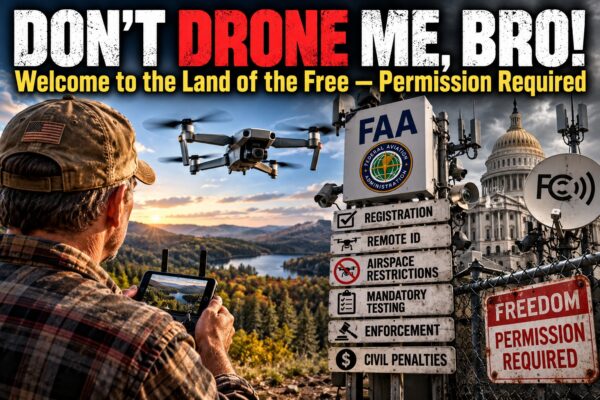
Apparently, that has become a threat to national security.
Welcome to 2026, where your flying camera has become a federal enforcement concern, the electromagnetic spectrum belongs to Washington’s regulatory empire, and the land of the free increasingly resembles the land of the federally approved.
Let’s talk about freedom. Or, more accurately, the illusion of it.
The Federal Aviation Administration recently tightened its enforcement policies for recreational drone operators. The agency is shifting away from its traditional emphasis on education and voluntary compliance toward more aggressive legal enforcement. Its new DETER program even offers certain first-time offenders reduced penalties if they admit liability and waive their right to appeal.
How generous.
Washington investigates you, offers you a deal, and asks you to surrender your right to challenge the decision in exchange for leniency.
Somewhere, Franz Kafka is laughing.
Now, before somebody at the FAA starts hyperventilating into a government-issued paper bag, let’s establish something. Nobody wants drones flying into commercial aircraft, interfering with firefighting helicopters, or hovering over airport runways. Those are legitimate safety concerns.
But when did flying a camera over your own forty acres become an activity requiring federal oversight?
And drones are merely the latest chapter in a much larger American tragedy.
Consider the electromagnetic spectrum.
Radio waves have existed since the creation of the universe. Nobody in Washington invented them. Congress didn’t manufacture them. The FCC didn’t discover them hiding behind the Lincoln Memorial.
Yet the federal government exercises extensive control over who may transmit, on which frequencies, at what power levels, and under what conditions.
Want to operate certain radio equipment? Get a license. Want to broadcast? Get authorization. Want to use frequencies reserved for another purpose? Congratulations, you’ve potentially committed a federal violation.
The government has effectively established an enormous regulatory system governing something you cannot even see.
That’s impressive bureaucratic ambition.
Of course, radio frequencies require coordination. Without sensible rules, powerful transmitters could interfere with aviation communications, emergency services, and one another. Nobody with two functioning brain cells disputes that.
But coordination and control are not synonymous.
And therein lies the problem.
The federal government increasingly approaches technological innovation with a simple philosophy: If Americans discover a new capability, Washington must determine how, when, where, and under what conditions they may use it.
The air above your property? Regulated.
The radio waves passing through your backyard? Regulated.
The water flowing across your land? Potentially regulated.
The flying camera you purchased with your own money? Registered, electronically identifiable under applicable rules, and subject to federal enforcement.
What’s next? A Department of Gravity requiring permits before Americans jump off their porches?
Don’t laugh. Somebody would probably propose a fee schedule.
Now consider the historical irony.
James Madison explained in Federalist No. 45 that the powers delegated to the federal government were intended to be “few and defined,” while those retained by the states were “numerous and indefinite.”
That was the original constitutional architecture.
A federal government with specific responsibilities, operating within defined limits, while the people retained their liberties.
Fast-forward roughly 240 years.
We now have a federal regulatory structure so extensive that ordinary Americans routinely need government authorization to engage in activities their great-grandparents couldn’t have imagined. Did you know that it’s illegal a normal citizen without a license to sell certain foods items (meat, poultry and dairy) across state lines according to the FDA and USDA?
And each new technology creates another opportunity for bureaucratic expansion.
Think about drones specifically.
These remarkable little machines have democratized aviation. For a few hundred dollars, an ordinary American can inspect his roof, photograph his property, locate storm damage, or capture breathtaking views once available only to wealthy aircraft owners.
That’s technological freedom.
And what does Washington see?
Another category of operators to regulate, fee and contol.
Another registration system.
Another identification requirement.
Another enforcement opportunity.
The government celebrates unmanned aviation as the future of warfare, commerce, surveillance, and technological innovation. Billions are invested in developing increasingly sophisticated unmanned systems.
We’ve watched inexpensive drones fundamentally transform the battlefield in Ukraine.
Yet the same country that celebrates this technological revolution imposes an expanding compliance burden on civilians who simply want to enjoy the technology.
Apparently, unmanned aviation is the future.
Provided the little peasants file the appropriate paperwork.
And this is where the issue becomes philosophical rather than technological.
In a free society, government should justify restrictions on individual liberty. Citizens shouldn’t have to continually justify their desire to exercise it.
Public safety is a legitimate government responsibility. But safety cannot become a magic phrase that automatically excuses every new restriction, surveillance capability, registration requirement, or enforcement mechanism.
Because there is no theoretical endpoint to that argument.
Virtually every human activity involves some degree of risk.
Driving. Hunting. Flying. Boating. Building. Communicating.
If eliminating risk becomes the overriding objective, individual freedom eventually becomes the obstacle.
And bureaucracy always has a solution for obstacles.
More bureaucracy.
Perhaps the greatest irony is that we still proudly describe America as the land of the free.
And compared with much of the world, we remain extraordinarily fortunate.
But liberty isn’t measured solely by comparing ourselves with authoritarian governments. It is measured by the constitutional principles we claim to uphold.
The question isn’t whether we have more freedom than somebody living under a dictatorship.
The question is whether we have preserved the freedoms our own system was designed to protect.
Because freedom rarely disappears in one dramatic moment.
It erodes incrementally.
One reasonable-sounding regulation.
One registration requirement.
One additional enforcement authority.
One more government database.
And eventually, activities once considered ordinary expressions of individual liberty become privileges administered by federal agencies.
No tanks in the streets required.
Just paperwork.
Lots and lots of paperwork.
I’m old enough to remember when flying a model airplane was called a hobby.
Now it can be an exercise in federal regulatory compliance.
So here’s a revolutionary thought.
Maybe the federal government’s job isn’t to regulate every conceivable application of human ingenuity.
Maybe its job is to protect the public while interfering with individual liberty as little as reasonably possible.
Maybe Americans should be trusted to exercise common sense without being treated as prospective federal defendants.
And maybe, just maybe, the land of the free ought to start acting like it.
Don’t drone me, bro.
It’s my flying camera, not an F-35.
And if Washington can’t tell the difference between protecting the public and controlling the public, perhaps the problem isn’t the technology.
Perhaps it’s the government that has forgotten who works for whom.
If you enjoyed this article, then please REPOST or SHARE with others; encourage them to follow AFNN. If you’d like to become a citizen contributor for AFNN, contact us at managingeditor@afnn.us Help keep us ad-free by donating here.
Substack: American Free News Network Substack
Truth Social: @AFNN_USA
Facebook: https://m.facebook.com/afnnusa
Telegram: https://t.me/joinchat/2_-GAzcXmIRjODNh
Twitter: https://twitter.com/AfnnUsa
GETTR: https://gettr.com/user/AFNN_USA
CloutHub: @AFNN_USA