I consider myself a reasonably open-minded Christian. I’ve studied Scripture, wrestled with theology, and learned that God doesn’t always fit neatly into the little boxes mankind builds for Him. But every once in a while, somebody creates something in the name of Christianity that makes me scratch my head and wonder whether we missed a meeting.
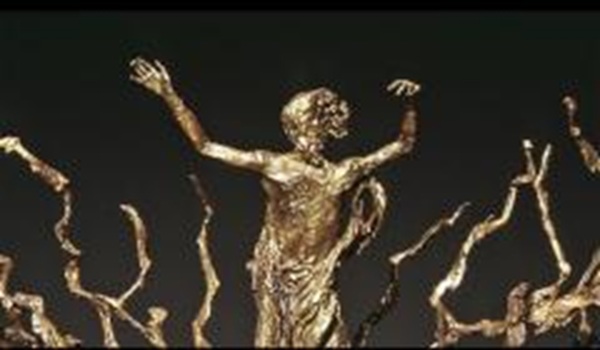
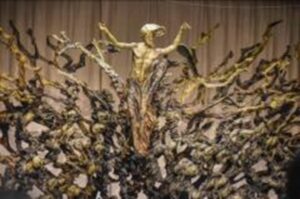
Enter the Vatican’s Resurrection, a gigantic bronze sculpture that looks like Jesus Christ emerging from the aftermath of a nuclear explosion—or possibly the world’s worst reptilian family reunion.
Seriously. Have you seen this thing?
Completed in 1977 by Italian sculptor Pericle Fazzini, this 66-foot-wide monstrosity dominates the Paul VI Audience Hall. At its center stands what is supposed to be the resurrected Jesus, arms outstretched, surrounded by twisted bronze, mangled figures, and what looks suspiciously like the vegetation from Satan’s landscaping company.
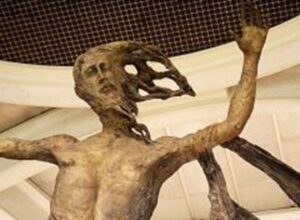
And then there’s the head.
From certain angles, Christ appears to have the elongated skull and protruding snout of a reptile. Naturally, the internet has gone absolutely bananas. Lizard people! Secret serpent worship! The Vatican hiding its true masters in plain sight!
Well, before we start issuing hunting licenses for extraterrestrial iguanas, perhaps we should investigate what the artist was actually trying to communicate.
Turns out, there’s a legitimate explanation.
Fazzini envisioned Christ rising from the Garden of Gethsemane after a nuclear explosion. Remember, this was the Cold War. Humanity had developed the technological capability to incinerate civilization several times over, and the artist wanted to portray Christ triumphing over mankind’s ultimate act of destruction.
That’s actually a pretty powerful theological statement.
Think about it. Mankind spends thousands of years perfecting the art of killing one another, finally develops weapons capable of turning entire cities into radioactive parking lots, and Christ rises above the wreckage anyway.
Death loses. Christ wins.
I get it.
In fact, I rather like the underlying message.
But here’s where my Christian brain starts arguing with my eyeballs.
Why does the resurrected Savior look like something that escaped from a science-fiction horror movie?
The Bible describes the resurrected Christ as victorious. He bears the wounds of crucifixion, yet He is alive, recognizable, and triumphant. In John 20, Mary Magdalene recognizes Him when He calls her name. In Luke 24, the disciples encounter Him on the road to Emmaus. In John 21, He even cooks breakfast for His disciples.
That’s my Jesus. The conqueror of death who still takes time to feed His friends.
Not a skeletal, distorted figure emerging from a bronze nightmare.
Now, I understand artistic license. Scripture itself contains imagery that would make Hollywood special-effects departments jealous. Ezekiel describes extraordinary living creatures. Revelation gives us dragons, beasts, and cosmic warfare. And Numbers 21 introduces the bronze serpent that Jesus Himself later references in John 3.
Christianity has never been short on unsettling symbolism.
But symbolism requires discernment.
A serpent can represent evil, judgment, healing, or deliverance depending upon its biblical context. Seeing something reptilian doesn’t automatically make it Satanic. Nor does finding a strange-looking sculpture in the Vatican prove that shapeshifting lizards secretly control the world.
Sometimes an ugly statue is just an ugly statue.
And sometimes a well-intentioned artist creates something that communicates a completely different message than the one he intended.
That’s what interests me.
As a Christian, I don’t need a denominational argument about whether the Vatican should have commissioned this thing. I’m more interested in the relationship between the message and the messenger.
If art is supposed to point us toward Christ, shouldn’t Christ remain the unmistakable center of the message?
If the average person looks at your representation of the Resurrection and sees a demonic creature before recognizing the Savior, perhaps your artistic communication plan needs a little divine quality control.
And let’s not pretend that questioning religious artwork is equivalent to questioning God. Those are two entirely different propositions.
The sculpture is a human creation. The Resurrection is a divine event.
One is subject to criticism. The other is the foundation of Christian hope.
Fazzini reportedly considered his work a form of prayer. I have no reason to question his sincerity. He wanted to show that even mankind’s most destructive weapons could not defeat Christ.
That’s a message worth celebrating.
But I also believe Christians should be willing to examine the imagery we place before the faithful. Not because every strange shape conceals an occult conspiracy, but because symbols matter. Images influence understanding. And what we repeatedly put before our eyes can shape what we believe.
The Apostle Paul instructed Christians to test everything and hold fast to what is good (1 Thessalonians 5:21).
That’s pretty solid advice for evaluating theology, political promises, internet conspiracies, and apparently enormous bronze sculptures.
So where do I land?
I understand the historical context. I appreciate the artist’s intended message. I reject the unsupported claims about secret reptilian overlords.
But I’m still creeped out.
And perhaps that’s perfectly reasonable.
Because the most important thing about the Resurrection isn’t the artistic chaos surrounding Christ. It’s the extraordinary simplicity of what happened on that first Easter morning.
The tomb was empty.
Christ was alive.
Death had been defeated.
No nuclear explosions, reptilian interpretations, or 66 feet of twisted bronze required.
He is risen. And frankly, that’s spectacular enough without making Him look like Godzilla’s second cousin.
If you enjoyed this article, then please REPOST or SHARE with others; encourage them to follow AFNN. If you’d like to become a citizen contributor for AFNN, contact us at managingeditor@afnn.us Help keep us ad-free by donating here.
Substack: American Free News Network Substack
Truth Social: @AFNN_USA
Facebook: https://m.facebook.com/afnnusa
Telegram: https://t.me/joinchat/2_-GAzcXmIRjODNh
Twitter: https://twitter.com/AfnnUsa
GETTR: https://gettr.com/user/AFNN_USA
CloutHub: @AFNN_USA