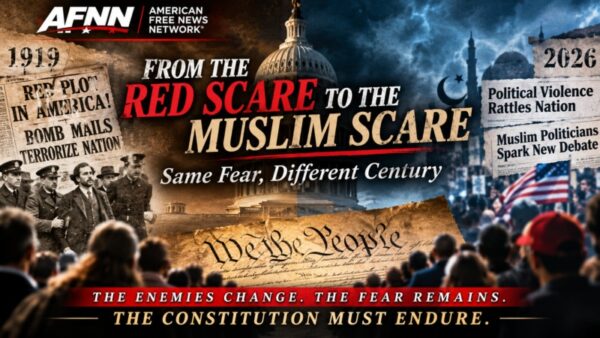
America has changed its enemies, its technology, and its political slogans. Human nature? Not so much.
In 1919, Americans were terrified of communists, anarchists, and Bolsheviks. In 2026, we’re worried about Muslims, socialists, Christian nationalists, and whichever political movement the media tells us is about to destroy civilization.
Apparently, after 107 years of technological advancement, the human brain is still running the same fear software. We’ve simply upgraded from newspapers to smartphones.
Welcome to the American Scare, Version 2.0.
When Fear Became Federal Policy
In 1917, President Woodrow Wilson signed the Selective Service Act, establishing the World War I draft. Congress followed with the Espionage Act of 1917 and Sedition Act of 1918, allowing the government to prosecute Americans for certain forms of opposition to the war.
Socialist leader Eugene Debs received a ten-year prison sentence for an antiwar speech. Apparently, disagreeing with Washington was becoming a dangerous hobby.
Then came 1919.
Anarchists mailed bombs to politicians, judges, and businessmen across America. Attorney General A. Mitchell Palmer’s home was bombed. A domestic worker lost both hands opening a package intended for a former senator.
These weren’t imaginary threats. Americans had legitimate reasons to fear political violence.
But Washington responded with the Palmer Raids, arresting thousands of suspected radicals, many without adequate legal protections. Hundreds were deported.
The government was supposed to protect the Constitution. Instead, constitutional protections became inconvenient obstacles.
Sound familiar?
Fast-Forward to 2026
America has witnessed the assassination of Charlie Kirk, two attempts on Donald Trump’s life, and the 2017 congressional baseball shooting that nearly killed Republican Steve Scalise.
Democrats haven’t escaped political violence either. Minnesota legislator Melissa Hortman and her husband were murdered in 2025.
Political violence is real. Pretending otherwise because the victim belongs to the opposing political party is intellectual dishonesty.
Meanwhile, the election of prominent Muslim politicians, including Ilhan Omar, Rashida Tlaib, Zohran Mamdani, and Abdul El-Sayed, has intensified arguments about Islam, Sharia law, socialism, and America’s constitutional identity.
Some Americans see religious freedom and democratic representation. Others fear a gradual transformation of the country.
And just like 1919, fear has a remarkable ability to turn political disagreement into suspicion of entire populations.
Criticize a Muslim politician’s policies, and someone may accuse you of Islamophobia. Question a Christian politician’s religious agenda, and someone may accuse you of attacking Christianity.
Apparently, asking constitutional questions now requires a helmet and body armor.
But here’s what everyone keeps missing.
Religious freedom protects what a politician believes. It does not provide immunity from criticism of what that politician proposes to do with government power.
The Psychology of Fear
Humans evolved to recognize threats, form tribes, and distinguish friends from enemies. Those instincts helped our ancestors survive predators, hostile tribes, and dangerous environments.
Unfortunately, the human brain doesn’t always distinguish between an approaching saber-toothed tiger and a politician delivering an obnoxious campaign speech.
Psychologists recognize out-group bias, our tendency to favor people who resemble us and distrust those who don’t.
Add fear, uncertainty, economic instability, and political violence, and ordinary disagreements begin to feel like existential threats.
Social media has industrialized the process.
Algorithms reward outrage. Politicians exploit anxiety. News organizations compete for attention. Americans increasingly encounter the most inflammatory examples of opposing viewpoints.
Before long, everyone believes someone else is coming to destroy America.
The irony? Both sides believe they’re defending democracy.
The Constitution Was Designed for Imperfect Humans
Our Founders understood something modern Americans routinely forget: government would be operated by flawed human beings.
People with ambitions, prejudices, egos, and fears.
That’s why they established separated powers, checks and balances, due process, and individual liberties.
The First Amendment protects political dissent and religious freedom. Article VI prohibits religious tests for federal office. The Fourth and Fifth Amendments restrain government investigations and punishment.
These protections aren’t rewards for good behavior or popular opinions.
They’re limitations on government power.
We can investigate extremists, prosecute terrorists, question elected officials, challenge religious doctrines, and oppose political ideologies.
We can demand that every elected official, whether Muslim, Christian, Jewish, or atheist, uphold the Constitution.
But we cannot constitutionally substitute collective suspicion for individual evidence.
And we certainly shouldn’t allow accusations of racism, Islamophobia, fascism, or Christian nationalism to become substitutes for answering legitimate political questions.
The answer to dangerous ideology is not censorship. The answer to terrorism is not collective punishment. And the answer to political disagreement is not political assassination.
Breaking the Cycle
So how do we escape this recurring American nightmare?
Start by demanding evidence instead of accepting accusations.
Judge politicians by their statements, votes, policies, and actions rather than their religious identities.
Apply criminal laws consistently, whether the defendant wears a MAGA hat, carries an Antifa flag, or belongs to a religious movement.
Protect peaceful dissent, even when the speaker makes your blood boil.
And recognize the difference between someone who disagrees with your interpretation of the Constitution and someone who actually violates the law.
These principles aren’t complicated. They’re simply harder to practice when we’re frightened.
America survived the First Red Scare, McCarthyism, the civil rights conflicts, Vietnam, and decades of ideological warfare.
It can survive another contentious election.
In 1919, Americans feared radicals would destroy their republic. In 2026, Americans fear different enemies, but the underlying psychology remains remarkably familiar.
The historical warning isn’t that threats are imaginary.
It’s that fear can convince otherwise reasonable people to abandon the very liberties they’re trying to protect.
The Constitution wasn’t written for a nation where everyone agrees. It was written precisely because we don’t.
The enemies change. The fear remains. The Constitution must endure.
If you enjoyed this article, then please REPOST or SHARE with others; encourage them to follow AFNN. If you’d like to become a citizen contributor for AFNN, contact us at managingeditor@afnn.us Help keep us ad-free by donating here.
Substack: American Free News Network Substack
Truth Social: @AFNN_USA
Facebook: https://m.facebook.com/afnnusa
Telegram: https://t.me/joinchat/2_-GAzcXmIRjODNh
Twitter: https://twitter.com/AfnnUsa
GETTR: https://gettr.com/user/AFNN_USA
CloutHub: @AFNN_USA