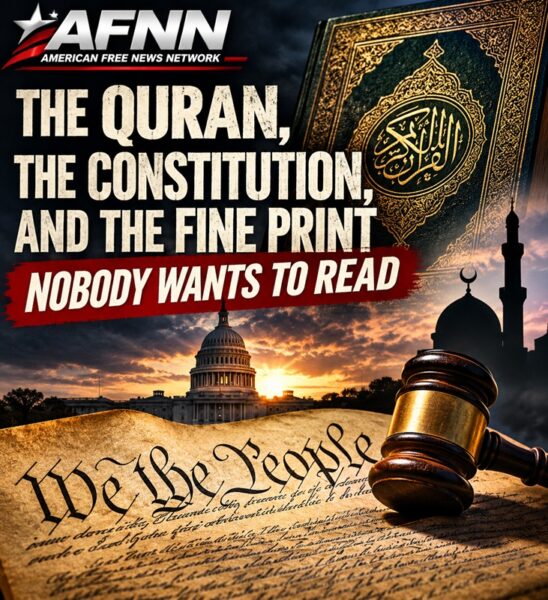
America has a Constitution. It’s a remarkable document that guarantees religious liberty, equal protection under the law, and individual freedom. It doesn’t require you to be Christian, Jewish, Muslim, atheist, or a card-carrying member of the Church of the Flying Spaghetti Monster.
Believe whatever you want. That’s the beauty of America.
But there’s a catch. Your religion doesn’t get to rewrite the Constitution.
And that brings us to three passages in the Quran that deserve considerably more scrutiny than the usual political shouting match about Islamophobia.
Quran 9:29 — Pay Up, Infidel
Quran 9:29 commands fighting certain non-Muslims, specifically among the People of the Book, until they pay the jizya tax while humbled.
This wasn’t merely theological poetry. Classical Islamic governments developed an entire legal framework around religiously differentiated citizenship.
Jews and Christians could often practice their religions, provided they accepted a subordinate legal status and paid the required tax. The precise rules varied throughout Islamic history, but the underlying distinction was unmistakable: your religion could determine your rights and obligations.
Now imagine Congress announcing a special tax on Muslims, Catholics, or Baptists simply because of their faith.
The constitutional lawsuits would arrive before the ink dried.
America’s First and Fourteenth Amendments protect religious liberty and equal protection. Government doesn’t get to establish second-class citizenship based on theology.
Quran 4:24 — When Women Were Property
Here’s where the historical record becomes especially uncomfortable.
Quran 4:24 prohibits relations with married women but includes an exception involving women described as those whom the right hand possesses.
Classical Islamic jurisprudence interpreted this language as permitting concubinage involving enslaved women, including certain female war captives.
Let’s dispense with the euphemisms.
We’re discussing a legal institution in which women could be enslaved and subjected to sexual relationships without the freedom enjoyed by an independent person.
The Thirteenth Amendment abolished slavery in the United States in 1865. American criminal law also prohibits sexual assault and trafficking.
No religious argument can restore ownership of human beings.
And before anyone starts celebrating American moral superiority, remember that Christians also used biblical arguments to defend slavery. They were wrong, too.
Quran 65:4 — The Childhood Problem
Quran 65:4 establishes divorce waiting periods, including for wives who have not menstruated.
Classical Islamic scholars, including Ibn Kathir, interpreted that provision as encompassing girls who had not reached puberty.
The verse doesn’t explicitly command child marriage. But traditional jurisprudence recognized marriages involving minors, with varying rules concerning guardianship and consummation.
That’s an uncomfortable historical fact, regardless of how modern interpreters approach the passage.
America has no single constitutional minimum marriage age. States establish marriage requirements and laws protecting children from sexual exploitation.
Religious tradition cannot simply override those protections.
A child’s welfare doesn’t become negotiable because someone invokes scripture.
The Constitutional Bottom Line
Here’s the distinction that gets lost whenever Americans start screaming at each other.
A Muslim who prays five times daily, observes Ramadan, avoids pork, and worships peacefully enjoys exactly the same constitutional protections as everyone else.
That’s America working as intended.
But a government that imposes religiously discriminatory taxes, authorizes slavery, or disregards child-protection laws cannot justify those practices by invoking Sharia.
Nor could a Christian government justify equivalent practices by quoting the Bible.
The Constitution protects your right to practice religion. It doesn’t grant your religion the right to govern everyone else.
America doesn’t need a religious test for citizenship. It needs consistent enforcement of constitutional principles.
Freedom of religion? Absolutely.
Freedom to impose religious law in violation of constitutional rights?
Not in this republic.
If you enjoyed this article, then please REPOST or SHARE with others; encourage them to follow AFNN. If you’d like to become a citizen contributor for AFNN, contact us at managingeditor@afnn.us Help keep us ad-free by donating here.
Substack: American Free News Network Substack
Truth Social: @AFNN_USA
Facebook: https://m.facebook.com/afnnusa
Telegram: https://t.me/joinchat/2_-GAzcXmIRjODNh
Twitter: https://twitter.com/AfnnUsa
GETTR: https://gettr.com/user/AFNN_USA
CloutHub: @AFNN_USA