Let me ask you something.
When was the last time you saw a breathless headline about golf courses stealing water from drought-stricken communities? I will wait.
Right. You haven’t. Because the outrage machine doesn’t care about fairways. It cares about AI. And more specifically, it cares about making you afraid of AI — because fear is a currency the political left has been spending for decades.
For the past two years I have watched politicians, pundits, and people who clearly skipped statistics class weaponize the same recycled set of misleading numbers about data centers and water use. AOC brought a jar of cloudy well water to a congressional hearing and implied a nearby data center poisoned it. Spoiler: it was construction sediment. The same sediment you get when they dig up the road in front of your house. Same physics. Different agenda. But facts are inconvenient when you have a camera and a talking point.
So let’s actually DO the science here. Because I teach it for a living, and I am genuinely tired of watching the American public get played.
—WHAT A DATA CENTER ACTUALLY DOES—
A data center is, at its core, a massive collection of processors — CPUs and GPUs — running calculations continuously. Your bank transaction. Your streaming video. Your weather forecast. Your text message. Every digital thing you do in a day touches a data center somewhere. That is not a bug. That is the infrastructure of the modern world.
The problem — and this is genuine physics, not opinion — is that processors are extraordinarily inefficient at converting electricity into useful computation. Most of what they consume becomes heat. Not a little heat. A single data center GPU puts out roughly TEN TIMES the thermal output of the human body. Pack 100,000 of them into one facility and you have a heat management problem that needs serious engineering.
That heat has to go somewhere. Where it goes is at the center of the entire controversy.
Most American data centers historically solved this by using EVAPORATIVE COOLING — running water over hot surfaces and letting it evaporate into the atmosphere. Water absorbs the heat, vapor carries it away, facility stays cool, chips keep running. It works. It does consume water. Up to 80% of what gets pulled in is “consumed” rather than returned. And in a genuinely water-stressed region, that deserves scrutiny.
But here is where the narrative stops being honest.
—WATER: THE NUMBER THEY NEVER SHOW YOU—
“AI data centers will use 276 BILLION liters of water by 2028!”
Sounds terrifying, doesn’t it?
Here is what the people screaming that number never mention: the United States consumed approximately 443 TRILLION liters of water in a single year. Not 276 billion. 443 TRILLION. ALL data centers combined — not just AI, but everything that runs on servers, including every Netflix stream, every email, every Google search — would represent somewhere between 0.03% and 0.06% of total national water use.
I want you to sit with that number for a second.
You want to know what Americans use MORE water on than every data center in the entire country put together?
Golf courses.
You want more?
American residential lawns use more. Coal and gas power plants use substantially more — they withdraw enormous volumes for steam turbine cooling, though most is returned. And agriculture? Agriculture uses so much more that comparing data centers to farm irrigation is the statistical equivalent of comparing a garden hose to Niagara Falls. The single largest water use category in the United States is irrigation. It dwarfs every other category. Combined. Including data centers by approximately 1,000 to 1.
None of this appears in the congressional hearings. None of it made it into the breathless news segments. And there is a reason for that.
Quinn’s Sixth Law: facts are the enemy of liberalism.
When you have a political agenda to stop AI development — or to use fear of AI as leverage in budget negotiations, regulatory fights, or election-year narratives — the LAST thing you want is your audience understanding what “276 billion liters” actually means in context. So you strip the context out. You show the number. You hold up the muddy water. And you hope nobody in the room has a calculator.
I have a calculator. I also teach people how to use one.
—DATA CENTERS ARE NOT THE ENEMY OF WATER—
There is a meaningful distinction in water science between WITHDRAWAL and CONSUMPTION. Water withdrawal is how much you pull from a source. Water consumption is how much you actually use up — the fraction lost to evaporation that does not return to the local system. When we talk about power plants “using a lot of water,” most of what they withdraw is returned slightly warmer. The consumption rate is far lower.
Data centers are moving — aggressively and measurably — away from the worst-case evaporative cooling model. Here is what that transition actually looks like in practice.
CLOSED-LOOP COOLING systems recirculate the same water repeatedly through a heat exchanger instead of continuously consuming fresh water. The water does the work of absorbing heat, passes through a cooling cycle, and goes back to do it again. Consumption rates drop dramatically — in some configurations, by 80% or more compared to traditional evaporative systems.
RECYCLED AND TREATED WASTEWATER is increasingly being used for cooling instead of potable municipal water. Amazon has committed to switching a significant portion of its facilities to recycled water sources. When a data center uses water that would otherwise have been discharged into a waterway anyway, it is not “consuming” water in any meaningful environmental sense.
DIRECT-TO-CHIP LIQUID COOLING eliminates large-scale water use for cooling the facility itself entirely. Instead of cooling the AIR in the building (which then cools the chips), modern immersion cooling or direct-liquid-cooling systems run fluid directly through or over the processor hardware. Far less water. Far more efficient. Microsoft has even experimented with submerging server infrastructure in sealed vessels of specialized cooling fluid. No evaporation. Zero water consumption.
CHOOSING THE RIGHT LOCATION is perhaps the single most impactful decision. A data center built in Iceland, Finland, or the northern United States has access to ambient air cold enough for FREE COOLING — just pulling in outside air — for six to nine months of the year. No water needed. Several large operators have deliberately shifted facility siting toward cooler climates specifically because of this. Google, Microsoft, and Meta all have major facilities in Scandinavia and the northern U.S. for exactly this reason.
Microsoft has also invested tens of millions of dollars into new wastewater treatment infrastructure specifically to handle cooling water, turning a potential environmental liability into a net community benefit.
The trajectory is clear. The industry is already moving in the right direction. The story of data centers and water is not a story of crisis. It is a story of a maturing technology sector adapting to real constraints. That is how engineering is supposed to work.
What is NOT helpful is a sitting congresswoman using a jar of muddy construction runoff as a prop to imply something more sinister — and a media apparatus that runs that clip without bothering to ask a single follow-up question.
—THE POWER GRID: WHERE THE REAL STORY IS—
Data centers are projected to consume 17% of ALL U.S. electricity by 2028. That number is not misleading. It is not out of context. It is a genuine infrastructure challenge. Power grids that were not designed for this kind of demand concentration are going to feel the strain.
But here is what the left does not want you to understand: that challenge is also an OPPORTUNITY. And the private sector — not the government, not a federal program, not a 500-page bill written by people who cannot explain what a kilowatt-hour is — is already responding.
PRIVATE POWER PLANTS. Google, Microsoft, and Amazon are not waiting for the public grid to catch up. They are building their own. Google has contracted for new nuclear generation. Microsoft signed a historic agreement to restart and expand the Three Mile Island nuclear facility — yes, THAT Three Mile Island — to power its data centers with zero-carbon electricity. Amazon is doing the same. These are not hypothetical commitments. Money has changed hands. Construction is underway or planned.
When a private company builds its own power plant to run its own data center, it does not pull that power from the public grid. That is ADDITIVE generation capacity in a region that previously had none. In many cases, surplus power from these dedicated facilities flows BACK into the local grid, benefiting ordinary consumers.
Let me repeat that for the people in the back: a data center with its own nuclear power plant can become a NET CONTRIBUTOR to the power grid of the surrounding community. Not a drain. A contributor.
GRID STABILIZATION THROUGH FLEXIBLE LOAD. Data centers are, in engineering terms, what is called a “flexible load” — meaning they can adjust their power consumption in real time without disrupting their core function. A batch AI training job does not care if it runs at 2 AM instead of 2 PM. Some of the most sophisticated operators are already in formal agreements with regional grid operators to curtail, shift, or adjust their power draw during peak demand periods. In return, the grid gets stability. The data center gets favorable power pricing. The ratepayer gets a more reliable grid.
This is MARKET-BASED grid management. No mandates. No bureaucracy. Just aligned incentives producing outcomes that benefit everyone.
BATTERY AND STORAGE INTEGRATION. Because data centers cannot tolerate any power interruption, they all maintain massive backup power systems — banks of batteries and standby generators that can carry the full load instantly if the grid fails. Those same battery systems can be integrated into what utility engineers call “demand response” programs, where the grid operator can pull power FROM the data center’s batteries during grid stress events. Again: the data center becomes a resource for grid stability, not a parasite on it.
THE CORRECT POLICY RESPONSE is not regulation designed to slow or stop data center construction. It is smart permitting that requires new facilities to demonstrate a power supply plan — whether grid-connected with grid stabilization commitments, or privately generated — before construction begins. Require waste heat reuse planning for facilities above a certain size. Incentivize location in cooler climates. Streamline permitting for nuclear generation.
That is a conservative framework, which is probably why the Left hates it, because it helps the working class. It uses markets, targeted requirements, and incentives rather than prohibition. It solves the actual problem. And predictably, it is not what the left is proposing. The left is proposing regulatory hurdles designed to slow AI development, dressed up as environmental concern.
Quinn’s First Law: liberalism always generates the opposite of its stated intent.
An environmental policy that slows domestic data center construction does not reduce AI computing. It offshores it — to China, where there are no environmental standards, no grid stability requirements, no waste heat recovery mandates, and no AOC to hold up a jar of water for the cameras.
Think about that the next time someone tells you they are “concerned about data center water use.”
—WAIT — THEY ARE GOING TO BUILD THEM IN SPACE—
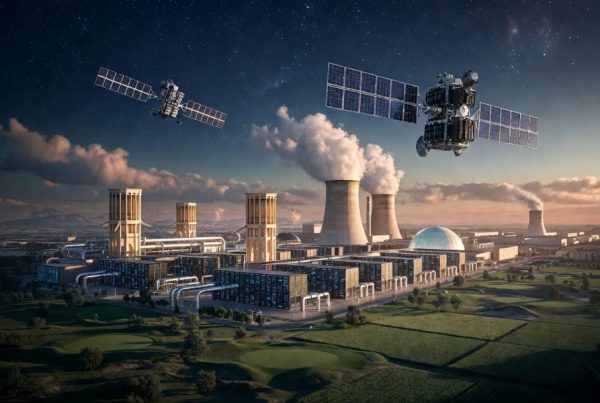
SpaceX, as part of its larger ambitions and its mid-2026 IPO pitch, has filed with the FCC for a constellation of up to ONE MILLION satellites — orbital data centers, running AI compute from low Earth orbit rather than from the ground.
The project is called Starmind, and the first-generation satellite is designated AI1.
Let me give you the numbers, because they are remarkable. Each AI1 satellite is approximately 20 meters tall when deployed with a wingspan of about 70 meters — wider than a Boeing 747. It produces 120 kilowatts of sustained compute power from massive deployable solar arrays. Communication between satellites uses high-speed optical laser links. First launches are targeted for late 2027.
Now here is the part that a science teacher cannot help but find elegant: space solves BOTH of the major data center problems simultaneously.
The power problem? Solar panels in low Earth orbit produce approximately FIVE TIMES the electricity per square meter that the same panels produce on the ground — no atmosphere absorbing radiation, no night cycles affecting low-earth-orbit sun-synchronous trajectories, no weather. Essentially unlimited, essentially free power once the hardware is deployed.
The cooling problem? There is no air in space. You cannot use air cooling and you cannot use water cooling. What you CAN do is deploy radiators — panels that radiate heat as infrared directly into the vacuum. The AI1 satellite has up to 110 square meters of deployable liquid radiators. The heat goes… into space. Literally. Zero water. Zero evaporation. Zero impact on a terrestrial aquifer.
The same radiative physics I described earlier — where a surface on Earth on a clear night radiates heat through the atmospheric transparency window directly to the cosmos — is, in space, available 24 hours a day, in every direction, with nothing blocking it.
SpaceX is not doing this because Elon Musk thinks it would be cool (though I imagine he does). They are doing it because the engineering case is compelling. When you need effectively unlimited clean power and effective zero-cost cooling, there is literally no better location in the known universe than low Earth orbit.
First AI1 satellites are expected in late 2027. Large-scale deployment follows in 2028 and beyond. The manufacturing facility in Bastrop, Texas — over 11 million square feet — is already under construction.
Skeptics will note, correctly, that getting a million satellites to orbit is an ambitious timeline, that radiation hardening of compute hardware in space is an engineering challenge, and that Musk’s schedules have historically been optimistic. Fair points. All of them.
But the physics is not speculative. The Starlink constellation — already the largest satellite network in human history — proved that SpaceX can manufacture and deploy satellites at scale. The AI1 is described by SpaceX engineers as simpler in some respects than a Starlink satellite, because it prioritizes solar arrays and radiators over the complex phased-array antennas that Starlink requires for ground connectivity.
Whether you think the timeline is realistic or not, the direction of travel is clear: the long-term answer to data center power and cooling challenges may not be on the surface of this planet at all.
And no amount of congressional theater with a jar of muddy water is going to change the physics of that.
—WHAT THE ANCIENT WORLD ALREADY KNEW—
Three thousand years ago, in cities like Yazd on the blistering Iranian plateau — where summer temperatures regularly hit 120 degrees Fahrenheit — Persian engineers designed cooling systems so effective that they could drop interior temperatures by 30 degrees without a single moving part, without electricity, and without a monthly utility bill. Some of those structures are STILL STANDING. Still functioning. No subscription required.
They are called BADGIRS, or wind catchers. Tall masonry towers that capture wind at elevation, route it down through shafts, pass it over underground water channels called qanats, use evaporative physics to drop the air temperature, and deliver cool air into the living space. When paired with massive dome structures called yakhchals — walls six and a half feet thick, built from a waterproof ancient mortar called saruj — these engineers could actually MAKE ICE in the middle of the desert. At 120 degrees outside. No refrigerant. No compressor. No electricity. No water bill.
The thermodynamic coefficient of performance of a well-designed badgir has been measured at approximately 28 to 1.
A modern central air conditioning unit achieves about 3 to 1.
A 3,000-year-old mud brick tower is roughly NINE TIMES more thermodynamically efficient than the machine you have bolted to the side of your house.
And this is not some obscure footnote. Five completely independent civilizations — Persian, Egyptian, Roman, Pakistani, Yemeni — arrived at essentially the same architectural conclusions independently. Because the physics doesn’t care about civilization or era. Hot air rises. Evaporation absorbs heat. The ground stays cool. Those are not opinions. They are laws of the universe.
And some data center engineers are beginning to pay very close attention.
—APPLYING ANCIENT PHYSICS TO MODERN INFRASTRUCTURE—
Radiative night-sky cooling alone deserves more attention than it gets. On a clear night, a surface exposed to the open sky radiates heat DIRECTLY INTO SPACE through a specific window in the infrared spectrum where the atmosphere is effectively transparent. A 10-square-meter shallow pool radiates approximately one kilowatt of thermal energy straight to the cosmos. For free. All night. This is the same physics the Persian ice houses exploited to make ice in a desert. And the same physics that SpaceX is scaling to an industrial level with its orbital radiator systems.
The Eastgate Centre in Harare, Zimbabwe — inspired by termite mound ventilation physics — uses a massive central atrium as a passive solar chimney, exhausting hot air through the roof and drawing cooler air in at the base. It uses a fraction of the energy a conventional building of the same size would require.
Masdar City in Abu Dhabi built a 45-meter wind catcher tower into its central plaza. Measurable temperature drop. Zero electrical input for that cooling effect.
The University of Arizona found a residential solar chimney maintaining 75 degrees Fahrenheit indoors when the outside air was at 106 degrees. No water. No power.
Now imagine applying these design principles at data center scale. Siting facilities to take advantage of prevailing winds and cooler air at elevation. Designing exhaust pathways that use thermodynamics instead of fans. Integrating earth tubes — buried pipe runs through the stable-temperature zone below grade — to pre-condition intake air before it even reaches the facility. Adding passive radiative cooling surfaces on rooftops that shed heat at night for free.
None of this eliminates the need for mechanical cooling in a hyperscale AI data center. But it can reduce it dramatically — cutting water consumption, cutting electrical load, cutting operational costs. This is what smart engineering looks like when it respects physics instead of ignoring it.
—THE CORRECT FRAMEWORK: NOT PROHIBITION, SMART REQUIREMENTS—
I am not arguing that data centers should be allowed to do whatever they want, wherever they want, with no accountability. That would be a sloppy argument and I do not make sloppy arguments.
What I am arguing is that the CORRECT regulatory framework looks very different from what the environmental left is proposing.
Smart requirements would mandate waste heat reuse plans for large facilities — similar to what Germany is already doing. They would incentivize location in cooler climates through favorable permitting timelines. They would streamline nuclear permitting so that a tech company that wants to build clean dedicated power can actually do so without a decade of environmental litigation. They would allow closed-loop and recycled-water cooling systems to satisfy permitting requirements, removing the incentive to use municipal water when alternatives exist.
What smart requirements would NOT do is use data center permitting as a backdoor mechanism to throttle AI development. They would not impose moratoriums on construction in water-stressed regions without demonstrating that the facility actually poses a meaningful marginal impact on local water supplies — which, given the context established earlier in this article, is a much higher bar than the headlines imply.
The difference between a sensible regulatory framework and a politically motivated one is whether the stated goal — protecting water, stabilizing the grid, reducing carbon — is actually achieved by the proposed policy. Slowing domestic data center construction does not achieve any of those goals. It shifts the compute offshore. It exports the carbon footprint to countries with worse environmental standards. And it hands a strategic AI advantage to an adversarial nation that does not hold congressional hearings about water jars.
That is not environmental policy. That is industrial sabotage with a green paint job.
—THE FULL PICTURE—
Data centers use a lot of water? Relative to what? Golf courses use more. Lawns use more. Agriculture uses 1,000 times more. The projected water use of ALL U.S. data centers in 2028 is between 0.03% and 0.06% of total national water consumption. And that number is declining as the industry transitions away from evaporative cooling toward closed-loop, recycled-water, and liquid cooling systems.
Data centers use a lot of power? YES. That one is real. 17% of U.S. electricity by 2028 is a genuine infrastructure challenge. The answer is private nuclear generation, grid stabilization partnerships, flexible demand programs, and battery integration. All of which are already happening. Not because of federal mandates. Because the economics align.
Data centers produce heat that gets wasted? They do. And the technology to capture that heat and use it to warm homes, power greenhouses, heat pools, and reduce natural gas consumption is OPERATIONAL RIGHT NOW in Helsinki, Dublin, Odense, and Singapore. The framing shift from “waste heat” to “recoverable thermal asset” changes the entire environmental calculus.
Data centers will eventually move to space? SpaceX is betting a significant portion of its post-IPO business strategy on exactly that. Unlimited solar power. Zero-water radiative cooling. The same physics that cooled the Persian desert now scaling to orbital infrastructure.
The arc of this story is not one of environmental catastrophe. It is one of a technology maturing faster than the regulatory and political apparatus can process. That is not unusual. It has happened with every major infrastructure transition in American history. The correct response is thoughtful, outcome-focused policy. Not panic. Not theater. Not a jar of muddy water.
Three thousand years ago, engineers in the Iranian desert figured out how to make ice without electricity or running water by understanding physics and working with it instead of against it.
The smartest data center engineers of 2026 are learning the same lesson. From the same source, as it turns out.
Whether the people writing the regulations are paying attention is, as always, the question.
But what do I know — I am only a combat medic who spent years in Iraq and a physics teacher who has been explaining the difference between relative and absolute numbers to teenagers since before most of our current congressional representatives figured out how to attach a file to an email.
IF THIS ARTICLE MADE YOU THINK: LIKE this article so the algorithm shows it to people who need to read it. SHARE this — every share really helps get the word out. Use it. COMMENT below with your take. Do you think data centers should face tougher restrictions, or is the market already solving it? Tell me where you land.
And if you want MORE of this — the data, the history, the science, the stories — JOIN Bski’s Classroom community or follow me on YouTube. Even better, subscribe to my account; it is about the cost of a cup of coffee per month. That is it. Your support keeps this classroom open, and I promise I will never run out of material as long as the left keeps trying to out-dumb itself.
 Mike Borowski is a medically retired Army combat medic with 23 years of service, including a combat deployment to Iraq, and a high school Anatomy and Physics teacher at a high-need Career Technical district in Northeast Ohio — where he also wrote and published the textbooks for both courses. He runs “Bski’s Classroom,” a platform dedicated to cutting through political noise with data, history, and the kind of blunt honesty that comes from someone who has seen both war and the American classroom up close.
X (Twitter): x.com/BskiMike22802
Substack: substack.com/@bskimike22802
YouTube: www.youtube.com/@BskiMike22802
AFNN: https://afnn.us/author/mikeborowski/
If you enjoyed this article, then please REPOST or SHARE with others; encourage them to follow AFNN. If you’d like to become a citizen contributor for AFNN, contact us at managingeditor@afnn.us Help keep us ad-free by donating here.
Substack: American Free News Network Substack
Truth Social: @AFNN_USA
Facebook: https://m.facebook.com/afnnusa
Telegram: https://t.me/joinchat/2_-GAzcXmIRjODNh
Twitter: https://twitter.com/AfnnUsa
GETTR: https://gettr.com/user/AFNN_USA
CloutHub: @AFNN_USA