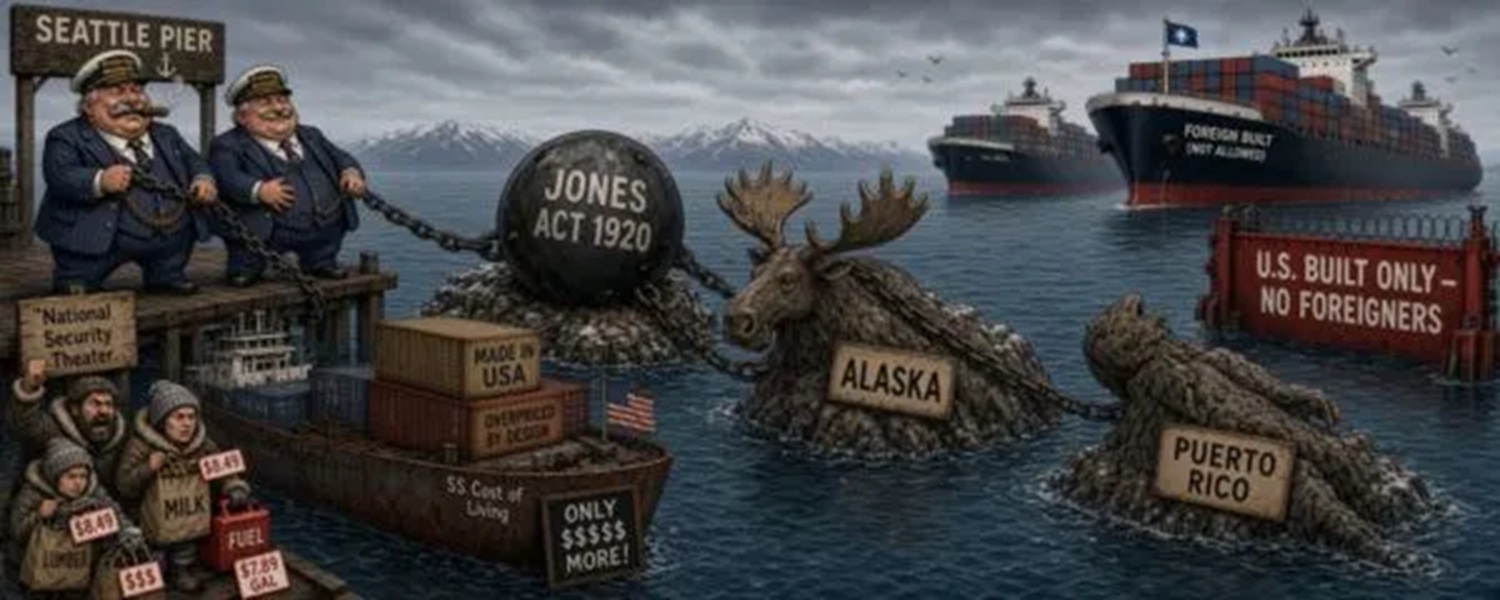
What would you think if I told you there is a law on the books, right now, that forces American citizens to pay 30% more for groceries, fuel, and building materials than they should… and does it on purpose?
What would you think if I told you this law has nothing to do with tariffs on China, nothing to do with inflation, and nothing to do with “corporate greed” — and everything to do with protecting a tiny handful of shipping companies from ever having to compete?
What would you think if I told you the people getting hurt the worst are some of the poorest American citizens in the entire country, spread across three states and one territory, and that fixing it wouldn’t cost the federal government a single dime?
You’d probably think I made it up. I wish I had. Buckle up, because we’re taking a field trip back to 1920, and I promise you it is dumber than you think.
WAIT, YOU’RE STILL DOING THIS?
Picture a law so old that when it was signed, women had just gotten the right to vote and Prohibition had been in effect for exactly one year. Woodrow Wilson signed it. A senator from Washington State named Wesley Jones wrote it, largely to protect shipping interests in his own backyard. That was 1920.
I want you to imagine every other industry frozen in 1920 conditions. Imagine if your phone still had to be “American-built” using 1920 manufacturing standards, cost four times as much as a phone anywhere else on Earth, and you were legally forbidden from buying a cheaper one made somewhere else — because, well, national security.
You’d laugh that idea out of the room in about four seconds. Yet the Jones Act does exactly this to an entire industry, and somehow it has survived over a hundred years, six wars, the moon landing, the internet, and two entirely different economic systems, completely untouched.
Wait… they’re STILL doing this? Yep. Still doing it. In the year 2026.
MEET THE CLUB THAT GETS TO KEEP THE DOOR LOCKED
Let’s stop being coy about who benefits from this arrangement, because “a handful of shipping companies” sounds like a conspiracy theory until you put names on it.
In Hawaii, the inter-island and mainland trade is functionally a duopoly split between two companies: Matson and Pasha. That’s it. That’s the field. No foreign competitor is allowed to show up and offer a better rate, because the law forbids it. In Puerto Rico, Crowley Maritime dominates the same way. These aren’t scrappy American underdogs fighting off cheap foreign labor. These are the only legally permitted players in a market of several million captive customers who have no alternative, because the law made sure of it.
Imagine if I told you that only two pizza places were legally allowed to deliver to your house, no others were permitted to even try, and then acted surprised when your pizza cost four times the national average. You wouldn’t blame the pizza. You’d blame whoever wrote the rule.
A CENTURY-LONG NATIONAL SECURITY PROMISE THAT NEVER SHOWED UP
Here’s where Quinn’s Law comes in handy, because it applies perfectly: liberalism, and yes, this particular flavor of big-government protectionism absolutely counts, tends to produce the exact opposite of its stated intent.
The Jones Act was sold as a way to guarantee America always has a strong, ready domestic merchant fleet standing by for wartime emergencies, drawing directly on the lesson of World War I, when the country got caught flat-footed without enough ships to move troops and supplies. Reasonable goal in 1920. So how did that promise hold up, a century later?
In 1980, the Jones Act fleet of large oceangoing vessels stood at 257 ships. By 2021, that number had collapsed to 96. Fewer than 100 ships now qualify, in large part because a Jones Act-compliant vessel costs at least triple what the identical ship costs to build anywhere else on Earth. The ships that remain skew older and smaller than the rest of the world’s merchant fleet, because nobody can afford to keep building new ones at those prices. It has gotten so absurd that some of these American-flagged, American-built ships now have to travel to Chinese shipyards for maintenance and repair, because that is where the affordable capacity actually is.
Sit with that one for a second. The law exists, allegedly, to keep America independent of foreign shipping capacity in a national emergency. And it has produced a fleet so small, so old, and so expensive to maintain that we now ship our “national security” vessels to China for repairs. If you wrote that as satire, an editor would tell you it’s too on the nose.
A law designed to build a mighty American maritime industry instead built a cozy, protected, shrinking monopoly with almost no incentive to modernize, because it never has to compete with anyone. That’s not a national security triumph. That’s a subsidized nap that’s been going on for a hundred years.
THE HUMAN BEINGS ON THE OTHER END OF THIS “PATRIOTIC” LAW
Let’s talk about Puerto Rico for a second, because the numbers here should make you angry.
A 2024 World Bank and Cato Institute analysis found the Jones Act functions like a hidden 30.6% tariff slapped on top of every mainland product shipped to Puerto Rico. Not 3%. Not 6%. THIRTY POINT SIX PERCENT. That analysis put the annual economic damage at roughly $1.4 billion dollars, with households alone eating around $203 per person, every single year, forever, for the “privilege” of being American citizens who happen to live on an island.
Now walk into a grocery store in San Juan and tell a mother of three that her formula, her rice, her propane tank for cooking, all cost more because Congress decided in 1920 that only a tiny club of U.S.-flagged shipping companies get to touch her supply chain. Tell her this is why, on paper, it is sometimes CHEAPER to fly goods in from a foreign country than to float them 1,000 miles from Florida.
Puerto Rico’s median income is roughly half the mainland average. This is not a law hurting Wall Street executives. This is a law squeezing working-class and poor American citizens, in a territory already drowning in debt, hurricanes, and neglect from both political parties.
Now hop over to Hawaii, and picture an actual rancher for a second instead of a statistic. He’s spent months raising calves on the Big Island. Shipping day arrives, and there is no livestock carrier waiting for him, because there are essentially zero Jones Act-compliant livestock ships left in existence. So he watches his cattle get walked, one by one, into a modified steel shipping container nicknamed a “cowtainer,” stacked on a container ship alongside furniture and electronics, because the actual purpose-built livestock vessels that would do this job properly are foreign-built and foreign-flagged, and therefore illegal for him to use. His other option is loading them onto an airplane. That’s it. Those are his choices, in the year 2026, because of a shipping law from the Wilson administration. The Grassroot Institute of Hawaii estimates this costs the state roughly $1.2 billion a year, nearly $1,800 per average family, every single year.
And don’t think Alaska gets a pass either. Fitting, honestly, since Senator Wesley Jones himself designed part of this law specifically to lock the Alaska territory into Seattle’s shipping interests and drive Canadian carriers out of the market. A century later, Alaskans are still paying for that little hometown favor.
A 1988 GAO study found the U.S.-build requirement ALONE, just that one piece of the law, was tacking on roughly $163 million a year in extra transportation costs, split between about $20 million on northbound dry cargo and tug-barge routes and roughly $143 million on southbound tankers. Earlier analyses that counted the full weight of the Jones Act, build requirement plus flag and crew requirements together, put the number as high as $269 to $674 million a year. The Alaska Statehood Commission separately estimated the Act was draining about $225 million a year from the oil industry alone, plus another $41 million from everything else. Forest products got hit too, to the tune of nearly $5 million in a single study year, hitting smaller, lower-value shipments the hardest.
What does that look like at ground level? Shipping premiums of 60 to 100 percent above global averages on many routes. A single container of lumber costing roughly $1,800 more to ship to Anchorage than to send the exact same container to Vancouver, a Canadian port not that much farther away. Scheduled cargo service into the state runs through a small handful of Jones Act carriers, Matson and TOTE Maritime chief among them, with Crowley running much of the barge resupply to remote and Bush communities that have no other lifeline. Alaska’s commercial fishermen get squeezed from both directions: the Act restricts which vessels can even carry their catch between U.S. ports, forcing them onto pricier American ships when cheaper, more efficient foreign vessels sit right there, unused, because the law says no.
Then there’s the Alaska Marine Highway System, the actual public ferry system Alaskans depend on to get around, which is itself bound by the U.S.-build requirement when it needs new vessels. One recent hybrid-electric ferry was originally estimated at $200 to $250 million. By the time the U.S.-build mandate got done with it, the price had climbed past $340 million, for a boat that a foreign shipyard could likely have built for somewhere in the $80 to $110 million range. That is not a rounding error. That is the state paying two to three times more, out of its own public budget, for the exact same ferry, because of a shipping law from 1920.
Three different places. Three different climates, cultures, and economies. One law, quietly taxing all of them the same way for a hundred years, and one Washington State senator’s hometown shipping interests still cashing in on it.
“BUT IT PROTECTS AMERICAN MARITIME JOBS”
I can already hear the objection forming, so let’s just handle it directly instead of pretending it doesn’t exist. Yes, the Jones Act protects some shipbuilding and maritime jobs, and defenders will point to real employment and economic-impact numbers tied to the domestic maritime industry. Nobody is disputing that a concentrated group of people benefits from this arrangement. That has never been in question.
The question is whether it is fair, or economically sane, to force millions of American citizens, disproportionately poor ones, disproportionately in states and territories with the least political power in Washington, to subsidize those jobs through inflated grocery bills, fuel costs, and construction prices, forever, with no end date and no accountability. A protected industry that shrank from 257 ships to 96 while collecting a century of legal protection from competition is not a policy success story we should keep funding by taxing rice and propane in San Juan. If the shipbuilding industry needs support, Congress can fund it directly and transparently, where voters can actually see the bill and vote on it. What we have instead is a hidden tax nobody voted for, passed onto people who never had a seat at the table when it happened.
THE PART EVERY REPUBLICAN STRATEGIST SHOULD BE CIRCLING IN RED
Here’s the part that should make every Republican strategist sit up straight: this is about as close to a risk-free political win as exists in modern American politics, and almost nobody is talking about it.
Think through the math with me. The average voter on the mainland has never heard the words “Jones Act” in their entire life and will not lose one second of sleep if it gets repealed or reformed. There is no outraged national base ready to primary anyone over cabotage law. This is not abortion. This is not guns. This is not immigration. It is, functionally, an invisible issue to the overwhelming majority of the electorate.
But to the people who DO know what it is — residents of Puerto Rico, Hawaii, Alaska, and Guam — repeal would mean cheaper groceries, cheaper fuel, cheaper construction materials for hurricane and disaster rebuilding, and real relief from a hidden tax nobody voted them into. That is the kind of tangible, wallet-level, “did that actually help me” win that builds real loyalty, particularly in Puerto Rico, a place both parties love to talk about and neither party has meaningfully helped in decades.
Republicans get to be the party that finally killed a century-old piece of cronyism protecting a handful of shipping companies at the expense of poor and working-class American citizens. Republicans get to reduce the cost of living in Puerto Rico, Hawaii, and Alaska without spending a single new federal dollar, because this isn’t a spending bill, it’s a DEREGULATION bill. Republicans get to hand Democrats an uncomfortable question on live television: if you care so much about “affordability” and “corporate greed,” why have you spent decades protecting a shipping monopoly that taxes poor Puerto Rican, Hawaiian, and Alaskan families to benefit Matson, Pasha, and Crowley?
This is a law protecting corporate interests at the direct expense of the working poor, and somehow the party that claims to fight for the working poor has never lifted a finger to touch it. Some of us find that suspiciously consistent.
THE BILL IS ALREADY SITTING THERE
Here’s the best part: nobody has to write this legislation from scratch. Senator Mike Lee introduced the Open America’s Waters Act, S. 2043, in the current Congress, which would repeal the Jones Act’s coastwise trade restrictions outright. It has a House companion. It exists. It has a bill number. It is not a fantasy policy paper, it is sitting in committee right now waiting for co-sponsors and a vote.
And notice the administration already gave Congress the cover to act. The Trump administration issued a Jones Act suspension earlier this year to bring down fuel prices, then extended it another 90 days in May, specifically to let energy, fertilizer, and other critical goods move freely into American ports. Even the free-market think tanks that don’t always agree on much are lined up together asking Congress to make that suspension permanent instead of temporary. The hard part, the political cover, has already been handed to Congress on a silver platter. All that’s left is for members to actually vote.
SO WHAT NOW?
Reform doesn’t require blowing up the entire law overnight, though full repeal via S. 2043 is sitting right there for anyone with the spine to vote for it. Even a targeted exemption for Puerto Rico, Hawaii, Alaska, and Guam, the non-contiguous territories and states with zero alternative to ocean shipping, would immediately lower the cost of living for millions of American citizens who have been quietly paying this tax since before their grandparents were born.
This is deregulation, affordability, and a direct challenge to corporate cronyism, all wrapped into one bill, aimed at helping some of the poorest Americans in the country. If Republicans want a genuine, easy, low-controversy win heading into the next election cycle, this is sitting right there on the table, gathering dust since 1920, with a bill number attached and everything.
IF THIS ARTICLE MADE YOU THINK: LIKE this article so the algorithm shows it to people who need to read it. SHARE this — every share really helps get the word out. Use it. COMMENT below with your take. Should Congress fully repeal the Jones Act via S. 2043, or just carve out Puerto Rico, Hawaii, Alaska, and Guam? Tell me.
And if you want MORE of this — the data, the history, the science, the stories — JOIN Bski’s Classroom community or follow me on YouTube. Even better, subscribe to my account; it is about the cost of a cup of coffee per month. That is it. Your support keeps this classroom open, and I promise I will never run out of material as long as the left keeps trying to out-dumb itself.
But what do I know, I am only someone who actually read the bill instead of just repeating “protect American jobs” for the last hundred years…
 Mike Borowski is a medically retired Army combat medic with 23 years of service, including a combat deployment to Iraq, and a high school Anatomy and Physics teacher at a high-need Career Technical district in Northeast Ohio — where he also wrote and published the textbooks for both courses. He runs “Bski’s Classroom,” a platform dedicated to cutting through political noise with data, history, and the kind of blunt honesty that comes from someone who has seen both war and the American classroom up close.
X (Twitter): x.com/BskiMike22802
Substack: substack.com/@bskimike22802
YouTube: www.youtube.com/@BskiMike22802
AFNN: https://afnn.us/author/mikeborowski/
If you enjoyed this article, then please REPOST or SHARE with others; encourage them to follow AFNN. If you’d like to become a citizen contributor for AFNN, contact us at managingeditor@afnn.us Help keep us ad-free by donating here.
Substack: American Free News Network Substack
Truth Social: @AFNN_USA
Facebook: https://m.facebook.com/afnnusa
Telegram: https://t.me/joinchat/2_-GAzcXmIRjODNh
Twitter: https://twitter.com/AfnnUsa
GETTR: https://gettr.com/user/AFNN_USA
CloutHub: @AFNN_USA