If you’re looking for a neat little date when the post-Cold War honeymoon between Russia and the West began going sideways, I have a candidate:
December 31, 1995.
Not 2014. Not 2022. Not even Kosovo in 1999.New Year’s Eve, on the Sava River.
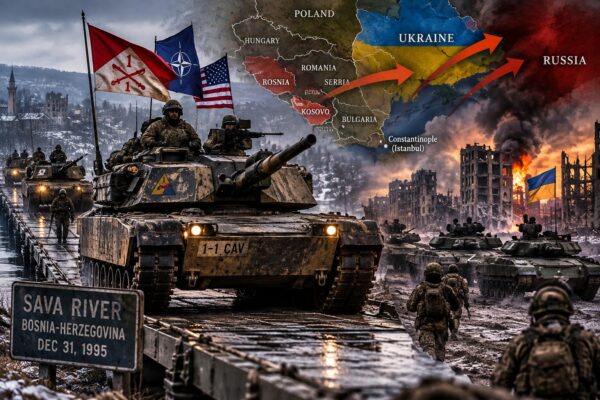
That day, an American armored column crossed from Croatia into Bosnia as part of NATO’s Implementation Force following the Dayton Peace Agreement. The mission was legitimate, UN-authorized, and intended to keep the Bosnian War from restarting—which was a pretty reasonable objective considering everyone had spent the previous few years killing each other.
But strategically, something bigger had happened.
NATO had discovered the Balkans.
Bosnia became NATO’s first major crisis-response operation and helped transform an alliance originally built to defend NATO territory against the Soviet Union into one willing to operate beyond its traditional borders. NATO’s own historical account describes the Balkans as central to developing this new “out-of-area” role. NATO
And across the Sava came the United States Army.
The crossing itself was an engineering nightmare involving flooding, mud, bridging equipment and the usual Army tradition of attempting extremely complicated things at the worst possible time of year.
Among the units crossing was 1st Squadron, 1st Cavalry Regiment, 1st Armored Division.
For those of us who served in that era, this wasn’t some abstract foreign-policy seminar. It was tanks, Bradleys, Humvees, mud, radios, maps and young Americans wondering exactly where Bosnia was before Uncle Sam provided an all-expenses-paid geography lesson.
But zoom the map out.
The Soviet Union had disappeared only four years earlier. The Warsaw Pact was gone. Moscow had withdrawn from much of Eastern Europe.
NATO, however, did not disappear.
It started adapting.
And that matters because during the negotiations over German reunification in 1990, Secretary of State James Baker told Mikhail Gorbachev that NATO’s military jurisdiction would move “not an inch” eastward in the arrangement then being discussed. Declassified documents confirm that conversation. Whether those discussions amounted to a broader promise never to enlarge NATO remains fiercely disputed; they did not become a treaty prohibiting future NATO expansion.
That’s an important distinction.
It’s also exactly the sort of distinction that lawyers adore and geopolitical rivals remember differently.
Then came Bosnia.
Ironically, the Russians initially came along. Russian troops participated in IFOR. For one strange post-Cold War moment, American and Russian soldiers were helping enforce the same peace.
Maybe this whole thing was going to work.
Narrator: It did not work.
Three years later, Poland, Hungary and the Czech Republic joined NATO.
Twelve days after their accession on March 12, 1999, NATO began bombing Yugoslavia over Kosovo.
Suddenly the organization Moscow had spent forty years staring at through binoculars wasn’t merely surviving the Soviet Union. It was expanding eastward and conducting military operations in the Balkans.
From Washington, every move had its own explanation.
Bosnia was about Dayton.
NATO enlargement reflected the decisions of sovereign Eastern European countries that very understandably had memories of Soviet domination and wanted insurance.
Kosovo was about stopping another humanitarian catastrophe.
Those explanations matter.
But game theory has an annoying rule: the other player gets a vote.
Moscow didn’t have to evaluate each move independently. It could look at the board.
Warsaw Pact: gone.
Soviet troops: withdrawn.
NATO: still here.
NATO operations in Bosnia: check.
Former Warsaw Pact countries joining NATO: check.
NATO bombing Yugoslavia: check.
KFOR entering Kosovo: check.
That doesn’t make Russia’s later actions justified, nor does it make Russia’s full-scale invasion of Ukraine in 2022 some unavoidable mechanical reaction to NATO. Russia made its own decisions, and the countries joining NATO weren’t chess pieces being dragged across the board by Washington.
But pretending 2022 materialized from nowhere is equally useless.
NATO itself says its Balkan operations helped transform the Alliance’s post-Cold-War role, establishing the pattern for multinational operations outside traditional collective defense.
That’s why I keep coming back to that river.
We didn’t cross the Sava intending to confront Russia.
We crossed it to enforce peace.
But history doesn’t particularly care what you intended when it calculates the next move.
Looking backward from Ukraine, the road runs through Kyiv, Crimea, NATO enlargement, Kosovo, Bosnia—and eventually back to an American armored column crawling across a floating bridge on New Year’s Eve 1995.
Nobody in that column was starting the Russo-Ukrainian War.
But they were participating in the creation of the post-Cold-War security order from which that war eventually emerged.
That’s a less comfortable argument.
It’s also a much more interesting one.
Sometimes history doesn’t announce the beginning of the next war with artillery.
Sometimes it starts with a bridge.
This is Part 3 of a 3-Part Series. Links to this article and subsequent ones are listed below. Links go live on the dates indicated.
October 14: NOV: Kosovo 1: The Bottle, the Battle, and the Bombers: Why Kosovo Was Never Just 1999
October 15: NOV: Kosovo 2: Four C’s on the Wall: The Symbol I Saw but Didn’t Understand
October 16: NOV: Kosovo 3: The Road to Ukraine Crossed the Sava River
If you enjoyed this article, then please REPOST or SHARE with others; encourage them to follow AFNN. If you’d like to become a citizen contributor for AFNN, contact us at managingeditor@afnn.us Help keep us ad-free by donating here.
Substack: American Free News Network Substack
Truth Social: @AFNN_USA
Facebook: https://m.facebook.com/afnnusa
Telegram: https://t.me/joinchat/2_-GAzcXmIRjODNh
Twitter: https://twitter.com/AfnnUsa
GETTR: https://gettr.com/user/AFNN_USA
CloutHub: @AFNN_USA