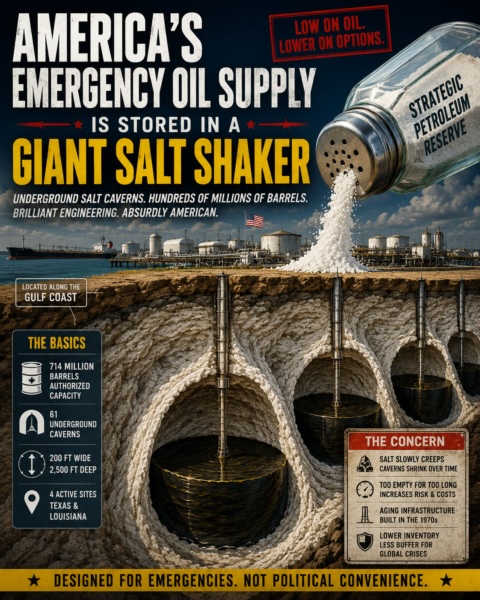
For decades, most Americans probably assumed the Strategic Petroleum Reserve looked something like Fort Knox.
You know the image.
Massive steel tanks. Barbed wire. Guard towers. A secret government facility hidden behind enough concrete to survive an alien invasion.
Nope.
Our emergency oil supply is stored inside gigantic underground caverns carved into ancient Gulf Coast salt domes.
If that sounds like the setup for a B-grade science fiction movie, congratulations. You’ve just discovered one of the least appreciated engineering projects in American history.
Even better? Some experts worry that if those caverns remain too empty for too long, the surrounding salt can slowly begin squeezing them shut.
I’m sorry.
Did you just say that America’s emergency oil reserve is stored inside giant underground salt bubbles that can gradually shrink?
Yes.
Yes, I did.
The entire concept sounds like something a petroleum engineer invented after three cups of coffee and an argument that began with the phrase, “Hear me out.”
The caverns themselves are extraordinary.
Imagine a chamber roughly 200 feet across and 2,500 feet deep.
Then build dozens of them.
Then fill them with hundreds of millions of barrels of crude oil.
Then connect them to pipelines feeding refineries along the Gulf Coast.
Then don’t tell the average American where their gasoline insurance policy actually lives.
For years, nobody cared.
The reserve was there.
Oil was cheap.
The world wasn’t ending.
Everything was fine.
Then politicians discovered the Strategic Petroleum Reserve could also be used as a very large national emergency checking account.
Need to respond to a supply disruption?
Open the vault.
Need to calm nervous markets?
Open the vault.
Need a temporary increase in supply?
Open the vault.
Eventually, somebody in the engineering department quietly raised a hand and asked an uncomfortable question.
“Are we planning to refill this thing?”
Because salt isn’t granite.
It isn’t concrete.
Salt moves.
Very slowly.
Over time, it behaves less like a rock and more like extremely cold toothpaste.
An empty cavern isn’t a permanent cavern.
It’s more like an ongoing negotiation between petroleum engineers and geology.
The good news is that nobody is predicting a Hollywood-style collapse.
There isn’t going to be a giant sinkhole swallowing Louisiana while crude oil shoots into the atmosphere like a geyser.
The caverns are continuously monitored.
They’re mapped with sonar.
Pressure is carefully managed.
Engineers know exactly what’s happening underground.
The bad news?
Many of the caverns were created in the 1970s.
Some of the wells, pumps, and supporting infrastructure are older than many of the people debating energy policy.
That has created an awkward national conversation.
How low can you safely reduce the reserve?
What’s the minimum operational level?
How quickly can it be refilled?
And perhaps most importantly:
Should the Strategic Petroleum Reserve be treated as a true wartime reserve?
Or should it become another tool for managing short-term market fluctuations?
Those are legitimate policy questions.
But I can’t get past the engineering.
Somewhere along the Gulf Coast, a team of geologists, petroleum engineers, and technicians is spending their careers making sure America’s emergency energy supply doesn’t get gently squeezed by a 60-million-year-old salt formation.
And they’re doing it so successfully that most Americans don’t even know these caverns exist.
Honestly, that’s probably the highest compliment an engineer can receive.
Nothing exploded.
Nothing collapsed.
Nobody noticed.
Mission accomplished.
The next time someone complains that government never builds anything interesting, remind them that the United States stores hundreds of millions of barrels of crude oil inside gigantic underground salt caverns.
Because if there’s one thing America excels at, it’s solving complex problems with a solution so absurdly ambitious that it somehow circles back around to being brilliant.
And if we’re being completely honest, storing the nation’s emergency oil supply inside a giant salt shaker is exactly the kind of overengineered, wonderfully ridiculous idea I would expect from America.
If you enjoyed this article, then please REPOST or SHARE with others; encourage them to follow AFNN. If you’d like to become a citizen contributor for AFNN, contact us at managingeditor@afnn.us Help keep us ad-free by donating here.
Substack: American Free News Network Substack
Truth Social: @AFNN_USA
Facebook: https://m.facebook.com/afnnusa
Telegram: https://t.me/joinchat/2_-GAzcXmIRjODNh
Twitter: https://twitter.com/AfnnUsa
GETTR: https://gettr.com/user/AFNN_USA
CloutHub: @AFNN_USA