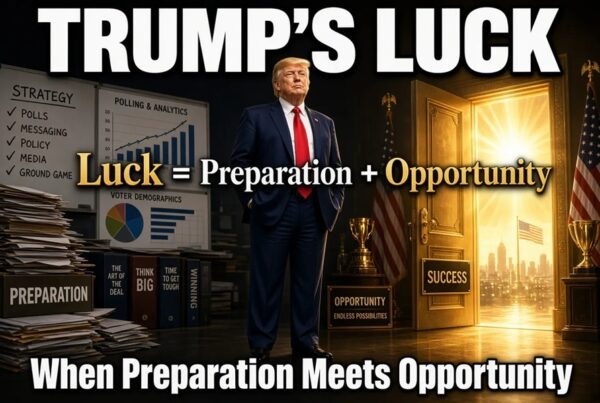
There is an old formulation, often attributed to the Roman philosopher Seneca, that luck is what happens when preparation meets opportunity. It is a useful lens for examining the last eighteen months of the Trump administration, because it exposes the intellectual laziness — and, more often, the cynical political motive — behind the Democrat-media complex’s favored explanation for nearly every Trump-era success: that he simply got lucky.
The pattern repeats with metronomic consistency. When a Trump-negotiated ceasefire holds, it is “fragile” and “unlikely to last.” When it does last, the credit belongs to career diplomats, to circumstances outside Trump’s control, or — most reliably — to Joe Biden, for having supposedly set the table years earlier. When the economy performs well, it is the “Biden economy” still working its way through the pipeline. When it does not, it is entirely Trump’s. Heads, Biden wins; tails, Trump loses.
Let us take a closer look.
Tier 1: Documented — The Economy That “Wasn’t His”
When Donald Trump was inaugurated as America’s 47th president in January 2025 with markets near record highs, the legacy did not credit strategic anticipation or the market’s confidence in his announced agenda. Instead, outlets rushed to frame any good news as a Biden inheritance he was merely lucky enough to “put his name on.” The Associated Press ran a piece literally headlined around the idea that Biden had funded the factories and Trump might simply “get to cut the ribbons.” Time magazine argued flatly that Trump was inheriting the strongest economy in modern history and that “there is no question” credit belonged to Biden. Robert Reich’s newsletter[ went further, instructing readers not to let Republicans or “the media” give Trump credit for job growth, drug price caps, or infrastructure gains that were about to mature — as though a president’s job is simply to stand next to good news rather than to shape the policy environment that produces or preserves it.
This framing survived contact with reality poorly. When the Bureau of Labor Statistics issued a massive downward revision showing 911,000 fewer jobs had actually been created under Biden than originally reported, CNN’s own coverage still hedged toward absolving the previous administration, while the White House pointed out — accurately — that the revision proved Trump inherited a considerably weaker labor market than the “envy of the world” narrative had claimed. The tell here is not that reasonable people can disagree about economic data. It is the asymmetry: the same commentariat that spent 2024 insisting Trump would inherit an unassailable economy pivoted within months to insisting any weakness was entirely his — with no acknowledgment that the underlying data had shifted underneath them.
None of this happened by accident on the administration’s side. The tariff-driven reshoring strategy, the deregulatory blitz on energy permitting, and the aggressive early use of executive authority to reverse Biden-era investment restrictions were all telegraphed in the 2024 campaign and executed within days of the inauguration — a preparation timeline that does not resemble luck so much as a transition team that had spent a year building an implementation plan before taking the oath.
Tier 1: Documented — Peace Deals Rebranded as Accidents
Nowhere is the “luck” framing more transparent than in the administration’s Middle East diplomacy. The Gaza ceasefire and hostage-release framework — building directly on the first-term Abraham Accords architecture — was the product of a sustained “peace through strength” posture: the willingness to strike Iranian nuclear infrastructure, the deployment of Special Envoy Steve Witkoff on a sustained shuttle-diplomacy track, and direct pressure campaigns on both Israel and Hamas’s regional patrons. This was not improvisation. It was the second-term application of a doctrine Trump’s team had been refining since 2020.
The Democratic response was instructive. When the Gaza ceasefire was announced, Joe Biden’s own reaction to a reporter’s question about Trump’s role was to ask, “Is that a joke?” — before insisting the deal had actually been “developed and negotiated” under his administration. Senator Elizabeth Warren and House Minority Leader Hakeem Jeffries posted statements praising the outcome while conspicuously omitting Trump’s name entirely. Vice President Kamala Harris’s statement thanked “the president” without saying which one. The Democrats conveniently “forgot” that President Trump had warned that there would be “hell to pay” if there were no significant developments with a hostage deal by the time he took office (no doubt why the deal was struck just days before his inauguration). As reported by Fox News at the time, “State Department spokesman Matthew Miller acknowledged the role that Trump’s team played in the negotiations and thanked them.”
What makes this pattern notable is who broke from it. Democratic strategist James Carville — no ally of the administration — publicly stated Trump “deserves some credit” and compared the moment to Jimmy Carter’s Camp David legacy. Senator John Fetterman (D-PA) congratulated Trump directly. Representative Josh Gottheimer (D-NJ) said plainly that “credit where it’s due” belonged with Trump and his team, and noted that most of his own party’s leadership had gone conspicuously silent. When members of the opposing party publicly break ranks to acknowledge an achievement their own leadership won’t name, that is not a partisan smear — it is a data point suggesting the disparagement is manufactured rather than earned.
Tier 1: Documented — The Border “It Was Already Happening” Frame
Border security offers the cleanest test of the “luck” thesis, because the numbers are not contested — only their cause. Southwest border apprehensions fell to roughly 238,000 in fiscal year 2025, down from over 1.5 million the year before, the lowest level since 1970. Nationwide encounters in September 2025 dropped more than 82 percent year-over-year. Border czar Tom Homan noted that total encounters for June 2025 were lower than what Border Patrol had processed in a single day at points during the Biden administration.
The press response has been to locate the real cause anywhere but the new administration’s policy. Pew Research Center’s own framing credited the initial decline to Biden-era asylum restrictions and Mexican enforcement crackdowns that began in mid-2024, treating the post-January 2025 acceleration as a continuation of a trend already in motion rather than a break from it — even while its own data showed monthly encounters falling from the tens of thousands under Biden’s last months to under 10,000 within weeks of Trump’s return, the lowest levels in over 25 years of recorded data. A Just Security analysis went further, arguing that a new academic study found both the 2024 Biden expulsion policy and Trump’s subsequent tightening produced only “relatively small” effects, and that most of the decline “happened on Biden’s watch” — a claim that requires ignoring the difference between a trend curve bending downward and a trend curve going to nearly zero.
What the “it was already declining” framing omits is the deliberate policy architecture Trump’s team had prepared before taking office: the national emergency declaration at the border on day one, the shutdown of the CBP One asylum-scheduling app, the deployment of active-duty troops to the southern border, and a five-consecutive-month streak of zero catch-and-release releases into the interior. These were not passive continuations of a Biden trend — they were a preplanned first-week policy rollout, executed on schedule, that turned a gradual decline into what then-DHS Secretary Kristi Noem called the most secure border in American history. Homan’s own label for the shift — “the Trump Effect” — was dismissed by critics as a talking point, but the monthly data he cited was not in dispute; only its interpretation was.
Tier 2: Credible but Contested — The “Fragile Ceasefire” Frame
A recurring press convention treats every Trump-brokered agreement as inherently temporary and every predecessor’s failed attempt as a noble effort undone by circumstance. Coverage of the Gaza framework repeatedly emphasized that prior truce-for-hostage deals in 2023 and January 2025 had unraveled, implicitly discounting the new deal’s durability before it had a chance to prove itself — while giving considerably less scrutiny to why those earlier efforts, under different diplomatic leadership, collapsed in the first place. This is a defensible editorial choice in isolation. Applied consistently and disproportionately by the Democrat-media-thinktank complex to the Trump administration’s diplomacy, it becomes a framing device — one that quietly recasts strategic follow-through as fortunate timing (“luck”).
CONCLUDING THOUGHTS
President Trump’s America First strategy has never been improvisational. It rests on a small number of consistent premises applied repeatedly across domains: restore deterrence through demonstrated willingness to use force, use tariffs and trade leverage as a coercive instrument rather than a purely economic one, prioritize bilateral leverage over multilateral consensus-building, and treat energy production as a strategic asset rather than an environmental liability.
Whether one agrees with these premises is a separate question from whether they constitute a strategy. They plainly do — and the same outcomes recur across multiple, unrelated theaters (the Middle East, North American trade, domestic energy permitting, border enforcement) in ways that random chance does not reliably produce.
This is, in fact, an old argument, and the ancients had a name for it. The Stoics — the school of Greek and Roman philosophers founded by Zeno of Citium and later refined by Seneca, Epictetus, and Marcus Aurelius — held that a well-lived and successful life was not a matter of fortune but of disciplined character meeting circumstance. Their core teaching was that a person cannot control external events, only their own preparation, judgment, and effort; what looks like good fortune to an outside observer is, to the Stoic, simply the visible result of readiness that was invisible until the moment it was needed. Applied to statecraft, the point is the same one made case by case above: outcomes that appear serendipitous from the outside are, on inspection, the product of self-discipline and groundwork laid long before the “lucky” moment arrived.
It is a strange label to apply to a president whose public style runs toward chaos and misdirection, but in the sense that matters here, President Trump is a modern-day Stoic. The volatility is tactical — a deliberate tool for keeping adversaries and negotiating partners off balance, never certain which version of a position they are dealing with. Underneath it sits a set of convictions President Trump has held and stated consistently since long before he held office: skepticism of multilateral trade frameworks, insistence that allies pay their share of their own defense, hostility to open borders, and a belief that American strength is best demonstrated rather than merely declared.
These were not positions improvised for a moment; they are the same arguments he was making in interviews and op-eds decades before he was in a position to act on them. What changed in 2025 was not the doctrine — it was that the man who had been rehearsing it for years finally held the office needed to execute it. That is readiness meeting opportunity, not chaos meeting chance.
Calling that “luck” is not a neutral description. It is a rhetorical device that allows Democrat commentators to acknowledge favorable outcomes while denying the strategic reasoning that produced them — because crediting the strategy would require engaging with the “America First” doctrine on its own terms, and that is a debate that senior Democrats and their legacy media and thinktank allies have shown little appetite for having honestly.
The more intellectually honest disagreement — the one worth actually having — is not whether President Trump got lucky, but whether the doctrine underlying his preparation is good for the country and the world. But that is a debate about strategy, not about chance — and it’s the one the “he just got lucky” narrative is designed to avoid.
The end.
H/T Dan Bongino
StuinSD is a reader-supported publication. To receive new posts and support his work, consider becoming a free or paid subscriber.
This article originally appeared in Stu Cvrk’s Substack. Reprinted here with permission
If you enjoyed this article, then please REPOST or SHARE with others; encourage them to follow AFNN. If you’d like to become a citizen contributor for AFNN, contact us at managingeditor@afnn.us Help keep us ad-free by donating here.
Substack: American Free News Network Substack
Truth Social: @AFNN_USA
Facebook: https://m.facebook.com/afnnusa
Telegram: https://t.me/joinchat/2_-GAzcXmIRjODNh
Twitter: https://twitter.com/AfnnUsa
GETTR: https://gettr.com/user/AFNN_USA
CloutHub: @AFNN_USA