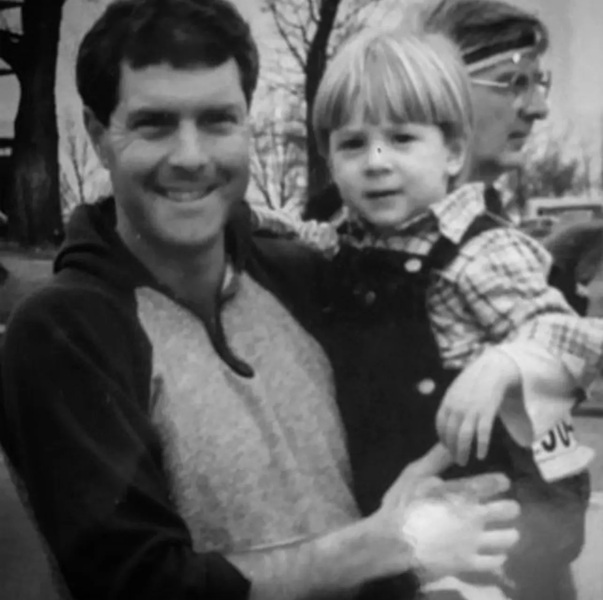
My dad was a runner. He started just before I was born. One day after work, they say he came home and decided it was time to quit smoking and start jogging. He stabbed out his smoldering cigarette and he tore off running, right then. He finished the cigarette later that evening.
He ran marathons throughout my childhood. Marathons were his thing. And although, occasionally, I still saw him sneak Marlboros, it was ONLY on special occasions. Such as Wednesday.
But he couldn’t smoke much because running and smoking contradicted each other. But then, the old man was a walking contradiction.
My father was an ironworker. Union man. Local Number Ten. He wore denim and boots every day of his professional life. The man hung suspended from 40-story skyscrapers, tied off with a safety harness, and stick-welded column splices from nine to five.
When he got home, he’d be covered in soot, with little white patches of skin around his eyes, and he smelled like diesel. And yet, the first thing he’d do was change into running clothes and go for a six-miler.
He began running the Pikes Peak Marathon on a whim. It was a spur-of-the-moment thing. One day he came home from work, loaded up our van with camping gear, and announced that our family was going to Colorado where he would run 26.2 miles, climbing 14,000 feet above sea level. My mother responded by picking up the kitchen phone receiver.
“Who are you calling?” Daddy asked.
“I’m upping your life insurance,” my mother replied.
We camped in Colorado for a few days. I remember the morning of the race. The old man was nervous. He wore red cotton shorts. A Coors Banquet Beer ball cap. He was unprepared. But he believed he could do it.
He kissed my hair and left camp before dark. He played Marvin Gaye and Tammi Terrell’s “Ain’t No Mountain High Enough” on his truck cassette player before running off into the darkness with hundreds of other deranged people in sneakers and race bibs.
We waited for what seemed like years for him to finish.
“Do you think Daddy’s okay?” I would ask my mother.
My mother would pat my head. “If he’s not, we’re set for life.”
Then she’d play the cassette tape again.
Mama and I greeted him at the finish line. My father was cut up, blood trailing down his calves, and limping badly. Apparently he’d fallen several times on the descent. But he was smiling. And crying. His first words were:
“Cigarette.”
But he never got one. Instead, he got a cheap T-shirt. And that night, we went out for burgers. My father hobbled around Colorado Springs, sipping a chocolate malt, riding a marathon high—the physical euphoria induced by a cocktail of painkilling hormones and chemicals released by the body during extreme moments of stupidity.

He ran the Pikes Peak Marathon every year after that. Every year until he died.
I remember one year, the morning after the race, I was in first grade, the old man took me to see the mountain. Just the two of us. It was almost sunrise. The clouds were low, clinging to the peak like a damp dishrag. The sky was electric blue in the dimness of morning.
Daddy was in a daze as he stared at the same mountain that inspired the lyrics to “America the Beautiful.”
“I want my ashes scattered up there,” he said.
My father said this casually. But overtones of sincerity were in his voice. After all, this mountain was the biggest thing he’d ever done. Years later, I realize now that this race was special to him because it was his. Nobody else’s. Just his.
The mountain hadn’t been part of his job. Nobody forced him to run this marathon. He wasn’t in the military. He did this purely for himself. The achievement was all his.
We scattered my father’s ashes on Pikes Peak one frosty morning. I was a little boy. It was not a good day for me. I was in a pissy mood. I was angry. I was bitter. I was flirting with a lifelong grudge against the old man.
My father, after all, left this world by his own hand. He left little more than memories of mental illness and abuse in his wake. He also left me with a host of issues.
The first of which was unforgiveness.
Unforgiveness is a tricky disease. You don’t even know you have it until it’s finally gone. You think you’re fine, even though you aren’t. You think all is well. You even swear to people that you’ve let all ill feelings go.
But then one day you realize the bitter emotions that rise in your throat whenever the unforgiven’s name is spoken are not your true feelings at all. They are the disease.
So anyway, I started running when I was 14. I was a fat kid. I had dropped out of school. I was alone. I was aimless. I had developed a crippling Frito-Lay habit.
One night, after a shower, I looked at my little white belly, staring back in the mirror. “Oh my God,” I thought, “I am so ugly.”
Feelings of self-hatred swept over me. I cried. I curled into the corner, wrapped in only a bath towel, and wept. I despised myself. I despised my broken family. I hated the life given me. I hated waking up in the mornings. I hated going to bed. I hated all the hours between. I hated it all. I didn’t want to die per se, but I didn’t see the point of being alive.
That’s what nobody ever tells you about unforgiveness. You don’t actually hate the wrongdoer. In the end, you are hating only yourself.
But something changed inside me as I wept, there on the bathroom floor. I decided I was going to be happy. I didn’t know how I could be happy. I didn’t know if it WAS even possible to be happy. But dammit, I was going to try. But first, before I could accomplish this, before I could begin the road toward self-care, I needed chips.
That same night, I suited up to go for my first run. I wore cutoff jeans and Chuck Taylors. I ran under the cover of darkness so nobody would see my jiggly body and laugh.
I ran four minutes. I almost died. I barely made it to the mailbox. When I got back home, my heart rate was elevated, my skin clammy, and I administered emergency Cheetos.
The next night I ran five minutes. The night after: six. Then, seven. Eight. Ten. Fifteen. Thirty.
After that, I started running from telephone pole to telephone pole. Just a few more poles each night. I never skipped runs. And if for some reason I missed one, I would go for two runs the next day.
I cried during those runs sometimes. Namely, because I felt close to my dad out there. I knew he was watching me. I could feel him. I felt his soul at rest. I felt his love for me, as he watched me jog and care for myself. And this feeling of his love would make me hurt even worse, and miss him even more. Which made me cry harder. Which made me feel more of his love.
By age 15, I was running five miles a day. My life had changed. I lost weight. I now subscribed to “Runner’s World.” I no longer wore cutoff shorts to run. And instead of All-Stars, I wore ASICS. And most of all, I had given up Cheetos, cold turkey. Now I ate Chili Cheese Fritos.
Over the years I have run many marathons, but I am the world’s worst marathoner. I am slow. I am gangly. I am uncoordinated. My wife says I run like an infant penguin who suffers from constipation.
How slow am I? At more than one marathon, during the final miles I have glanced behind myself only to see a hearse following me.
The last marathon I ran, I finished in nearly last place. Seriously. I galloped to the finish line with an 83-year-old woman named Marge whom I met at mile 26. We had our arms slung around each other’s shoulders. Marge’s feet hit the finish line a split second before mine.
“Beat you,” were her first words.

But for all these years, somewhere in the back of my heart, I’ve always wanted to visit my old man atop Pikes Peak, on foot, while wearing a pair of running shoes. Life has always gotten in the way, of course. Colorado seems halfway across the world from me. And I’m too busy.
I’ve only visited my father’s mountain once since his death, and it was by car. I healed a lot during that visit. Not entirely. But a lot.
Still, this is a year of firsts for me. This is the year I’ve decided to quit idle talk and finally DO some of the things I feel I must. To visit people and places I’ve always known were awaiting me. To take care of my own mental well-being.
My sister is going to Colorado with me. It will be just the two of us, meeting in an airport, carrying our gym bags. We have been training for months. We have been calling each other for support and motivation while running hill repeats. We have been jogging the bleachers. Doing squats. And one of us has even suffered a debilitating Cheetos relapse.
But in a few weeks, we will run up that mountain together. We will stand at the top together.
I don’t know whether I will cry. But I know the disease of unforgiveness is gone. I know I’m a different man than I was before. And above all, I know there ain’t no mountain high enough to keep me from getting to him

.
Questions: SeanDietrich@gmail.co
Visit the Sean of the South Website
Find out where you can see Sean live.
Originally published on Sean’s website. Republished here with permission.
If you enjoyed this article, then please REPOST or SHARE with others; encourage them to follow AFNN. If you’d like to become a citizen contributor for AFNN, contact us at managingeditor@afnn.us Help keep us ad-free by donating here.
Substack: American Free News Network Substack
Truth Social: @AFNN_USA
Facebook: https://m.facebook.com/afnnusa
Telegram: https://t.me/joinchat/2_-GAzcXmIRjODNh
Twitter: https://twitter.com/AfnnUsa
GETTR: https://gettr.com/user/AFNN_USA
CloutHub: @AFNN_USA