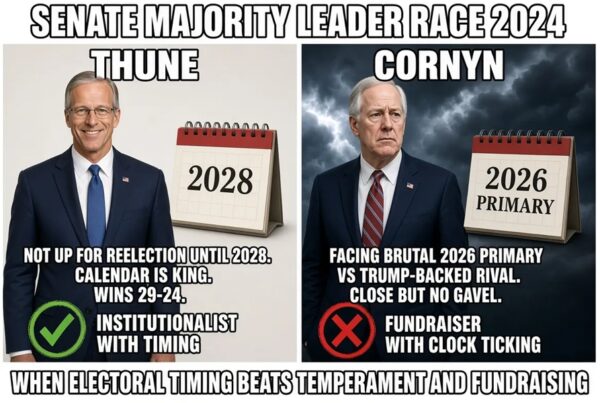
Timing trumps temperament and fundraising ability
John Thune’s ascension to Senate Majority Leader over John Cornyn in November 2024 is often explained in the legacy media as a matter of temperament and fundraising prowess. The more consequential variable was timing.
Thune’s Senate class does not face voters again until 2028; Cornyn faced the music in 2026. That single fact, more than any policy distinction between the two men, determined which of them could absorb the political cost of leading a Senate majority that has repeatedly frustrated the America First wing of the party — most visibly through Thune’s refusal to force the SAVE America Act past a filibuster he lacks the votes to sustain. The South Dakota GOP’s near-miss censure vote in June 2026 was the clearest test of that arrangement to date, and it held, confirming that Thune’s insulation from his own base was durable enough to survive an organized attempt to break it.
The documented record — the leadership vote itself, the candidates’ donor profiles, the censure resolution and its defeat — supports this reading without much interpretive strain.
A further claim can be made that Thune’s elevation was not simply a fortunate alignment of Senate class and electability but the product of deliberate institutional engineering by the McConnell network, executed specifically to install a leader shielded from base backlash until 2028. That claim is very plausible, consistent with the available evidence on fundraising infrastructure and staff continuity, but impossible to confirm from public sources.
In the analysis that follows, this claim is treated as speculative rather than reported as established fact.
THE PROCESS
McConnell announced in February 2024 he’d step down from leadership after 17 years. Cornyn, Rick Scott, and Thune were the three official candidates, chosen by the Senate Republican Conference on a secret ballot on November 13, 2024. Thune beat Cornyn 29-24 on the second ballot after Scott was eliminated in the first round. The night before the vote, candidates made closed-door pitches to the conference in a session senators described as “energetic” but not a debate. Trump deliberately withheld an endorsement — sources indicated he doubted Scott could actually win the internal vote — but he still shaped the race by publicly demanding the winner support recess appointments to speed Cabinet confirmations.
MAJOR FACTORS IN THE SELECTION/ELECTION
Below are some of the major factors that influenced the Republican Senate majority leader selection/election process.
Small State vs. Texas, and the Name-Recognition Asymmetry
This cuts opposite the intuitive direction. Cornyn had the donor-rich home base and decades of national fundraising infrastructure — he raised $17.2 million for GOP incumbents and candidates in the leadership-race cycle, including through the Cornyn Victory Committee — but that same high profile as a Texas power broker and former NRSC chair made him a bigger, more visible target for the “establishment RINO” charge from the MAGA base.
Thune’s relative anonymity outside South Dakota — a small, safe, low-media-market state — meant he carried less baggage in the eyes of the broader conference and less name-ID for outside groups to weaponize against him ahead of the vote. He also wasn’t shy about matching Cornyn dollar-for-dollar in an insider sense: Thune transferred $4 million to the National Republican Senatorial Committee (NRSC) in September 2024, the largest single-senator contribution to the committee in history at that point, breaking a record he himself had set in 2016.
Both Have Anti-Trump Paper Trails — and Establishment, Not Grassroots, Networks
Thune’s rift with Trump dates to his 2016 call for Pence to replace Trump atop the ticket after the Access Hollywood tape, and he voted to acquit Trump in the 2021 impeachment trial while still saying Trump’s conduct “undermine[d] faith in our election system.”
Cornyn has a parallel record as a McConnell-aligned institutionalist. Both men’s institutional support in the leadership race came from conference insiders and leadership-adjacent figures — NRSC Chairman Senator Steve Daines (R-MT) privately urged colleagues to back Thune, and Thune’s public endorsers included North Dakotan Kevin Cramer, who cited decades-long personal ties rather than ideological alignment — while grassroots MAGA energy that cycle visibly rallied around Scott instead, with online campaigns warning that both Cornyn and Thune “would threaten Trump’s agenda.” That’s the tell: the actual base preference was neither Thune nor Cornyn.
Donor Ties — Documented Disparity
This is where the record is richest, and it favors your thesis that Cornyn’s exposure was more acute:
- Cornyn: By spring 2024 he’d raised $5.6 million in Q1 alone through his joint fundraising committee and used a joint fundraising committee (Cornyn Victory) that raised roughly $20 million, a quarter of which flowed to the NRSC. His donor base skews heavily oil-and-gas — ConocoPhillips CEO Ryan Lance, Kinder Morgan’s Richard and Nancy Kinder, Energy Transfer’s Kelcy Warren, and Devon Energy’s Clay Gaspar are all recurring maximum-or-near-maximum donors, consistent with his record as a Senate ally of the oil industry on LNG exports and EV-incentive opposition.
- Thune: He was the only one of the three leadership candidates to stand up his own personal Super PAC (New Heights Action) in 2024, mirroring McConnell’s own model, and it pulled in over $3 million in a single quarter, including $1 million from Blackstone’s Stephen Schwarzman. An INET analysis found his 2023-24 fundraising underwent an abrupt shift toward megadonor money as he ascended toward leadership, and his lobbyist/staffer revolving-door network closely mirrors McConnell’s — dominated by big-business and industry-side firms rather than labor or grassroots-adjacent groups. Note that the INET analysis was prescient with its entitled announcement: “Leadership in the Senate: New Boss Same as the Old Boss?”
The bottom line is that Cornyn’s donor ties were older, more industry-concentrated (oil/gas specifically) and more closely tied to a state donor class that draws outsized national scrutiny, whereas Thune’s megadonor pivot happened more quietly and more recently, coinciding with — not preceding — his leadership ambitions. This is a case where “less name recognition” and “less scrutinized donor profile” are two sides of the same coin.
The McConnell Factor
Thune’s replication of McConnell’s personal-Super-PAC model, plus the near-identical revolving-door lobbyist network, is the strongest documented evidence of institutional continuity. This supports a “McConnell’s preferred successor” reading even though McConnell formally declined to endorse anyone in the race.
The credible-but-unconfirmed layer is this: reporting doesn’t establish that McConnell or his staff directly whipped votes for Thune, but the fundraising-apparatus mimicry and personnel overlap are consistent with a soft institutional handoff rather than a genuinely open contest. Their continued close relationship — including detailed phone calls during McConnell’s 2026 hospitalization — is documented but doesn’t by itself prove pre-2024 coordination; that inference is yours to draw explicitly as speculative if you use it.
2026 vs. 2028 Reelection Timing
Cornyn faced reelection in 2026 and was soundly thumped in the primary by Texas State Attorney General Ken Paxton. This may have even been predicted via internal polls and tipped the balance to Thune. On the other hand, Thune wasn’t up until 2028.
In retrospect, Cornyn’s 2026 primary threat proved real and expensive — his primary fight against Paxton became one of the most expensive in Texas history, with outside groups like the Trump-adjacent Texans for a Conservative Majority super PAC spending heavily on his behalf — which retroactively validates the 2024 electoral-math logic: whoever won the gavel would immediately become an America First target, and Cornyn couldn’t afford that fight and a primary in the same two-year window. Thune could because many voters have short memories.
THE CENSURE VOTE
The Thune censor resolution vote by the South Dakota Republican Party reinforces the thesis that reelection timing was a major factor. The SD GOP Resolutions Committee approved a censure resolution against Thune over his refusal to force the SAVE America Act through via a talking filibuster or rules change, with Thune’s own defense being: “We don’t have the votes, either to proceed to a talking filibuster nor to sustain one if we got one… That’s just a function of math.” The full resolution language explicitly conditioned the censure’s withdrawal on the SAVE America Act actually being signed into law.
On the SDGOP State Convention floor on 26 June, the censure failed on a voice vote, with the majority of delegates voting against it amid applause and whistling from the floor. Opponents’ stated rationale was that censuring their own majority leader “would only help Democrats.” Democracy Docket framed the outcome as showing “the limits of MAGA pressure even in a deep-red state.” Proponents maintained that floor discussion with not balanced (pro-Thune speakers gamed the time allotted).
That result is exactly the mechanism that reinforces that timing of reelection campaigns was the major deciding factor: institutional/party-loyalty logic overriding grassroots anger, in the one venue where Thune was most personally exposed, two years before he next faces voters — buying him the runway to let 2026 fade before 2028.
SPECULATION: THE CASE FOR PREMEDITATION
A plausible theory is that Thune and McConnell-world coordinated a deliberate 2024 succession plan anticipating the 2026-vs-2028 shield, rather than the timing being a fortunate byproduct of Thune’s Senate class. Let us examine that possibility.
1. The timing precondition existed before the contest, not because of it. Senate classes are fixed by the Constitution, not chosen by candidates. Thune is a Class III senator, having been elected in 2022 and next facing voters in 2028; Cornyn is a Class II senator, having been elected in 2020 and next facing voters in 2026. The point is: neither man picked his own election year. What is choosable is who a departing leader (or the leader’s network) chooses to elevate, and someone assembling a succession plan in 2022–23—well before McConnell’s February 2024 retirement announcement—would have known exactly which candidates carried which electoral clocks. If McConnell-aligned operatives were already thinking several cycles ahead about how to insulate the next leader from an America First backlash, Thune’s class placement wasn’t a lucky accident to discover in 2024—it was knowable years in advance.
2. The fundraising posture shift front-runs the vacancy. The INET analysis you already have shows Thune’s donor profile pivoted sharply toward megadonors in the 2023–24 cycle, coinciding with — not following — his ascension effort, and he was the only 2024 candidate to stand up a personal leadership Super PAC modeled explicitly on McConnell’s own vehicle. Standing up a Schwarzman-funded PAC isn’t a two-week improvisation; the infrastructure (legal formation, staff, initial donor commitments) typically takes months to arrange, meaning the apparatus was likely being built well before McConnell’s public February 2024 announcement — consistent with insiders having advance knowledge that a vacancy was coming.
3. The revolving-door overlap is a network signature, not a coincidence. The near-identical lobbyist/staffer networks between Thune and McConnell — dominated by the same industry-side firms — suggest shared personnel infrastructure, which is how institutional continuity actually gets executed in practice, not through public statements but through staff continuity. A “plan” in Washington rarely looks like a memo; it looks like the same fifteen people staying employed across two offices.
4. McConnell’s public neutrality is exactly what a soft handoff would look like. McConnell declined to endorse anyone, which is consistent with either genuine neutrality or a leader who didn’t need to endorse publicly because the groundwork (fundraising infrastructure, staff networks, whip operation via Daines) was already doing the work quietly. The absence of a public signal isn’t evidence against coordination — it’s what coordination designed to survive MAGA scrutiny would necessarily look like.
CONCLUDING THOUGHTS
The “engineered succession” reading isn’t necessary to explain the outcome. The documented record supports a more mundane and more defensible conclusion: Thune won because he was structurally better positioned to survive the job, not necessarily because anyone plotted a multi-year installation.
Based on the documented evidence available, here are the likely reasons, in order of evidentiary weight:
Electoral clock. Thune wasn’t up until 2028; Cornyn faced voters in 2026 (what did his internal polls say?). This alone explains why the conference could hand Thune the base-alienating parts of the job — stalling the SAVE Act, resisting filibuster reform — without immediately costing him his seat. Cornyn’s subsequent primary fight against Paxton confirmed the risk was real, not hypothetical.
Lower exposure, not lower entanglement. Thune’s donor base is just as establishment-coded as Cornyn’s, but it was newer, less concentrated in a single scrutinized industry, and attached to a senator with far less national name recognition. Cornyn’s decades of oil-and-gas money and Texas donor-class visibility made him the easier target; Thune’s megadonor pivot happened quietly and late enough to avoid the same level of scrutiny going into the vote.
Fundraising capacity mattered on its own terms. Thune’s record NRSC transfer and top-ranked campaign war chest gave him a straightforward, non-conspiratorial case for the job: he could raise money for colleagues, which is most of what a conference actually wants from its leader.
Institutional continuity, not necessarily coordination. The overlap between Thune’s and McConnell’s donor and lobbyist networks is real and documented. This is a convergent interest — ambitious senators build the same kind of infrastructure McConnell built because that infrastructure is what wins the job.
The censure vote validates the strategy after the fact. Whether or not 2028 insulation was the deliberate goal in 2024, it functioned as one in June 2026, when the SD GOP’s own delegates declined to escalate against him. The shield worked, regardless of whether anyone engineered it.
Nevertheless, because the documented evidence doesn’t support the premeditated theory does not mean it can be discarded out of hand. Since the Republican leadership has been a controlled – and highly secretive – operation for decades, Occam’s razor would indicate that Thune’s succession was well planned but potentially miscalculated because the SAVE Act’s fate could very well determine his own political future in 2028.
The end.
StuinSD is a reader-supported publication. To receive new posts and support his work, consider becoming a free or paid subscriber.
This article originally appeared in Stu Cvrk’s Substack. Reprinted here with permission
If you enjoyed this article, then please REPOST or SHARE with others; encourage them to follow AFNN. If you’d like to become a citizen contributor for AFNN, contact us at managingeditor@afnn.us Help keep us ad-free by donating here.
Substack: American Free News Network Substack
Truth Social: @AFNN_USA
Facebook: https://m.facebook.com/afnnusa
Telegram: https://t.me/joinchat/2_-GAzcXmIRjODNh
Twitter: https://twitter.com/AfnnUsa
GETTR: https://gettr.com/user/AFNN_USA
CloutHub: @AFNN_USA