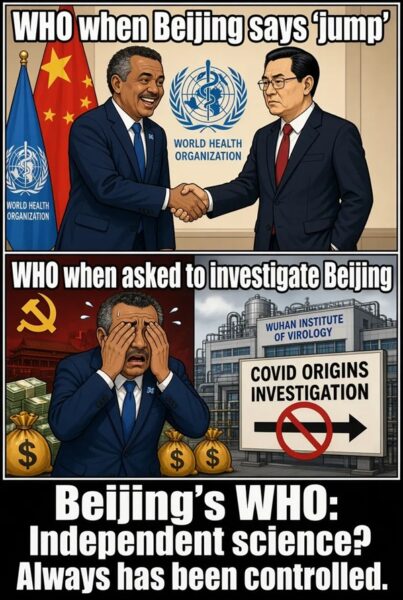
The World Health Organization serves as the directing and coordinating authority on international health work. According to its organizing principles, it connects 194 member states, partners, and people to promote health, keep the world safe, and serve the vulnerable populations. U.S. voluntary funding given to the WHO has dwarfed China’s contributions, yet China exercises out-sized influence on the WHO.
On 20 January 2025, President Trump signed Executive Order 14155, formally announcing the US intent to withdraw from the WHO. The US formally completed its withdrawal on 22 January 2026. The reasons for the withdrawal included mishandling of COVID-19, a persistent refusal to implement urgently needed changes in accountability and transparency, and an inability to demonstrate independence from “inappropriate political influence” by member states (particularly communist China).
PHASE 1: ENTRY AND EARLY MANEUVERING (1949-2003)
China’s engagement with the WHO began even before the country’s formal entry. Throughout the history of the WHO’s relationship with China, politicization has been a key factor and point of debate. In 1972, communist China replaced the Republic of China (ROC – Taiwan) as a member of the WHO. From the beginning, the CCP viewed the WHO not simply as a health body but as a geopolitical arena. China’s Ministry of Health wanted to use the WHO as a political arena to influence developing countries.
Even during the Cold War era, there were CCP-aligned figures operating inside the organization. C.K. Chu worked at the Geneva-based World Health Organization for 14 years, maintaining close contact with the Embassy of the People’s Republic of China in Switzerland. After his retirement in 1963, he returned to Beijing and was immediately admitted into the Party.
PHASE 2: THE SARS TURNING POINT AND CHINA’S HUMILIATION (2003)
The 2003 SARS outbreak represented a critical juncture — and a rare moment of genuine WHO pushback. Then-WHO Director General Dr. Gro Harlem Brundtland made history by declaring the WHO’s first travel advisory in 55 years, recommending against travel to and from the disease epicenter in southern China. Dr. Brundtland also criticized China for endangering global health by attempting to cover up the outbreak through its usual playbook of arresting whistleblowers and censoring media.
This was the last time a WHO director general would publicly confront Beijing. WHO sources say China felt so stung by this “humiliation” that it threw its weight behind reforms to limit the agency’s power.
PHASE 3: INSTALLING A LOYAL DIRECTOR GENERAL (2006)
China’s response to the SARS rebuke was swift and strategic. In 2006, China helped install its favored candidate, Dr. Margaret Chan, a Chinese national, in the top job. Beijing launched an “extraordinarily aggressive campaign“ to help her win power, by cancelling debts and doubling donations to voting African countries before the election.
The 2006 appointment of Margaret Chan as director-general marked the first time China had successfully elected a candidate to the top leadership position of a specialized UN agency.
Under Chan, the organization consistently deferred to Beijing’s political interests. Ms. Chan’s two mandates were marked by some polemics at the time of Ebola, a strange episode of praise for North Korea’s health system, and several stands against Taiwan for not “respecting” fully the “One China” principle.
Chan also restructured the WHO’s election mechanics: She introduced new ‘FIFA-style’ secret ballot voting rules to give countries vulnerable to diplomatic pressure the same voting power as richer countries. China paid far less to the WHO than other major countries. Instead, it ploughed its money into cutting private deals with small voting countries.
PHASE 4: LOCKING IN CONTROL – THE TEDROS ELECTION (2017)
When Chan’s tenure ended, China repeated its electoral playbook, this time for a non-Chinese candidate who would nonetheless reliably serve Beijing’s interests. China was an important ally of Tedros in the WHO’s director general election in 2017. Months before the election, Tedros was invited to speak at Peking University where he called for stronger cooperation between China and the Global South on health issues.
Tedros was elected to head WHO with Chinese behind-the-scenes support, reflecting China’s close relationship with Addis Ababa, which had become China’s bridgehead in Africa. African nations, many of them heavily indebted to China through Belt and Road loans, voted overwhelmingly for Tedros. Beijing has leveraged its development practices through its Belt-Road Initiative, which rely on predatory loans, to gain influence over other countries.
The day after his electoral victory, Tedros confirmed to Chinese state media that he and the WHO would continue to support the “One China” principle, which recognizes the government in Beijing as the legitimate Chinese government.
HOW CHINESE INFLUENCE WAS OPERATIONALIZED
China’s leverage over the WHO rested on several interlocking mechanisms:
Financial dependence and growing contributions. Countries’ assessed contributions had grown by only 3% since 2014, while extrabudgetary voluntary contributions grew by 18%, to nearly $4.7 billion in 2018–19. This dependence on voluntary contributions leaves the WHO highly susceptible to the influence of individual countries.
Diplomatic pressure through the Global South. China succeeded in leveraging its capacity to influence the WHO — and other such organizations — considerably in excess of its financial contribution, a testimony to its more concerted and focused approach to multilateral affairs.
Structural vote manipulation. By promoting secret ballots and cultivating smaller member states through debt relief and investment, Beijing was able to move votes with relatively modest financial outlay.
Belt and Road health diplomacy. In January 2017, China signed a Memorandum of Understanding with the WHO for cooperation on the One Belt, One Road initiative.
Note: In contrast, the U.S. has invested over $100–130 billion in the President’s Emergency Plan for AIDS Relief (PEPFAR) since 2003 (roughly $110 billion in some 10–15 year approximations), delivering targeted HIV/AIDS (and related Ebola/TB) support in Africa and elsewhere. This bilateral approach often achieved strong results by operating with direct accountability outside heavier multilateral bureaucracies like WHO.
SIGNIFICANT PRO-CCP DECISIONS BY THE WHO AND CONSEQUENCES
Beijing has gained much through its political capture of the WHO, for example:
1. Suppression of Taiwan’s participation. Since China acceded to the UN in 1971, it has periodically blocked Taiwan’s WHO membership. From 2009 to 2016, China allowed Taiwan to join the World Health Assembly as an observer. After the election of President Tsai Ing-wen in 2016, cross-strait relations chilled, causing China to block Taiwan’s future participation. This exclusion had catastrophic public health implications — Taiwan’s health officials warned the WHO of the possibility of human-to-human transmission of COVID-19 in the early days of the outbreak. Taiwan was frozen out of emergency meetings and briefings despite having one of the world’s most effective pandemic responses. Knowing this, the Trump Administration sent Health and Human Services Secretary Alex Azar to Taiwan in August 2020 to better understand Beijing’s mishandling of the pandemic and hone domestic responses.
2. Delayed declaration of COVID-19 emergency: As the coronavirus spread beyond its borders, China’s leaders successfully lobbied the WHO not to declare a public health emergency of international concern. Soon after this disastrous decision, the Chinese Communist Party blocked a WHO team from investigating the pandemic’s source and China’s response, in violation of the International Health Regulations.
3. Endorsement of China’s false early narrative: WHO’s failure to recognize proven human-to-human contamination — going along with China’s refusal to admit human-to-human transmission — despite strong and persistent indications to the contrary, and alerts by Taiwanese health officials, contributed directly to global delays in response.
4. Lavish praise of China’s “transparency”: The WHO Director-General thanked Xi Jinping for his “detailed knowledge of the outbreak” and said that China was “setting a new standard for outbreak control” — this despite the month-long delay in responding and the cover-up that included punishment of whistleblower doctors.
5. Delayed pandemic declaration: The organization refused to declare a pandemic until March 11, when 114 countries had already reported 118,000 cases. These decisions had global consequences, as WHO guidelines are followed by countries and private actors who base — and later justify — their actions on those guidelines.
6. Endorsement of Traditional Chinese Medicine: The organization endorsed traditional Chinese medicines that are scientifically unproven, including them on its official list of remedies, following extensive lobbying from Beijing.
7. Obstructed COVID-19 origins investigation: When the WHO produced a report evaluating the possible origins of COVID-19, it became evident that the entire report was nothing but Chinese propaganda. Dr. Fauci himself stated there were “considerable concerns” because of “a lot of restrictions on the ability of the people who went there to really take a look.”
CONCLUDING THOUGHTS
The CCP’s approach to gain control of the WHO was calculated and methodical: entry through UN displacement of Taiwan, placement of sympathetic personnel over decades, exploitation of the organization’s financial vulnerabilities, debt-diplomacy to control developing-world votes, and installation of compliant leadership.
The result was an organization that, at the most critical moment in living memory, delayed global response to COVID-19 by repeating information from Chinese authorities, ignored warnings from Taiwanese doctors, and was reluctant to declare a public health emergency of international concern.
The WHO’s institutional credibility has never recovered. President Trump’s decision to leave and end US subsidies to the politically corrupted WHO was entirely justified.
The end.
StuinSD is a reader-supported publication. To receive new posts and support his work, consider becoming a free or paid subscriber.
This article originally appeared in Stu Cvrk’s Substack. Reprinted here with permission
If you enjoyed this article, then please REPOST or SHARE with others; encourage them to follow AFNN. If you’d like to become a citizen contributor for AFNN, contact us at managingeditor@afnn.us Help keep us ad-free by donating here.
Substack: American Free News Network Substack
Truth Social: @AFNN_USA
Facebook: https://m.facebook.com/afnnusa
Telegram: https://t.me/joinchat/2_-GAzcXmIRjODNh
Twitter: https://twitter.com/AfnnUsa
GETTR: https://gettr.com/user/AFNN_USA
CloutHub: @AFNN_USA