There are two ways to explain why someone doesn’t have what you have. One says: they took it from you, or from someone like you, and the only way to make things right is to take it back. The other says: build something. Work. Wait. Trust that effort compounds.
Those two explanations aren’t just economic theories. They’re two different postures toward existence itself — call them lack consciousness and plenty consciousness. One is organized around a four-letter word: lack. The other around a five-letter one: faith. And which one a person, or a whole society, adopts turns out to matter more than almost anything else about how that life, or that society, ends up.
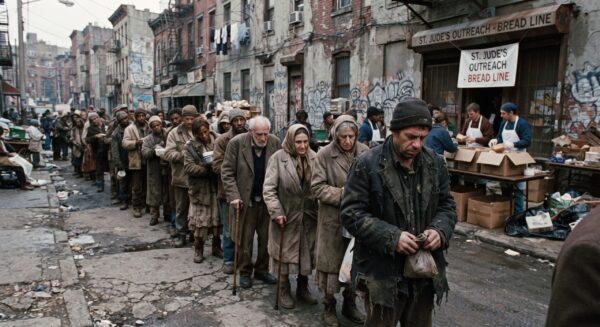
Lack consciousness starts from scarcity and grievance. Its emotional register is envy, resentment, and — when it fully matures — hate. It sees the world as a fixed pie: if someone else has more, you necessarily have less, and the gap between you is evidence of a wrong that needs righting, usually by force. Marx and Engels opened their most famous pamphlet by describing all of human history as nothing but the story of “oppressor and oppressed” locked in perpetual war. Winston Churchill, watching the ideology in action a century ago called it: “the philosophy of failure, the creed of ignorance, and the gospel of envy.” Lack consciousness doesn’t ask you to work, believe, and build. It asks you only to look sideways, find the person who has more, and decide what they owe you. Assets just magically have appeared and those who did not contribute feel justified in demanding a cut.
Plenty consciousness starts from a different premise entirely: that the world isn’t fixed, that effort, inventiveness, risk taking, and character actually produce something, and that your circumstances today aren’t a life sentence. Its register is faith, diligence, patience, industriousness, and — at its best — love, both for the work itself and for the people you build alongside. George Washington, writing to the states at the exact moment the American experiment began, warned that if the young nation failed to become “completely free and happy, the fault will be entirely their own” — not fortune’s fault, not another class’s fault. That’s the whole posture in one sentence: the outcome is yours to build, not something owed to you and requiring someone else’s downfall.
How does a society move from one of these postures to the other? America began, explicitly and on the record, closer to the second. Its founding documents, its founding figures, and its founding religious language, all point toward individual responsibility, effort, and providence rather than grievance. And yet a real and growing current of modern political life runs on the first — on the conviction that the response to inequality should be resentment, and the remedy for inequality must be confiscation.
Future posts will trace the lack mentality: to its philosophical roots, to the nations that built entire economies and governments on it, to the dictators who preached equality while living the opposite of it, and to the mechanisms — including the deliberate corruption of truth itself — that keep it alive long after the evidence against it has piled up. And alongside this, we’ll examine the alternative: that faith, diligence, and the willingness to build rather than take isn’t just morally cleaner. It’s the only one of the two that has ever actually worked.
Cushman Younger 2026
Cushman Younger also writes poems some of which are available on Amazon Kindle under the title “The Cruel March of Time“.
If you enjoyed this article, then please REPOST or SHARE with others; encourage them to follow AFNN. If you’d like to become a citizen contributor for AFNN, contact us at managingeditor@afnn.us Help keep us ad-free by donating here.
Substack: American Free News Network Substack
Truth Social: @AFNN_USA
Facebook: https://m.facebook.com/afnnusa
Telegram: https://t.me/joinchat/2_-GAzcXmIRjODNh
Twitter: https://twitter.com/AfnnUsa
GETTR: https://gettr.com/user/AFNN_USA
CloutHub: @AFNN_USA