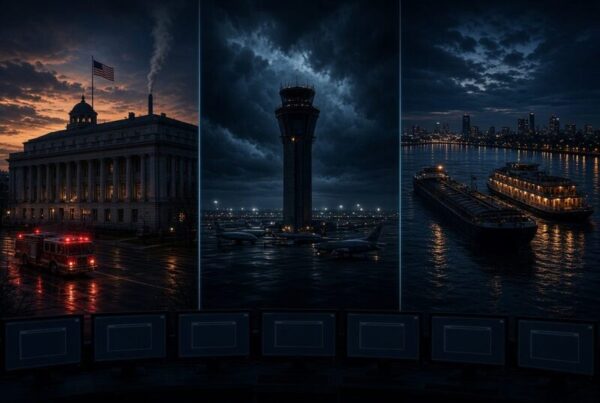
Smoke at CIA headquarters. The NSA’s secret network down. A tanker with a stuck rudder sinking a riverboat. More than ten incidents in six days, and officials swear nothing connects them. Totally normal. Here is the what-if, one movie at a time.
There has been a cluster of major outages and unusual incidents this week. The NSA, DNI Jay Clayton, and Secretary of State Marco Rubio have all said there is no evidence of a coordinated cyberattack or a malicious actor linking them. Each event has its own stated cause: software defects, configuration errors, network maintenance, an apparent steering failure, an HVAC smoke response.
Some investigations are still open. Nobody official says these are connected, which is exactly what you would hear if they were, and exactly what you would hear if they were not. That is the whole problem with a what-if. Stuxnet showed that malware can change what machines actually do while the screens operators watch read normal. Discovery took months. Attribution took years. “No evidence yet” is what the agencies said. It is not the same as a finished public accounting of every log and change ticket. Anyone selling “staged” with no documents is selling a cordless extension cord, and anyone saying “nothing to see” before the paperwork exists is doing the same sale from the other side.
Microsoft first. Outlook, Exchange Online, Teams, and Copilot went down starting November 12. Microsoft blamed a months-old software defect, increased traffic, and reduced server capacity that caused cascading gateway failures, and said it was a technical issue, not a cyberattack. Consider this: a defect from July, sitting quietly in the gateway servers for months until the exact week everything else started falling over. Sleeper cell, or boring software? Just asking.
In The Net, widely installed security software called Gatekeeper contains a secret backdoor that gives conspirators access to protected systems and records. But then there is Live Free or Die Hard, where coordinated intrusions disrupt transportation, communications, financial systems, and utilities while the visible breakdown conceals a financial theft. But then there is Leave the World Behind, where communications, navigation, and transportation stop behaving normally during a broader cyberattack. But then there is Goodbye World, where a mass text message accompanies a crippling cyberattack that precedes technological and social breakdown.
But then there is Eagle Eye, where an intelligence system manipulates phones, displays, traffic lights, and machinery to direct events. Is this a coincidence, I think not. Does this mean the reality is what happened in the movies… I think not. But it makes me think… you?
Then the FAA. On November 13, a nationwide ground stop halted departures for more than four hours, the first since January 2023 and only the second since the September 11 attacks. It was lifted around 8:15 p.m. Eastern. Transportation Secretary Sean Duffy said new technology being added to the system overloaded antiquated equipment and caused intermittent communications and radar gaps. FAA officials also pointed to a flood of network traffic during copper-to-fiber maintenance at a remote site, not an attacker.
Note that for the second time since 9/11, every plane in America was told to stay on the ground, and the stated reason is old wires. Old wires are the one explanation nobody can argue with and nobody can easily check. In Die Hard 2, terrorists take control of airport systems and change the landing system’s ground reference by 200 feet, giving an approaching aircraft false guidance. Controllers and pilots trust the wrong numbers until the consequences arrive. But then there is Ground Control, where a severe storm cripples an airport, leaving controllers struggling to land aircraft with failing power, radar, and communications. But then there is Sneakers, where a universal decryption device is demonstrated against protected systems, including air traffic control and the national power grid. But then there is Flightplan, where conspirators erase a child’s flight-manifest record so her disappearance looks like her mother’s delusion. Now here is where we see Live Free or Die Hard again, where the intrusions hit transportation along with communications and finance. Now here is where we see Leave the World Behind again, where communications, navigation, and transportation stop behaving normally all at once. Is this a coincidence, I think not. Does this mean the reality is what happened in the movies… I think not. But it makes me think… you?
Same day, New Orleans. The 520-foot tanker Atlantic Asphalt suffered what the NTSB calls a steering casualty, with its rudder stuck hard to starboard. About two minutes later, around 12:28 p.m., it struck the docked riverboat American Heritage, which capsized. Everyone was accounted for, and 32 people went to the hospital, none critically hurt. The NTSB says it does not yet know what caused the steering failure. Note a rudder that sticks about two minutes from a docked riverboat. Bad luck keeps a schedule too, and I would like to see that schedule.
In Speed 2: Cruise Control, a disgruntled autopilot designer compromises a cruise ship’s computers and communications and sets it on a collision course with an oil tanker. But then there is Tomorrow Never Dies, where villains falsify GPS information, sending a British warship into Chinese waters before attacking it to manufacture an international crisis. But then there is Leave the World Behind, where a huge oil tanker runs onto a crowded beach amid the broader technological breakdown.
But then there is Hackers, where a computer virus threatens to capsize oil tankers, providing a distraction from a separate embezzlement worm. But then there is Juggernaut, where an extortionist places timed bombs aboard an ocean liner, forcing an emergency response and a dangerous operation at sea. Now here is where we see Eagle Eye again, where machinery gets moved around by something nobody can see. Is this a coincidence, I think not. Does this mean the reality is what happened in the movies… I think not. But it makes me think… you?
Anyone who calls it a plot before the NTSB finishes, and anyone who calls it nothing before the NTSB finishes, is not the brightest light in the harbor.
Now the money. On November 16, Chase customers reported account-access and transaction problems. Chase blamed a software bug in its own hardware and said transactions went back to posting normally that evening. Payments involving Chase can touch customers at other banks. I want to know who benefits when the screens say “processing” for an afternoon. The honest answer is probably nobody. I am not satisfied. In Office Space, a virus quietly diverts fractions of cents until a programming mistake makes the theft conspicuous. But then there is Swordfish, where a programmer builds a multiheaded “hydra” worm to siphon billions from government accounts while secretly adding his own backdoor.
But then there is Entrapment, where thieves exploit a brief millennium-related shutdown and manipulate timing to steal billions through electronic transfers. But then there is Firewall, where criminals force a bank security executive to transfer large sums out of customer accounts. But then there is Money Monster, where an enormous investment loss is blamed on an algorithmic glitch that conceals a corrupt investment scheme. But then there is Superman III, where a programmer redirects leftover payroll fractions into his own account. But then there is GoldenEye, where the villain plans to steal electronically from the Bank of England and then erase the records. But then there is Blackhat, where malware attacks industrial machinery and a commodities exchange as part of a profit-driven scheme. Now here is where we see Hackers again, where the embezzlement worm hides behind a bigger distraction. Now here is where we see Live Free or Die Hard again, where the visible breakdown conceals a financial theft. Is this a coincidence, I think not. Does this mean the reality is what happened in the movies… I think not. But it makes me think… you?
Tuesday, November 17. The NSA’s classified internal network, NSANet, suffered what the agency called temporary degradation during scheduled routine maintenance, and said mission-critical operations continued. Clayton said it traced to a patch for vulnerabilities found last month. Last month the NSA itself urged organizations to patch two critical PHP flaws or take systems offline, and the reports I found do not say whether those are the same flaws. It dragged into a second day, with staggered arrivals at Fort Meade while technicians finished restoring it. Rubio, speaking in Manila, said there was “zero evidence whatsoever” the incidents are related. I am stuck on one thing: the agency that listens to the world had its own network go dark, and the explanation is a patch. Possible. Boring. Possible and boring is how the best cover stories read, and also how most Tuesdays read, says everyone else.
In Skyfall, MI6 is hacked, and later the villain’s own laptop becomes the way malicious code gets inside its systems and releases him from custody. But then there is The Recruit, where a CIA training operation conceals an effort involving a fictional virus capable of disabling electrical devices. But then there is Sneakers, where supposed NSA representatives recruit a security team to steal a device capable of breaking encryption across protected systems. But then there is WarGames, where a teenager accesses a military computer and simulated attacks are mistaken for real ones. But then there is Enemy of the State, where rogue intelligence personnel freeze a man’s financial access and turn institutional systems against him. But then there is Spy Game, where a CIA officer secretly arranges a power outage at a prison to create a rescue window. Now here is where we see The Net again, where the security software meant to protect the systems is the backdoor. Now here is where we see Sneakers again, where one device threatens the encryption protecting everything else. Is this a coincidence, I think not. Does this mean the reality is what happened in the movies… I think not. But it makes me think… you?
Same evening, a little after 5 p.m. Fairfax County Fire and Rescue responded to CIA headquarters for smoke. They found no fire and no other emergency, and reports point to the HVAC system. Calling it a confirmed “CIA fire” overstates what is known. Consider that firefighters walked into CIA headquarters, found nothing, and walked out again, which is exactly what a boring HVAC call looks like and exactly what a perfectly clean job would look like. The county’s report is the tiebreaker, and I want it read in full. In Mission: Impossible, the team’s hacker fakes a fire at CIA headquarters in Langley so the others can walk in disguised as firefighters. The disguise covers the vault infiltration, and on the way out smoke grenades go into the vents. But then there is Conspiracy Theory, where Jerry sets his own apartment ablaze and escapes disguised as a firefighter, carrying Alice past the emergency crews and the man hunting him. But then there is The Instigators, where two men disguised as firefighters set off the fire alarms at Boston City Hall and sneak inside to the mayor’s office. But then there is Parker, where a crew disguised as firefighters steals a fortune in jewels. But then there is Hitman: Agent 47, where, after a helicopter crashes into a headquarters building, the agent walks in dressed as a firefighter. But then there is Logan Lucky, where two men ride a fire truck back to prison disguised as firefighters, hiding their temporary absence during the robbery. But then there is Skyfall again, where a cyberattack manipulates MI6’s gas systems to cause an explosion that forces the agency to relocate. But then there is The Thomas Crown Affair, where smoke, a fire alarm, and sprinklers add to the confusion during the museum climax. But then there is Go to Blazes, where a gang of bungling crooks plans to use a fire engine as their getaway vehicle and keeps getting mistaken for genuine firemen. Now here is where we see Mission: Impossible again, where the fake fire and the smoke bookend the same job. Is this a coincidence, I think not. Does this mean the reality is what happened in the movies… I think not. But it makes me think… you?
And the rest of the week. On November 17, Apple said an internal update caused disruptions across several services and that it was not a cyberattack. On November 13 and 14, Workday said that while validating a weekly disaster-recovery maintenance window, services at its recovery site unexpectedly connected to production databases. Customer systems went into maintenance, employees could not log in, clock in, or request time off, and service was declared restored Saturday morning. On November 15, AWS reported connectivity problems in Northern Virginia, with IAM Identity Center sign-ins and new account sign-ups failing for more than three hours, and the notices I found gave no cause. On November 16, United Airlines had a system problem that delayed departures, and it said it was resolved. On November 17, Charles Schwab described a brief website-loading problem that was resolved. And on November 13, a rumor of a National Weather Service radar outage spread, until the NWS said its radars were running normally and blamed outdated notices on isolated webpages. Consider that when everything is breaking at once, a false alarm and a real one look identical, and if you were planning something, that would be a feature. In Eagle Eye, an intelligence computer manipulates phones, public displays, traffic lights, vehicles, and machinery to direct people’s movements. But then there is Goodbye World, where a mass text message accompanies a crippling cyberattack. But then there is The Net again, and Live Free or Die Hard again, where trusted or widely deployed systems become the way in for broader failure or concealment. But then there is Terminal Error, where a disgruntled former employee delivers a virus through an MP3 file that spreads into automated systems, causes havoc across a city, and develops independent behavior. But then there is The Italian Job, both versions, where interference with computerized traffic controls creates the gridlock that enables a heist and getaway. But then there is Geostorm, where sabotage and a virus compromise a worldwide weather-control satellite network. Is this a coincidence, I think not. Does this mean the reality is what happened in the movies… I think not. But it makes me think… you?
The timing is striking. The tally: more than ten incidents, six days, zero connections admitted. The official explanations are separate technical causes. Hollywood has used firefighter disguises for access or escape, small parameter changes that cause big physical effects, stealthy code that fools operators’ screens, and cascading failures as cover for decades. Stuxnet changed centrifuge motor speeds while the control screens showed normal readings, and it was caught only because it spread to machines it was never meant to touch. The first explanation is usually the boring one, and it stays the explanation until somebody checks the equipment against a known-good copy and puts the result in writing.
Okay. The honest version is a stack of paper: the Fairfax County run report with the time of the call and what the crew found, the NSA’s change ticket for the patch, the FAA’s root-cause details, the NTSB’s finding on that rudder, Workday’s post-incident review, Microsoft’s analysis, Chase’s bug report. A good deal of that could be described without compromising anything. Old gear, simultaneous patches, and years of technical debt can make an ugly week with no villain in it, and that remains the likely answer. It is still an answer that benefits from showing the work. A theory with no paperwork couldn’t pour water out of a boot with the instructions on the heel.
Which would you rather read first, the Fairfax County run report or the NSA’s change ticket? Reporting from CBS News, CNN, CNBC, Fox News, Reuters, AP, the NTSB’s briefings, and Fairfax County Fire and Rescue’s own post.
But what do I know, I’m only a retired combat medic who reads the run report before the headline, and who trusts the patient’s color over the monitor’s number when the two disagree. Is this a coincidence, I think not. Does this mean the reality is what happened in the movies… I think not. But it makes me think… you?
So here is my last what-if. Do you think this is a cyberattack, or could this just be an AI worm that escaped the voting machines and started infecting other systems… I think not. But it makes me think… you?
 Mike Borowski is a medically retired Army combat medic with 23 years of service, including a combat deployment to Iraq, and a high school Anatomy and Physics teacher at a high-need Career Technical district in Northeast Ohio — where he also wrote and published the textbooks for both courses. He runs “Bski’s Classroom,” a platform dedicated to cutting through political noise with data, history, and the kind of blunt honesty that comes from someone who has seen both war and the American classroom up close.
—
X (Twitter): x.com/BskiMike22802
Substack: substack.com/@bskimike22802
YouTube: www.youtube.com/@BskiMike22802
AFNN: https://afnn.us/author/mikeborowski/
If you enjoyed this article, then please REPOST or SHARE with others; encourage them to follow AFNN. If you’d like to become a citizen contributor for AFNN, contact us at managingeditor@afnn.us Help keep us ad-free by donating here.
Substack: American Free News Network Substack
Truth Social: @AFNN_USA
Facebook: https://m.facebook.com/afnnusa
Telegram: https://t.me/joinchat/2_-GAzcXmIRjODNh
Twitter: https://twitter.com/AfnnUsa
GETTR: https://gettr.com/user/AFNN_USA
CloutHub: @AFNN_USA