I am going to start this one with a confession, the same way I start most of these.
I teach Physics. I teach Anatomy. I did not inherit somebody else’s curriculum and read off a textbook somebody else wrote. I WROTE the textbooks. Both of them. Published them. So when a city council stands up at a ribbon-cutting and tells me a fresh coat of blacktop is “helping the planet,” I need you to understand something: I am not the guy who hears the word “science” and just nods along. I am the guy who goes and checks the arithmetic, because checking the arithmetic is literally my job, five periods a day, in front of teenagers who would rather be anywhere else grading me on whether I actually know what I’m talking about.
So I checked it.
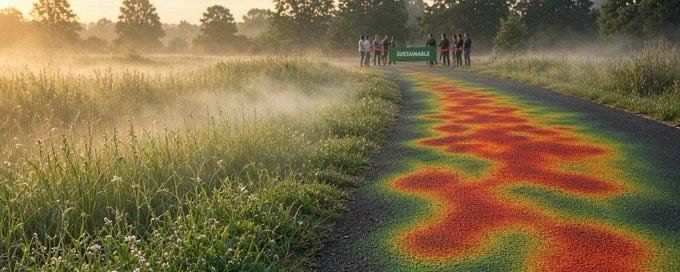
Last month a city council cut the ribbon on a brand-new paved bike trail, hung a big green SUSTAINABLE banner behind the podium, and shook hands like they’d personally patched the ozone layer. Nobody up there ran a single number. I ran all of them. And by the time I was done, this stopped being a post about bike paths and turned into a post about how selective the environmental movement gets the second the actual physics stops being convenient. Buckle up. This one’s long, because I’m not skipping steps just to keep it short.
HERE IS THE THING THESE PEOPLE KEEP GETTING BACKWARD.
There are two completely different projects getting sold to you under the same banner right now, and they are not the same project. One is a city repainting an existing car lane so it’s bikes-only. The other is a city pouring brand-new asphalt through a park or a greenway so people have somewhere to ride. Same press release. Same climate-hero photo op. Completely different physics. One of these changes the actual temperature of your neighborhood. The other one changes nothing. Let me show you the difference, because I don’t expect you to just take my word for it. I never expect that, and neither should you.
The lane that just got repainted has been baking in the sun since before some of these council members were born. Yesterday it absorbed roughly 90 percent of the sunlight that hit it. Tomorrow, with a fresh coat of bike-lane paint, it absorbs roughly 90 percent of the sunlight that hits it. The material has no idea whether a Honda or a Huffy is rolling over it. None. Zero.
I’VE ALREADY MADE THIS ARGUMENT ONCE. AT A SMALLER SCALE. IN A PARKED CAR.
Every point I’m making about paint versus pavement is the same argument as the difference between cracking your car windows and using a reflective windshield shade on a hot day, just scaled up from a sedan to a city block. Once you see it in the small version, you don’t unsee it in the big one.
McLaren, Null and Quinn ran the actual test in 2005, published in Pediatrics: park a car in the sun, crack the windows an inch and a half, measure what happens. Cabin temperature still rose about 40 degrees Fahrenheit in sixty minutes. The rate of rise with the windows cracked was 3.1 degrees every five minutes. Sealed shut, it was 3.4. Read that again. Cracking the window barely moved the number, because a two-inch gap at the top of a door isn’t opening a greenhouse, it’s opening a very small leak in a box that’s being pumped with eight hundred to twelve hundred watts of solar power through the windshield the entire time. You changed the loss term by a hair and left the source term completely alone.
A reflective shade does the opposite. It doesn’t try to vent the heat after the fact. It stops the photon before the dashboard ever gets to absorb it and turn itself into an eighty-degree-Celsius infrared heater sitting eighteen inches from your knees. Dashboard temperature drops by a quarter or more. Cabin air drops several degrees. And none of it requires you to give anything up — you just changed what color the aperture is.
That’s the whole bike-lane debate in one sentence. Repainting a car lane is cracking the window: it fiddles with a small loss term and leaves the source term — the actual asphalt — completely alone. Pouring new dark blacktop through a park with no thought given to the mix is leaving the windows shut with no shade at all and acting surprised when the interior cooks. And the cities getting this right — Phoenix’s Cool Pavement Program, StreetsLA’s reflective streets, Tokyo’s water-retentive pavement for the 2020 Olympics — are running the shade. They’re changing the color of the aperture instead of hoping a breeze fixes it later.
NOW HERE IS THE ONE THAT’S ACTUALLY TRUE. PAY ATTENTION. THIS IS THE PART THEY DON’T WANT AT THE RIBBON-CUTTING.
New blacktop is a completely different animal, and this is where I need people on BOTH sides to sit down and be honest for a minute.
Fresh asphalt reflects about 4 to 5 percent of the sunlight that hits it. Let that sit. Ninety-five-plus percent gets absorbed. Aged asphalt, after a few years of sun and traffic, climbs to maybe 10 or 15 percent reflected. Grass reflects 20 to 26 percent. That is not a rounding error. That’s the difference between a surface that spends the afternoon soaking up heat like a cast-iron skillet left on the burner, and a surface that spends the afternoon sweating that energy off through evapotranspiration, which is the exact same trick your own body uses when it’s hot outside. I teach that mechanism in the first month of Anatomy.
On a clear summer day, blacktop in full sun regularly hits 140 to 158 degrees Fahrenheit. I have stood on pavement that hot. It is not comfortable and it is not theoretical. Grass under that same sky sits around 86 to 95 degrees. That’s a 36-degree gap between a bike trail and the meadow it just replaced, and I’m not exaggerating for effect. That number comes straight from Takebayashi and Moriyama’s published field measurements. It’s exactly why Phoenix and Los Angeles are right now spending real tax dollars painting their own city streets a lighter color to fight this same problem. Hold that thought. It gets good.
THE MATH. SHOWN, NOT ASSERTED. THAT IS THE DIFFERENCE BETWEEN ME AND EVERYONE ELSE YELLING ABOUT THIS ON BOTH SIDES.
Take a ten-mile paved trail, twelve feet wide, the standard width for a shared bike path. Lay it where grass used to be. That’s 58,863 square meters of new dark surface. About 14 and a half acres.
On one clear summer day, that strip as fresh asphalt absorbs around 371 megawatt-hours of solar energy. Left alone as grass, it would have absorbed about 317. The gap is 53.7 megawatt-hours. In a single day. Off one modest bike trail. That is roughly what 1,800 average American homes burn through in electricity in twenty-four hours. Nobody built a power plant. The trail just started keeping sunlight that used to bounce away or get spent cooling a lawn.
And it doesn’t stop when the sun goes down. Asphalt has real thermal mass. It keeps radiating that stored heat into the night air for hours after grass would have already cooled off. That is the actual reason your city feels hottest at 9pm and not at 2pm. The heat didn’t leave. It got released on a delay, like a stove burner that stays hot long after you’ve turned it off.
STOP CALLING THIS “GLOBAL WARMING.” I MEAN IT. IT WEAKENS YOUR OWN ARGUMENT.
I have to slow down here, because this is the part where I lose people on my own side, and I would rather lose you here than be wrong in public.
Everything above is real, measured, and local. It is NOT global warming. Those are two different measurements, and mixing them up doesn’t make either argument stronger. It just makes both of you sound like you skipped the reading. A 2021 study in Science Advances looked at 342 European cities during the brutal July 2019 heat wave and found satellite surface readings were overestimating the real air-temperature heat-island effect by roughly six times over. Six. And NASA’s own climate scientists have checked, more than once, whether hot city weather stations are quietly inflating the global warming record. The honest answer, independently confirmed by MIT’s Climate Portal, is that keeping or dropping those urban stations moves the entire 120-year global trend by about one one-hundredth of a degree. That is the whole contamination. That is it.
So no. A bike trail through your local park did not move the planet’s thermostat. It moved the thermostat on that specific quarter-mile of park, on hot afternoons, for years to come, and that is a real cost that deserves an honest conversation, not an apocalypse from one side or a shrug from the other, depending on which headline needs clicks that week.
I ALMOST OPENED WITH THE WATER VAPOR ARGUMENT. HERE IS WHY I DIDN’T.
Before I get to the part that’s going to make some of you very uncomfortable, let me show you a trap I almost walked into myself, because showing my work when I’m wrong is the entire point of teaching Physics instead of just believing it.
Here’s the gotcha that gets passed around constantly, usually with a smug little checkmate energy attached to it: water vapor is the single largest greenhouse gas on the planet, full stop, no contest. And that sentence is TRUE. Radiative-transfer accounting — Schmidt et al. 2010 is the standard citation — splits up the roughly 150 to 160 watts per square meter of outgoing heat that gets trapped by the atmosphere, and water vapor alone accounts for about half of it. Clouds get another quarter. CO2, the gas everyone is having a nervous breakdown about, sits at around 19 to 20 percent, a little higher under clear skies. By raw contribution to the greenhouse effect that already exists, water vapor beats CO2 by a factor of two to three, easily.
I could stop right there and write you a very entertaining, very shareable post about how every environmentalist who has ever taken a shower, watered a lawn, run a humidifier, filled a swimming pool, or stood next to a cooling tower is a raging hypocrite for lecturing you about YOUR emissions. It would get a lot of engagement. It would also be wrong, and I am not going to do that, because I’ve spent this entire article holding my own side to a standard, and I’m not abandoning it the second it becomes convenient to.
Here’s the test — the exact same test I ran on the bike trail two sections ago. Is it a forcing, or is it a feedback? A forcing changes the temperature. A feedback responds to the temperature that’s already changed. Water vapor is entirely, completely, no-exceptions a feedback. Its atmospheric concentration isn’t set by how many people took showers this morning. It’s set by temperature, through a relationship called the Clausius-Clapeyron equation, which says the atmosphere can hold roughly seven percent more water vapor for every degree Celsius it warms. Warm air holds more water. Cool air wrings it out as rain in about nine or ten days on average. Direct human water-vapor emissions — irrigation, cooling towers, every steamy bathroom mirror in America — are a rounding error against an ocean that’s evaporating and precipitating on a planetary scale every single day, and none of it accumulates, because anything extra falls out of the sky within a week and a half.
CO2 does not behave that way. It is not condensable. It does not rain out. A meaningful fraction of what we put into the air this year will still be up there in the year 2500. That’s the entire reason CO2, methane, and nitrous oxide get classified as forcings and water vapor gets classified as a feedback: remove the long-lived gases, cool the planet down, and water vapor mostly falls out of the sky on its own within weeks, taking a huge chunk of the existing greenhouse effect down with it. Water vapor doesn’t drive the bus. It rides in the back seat and gets louder every time CO2 steps on the gas.
So no, I am not going to tell you to stop showering. That argument doesn’t survive contact with Clausius-Clapeyron any better than “bike lanes cause global warming” survived contact with an albedo table. If someone hands you the water-vapor line as a slam dunk, you now know more atmospheric physics than they do, and you should say so, politely, right before you show them the paper.
NOW HERE IS THE GAS THAT ACTUALLY DESERVES THE OUTRAGE. AND WATCH WHO’S PROTECTING IT.
If water vapor was the wrong target, methane is the right one, and this is where I stop being generous.
Methane is a strange animal. In terms of what’s already sitting in the sky trapping heat right now, it’s small — methane plus nitrous oxide together account for only about six percent of the existing greenhouse effect, dwarfed by water vapor’s fifty and CO2’s twenty, mostly because there just isn’t much of it up there: about 1.9 parts per million against CO2’s roughly 425. But per molecule, pound for pound, methane is a monster. A 2016 recalculation, Etminan et al., finally accounted for its shortwave absorption bands and raised its radiative efficiency by about 25 percent over older estimates. Over a twenty-year window, a ton of methane traps somewhere between 80 and 86 times more heat than a ton of CO2. Over a hundred years it’s still 27 to 30 times worse. That’s IPCC data. I am not rounding up for effect.
And unlike water vapor, methane IS a real forcing — a real anthropogenic driver of actual warming, not a passenger along for the ride. Effective radiative forcing since 1750: 0.54 to 0.57 watts per square meter, per IPCC AR6, making it the second-largest well-mixed greenhouse gas forcing on the planet, behind only CO2’s 2.16 to 2.37, and bigger than nitrous oxide, bigger than every halogen gas combined. The IEA attributes roughly 30 percent of all warming since the late 1800s to methane specifically — something close to half a degree Celsius sitting on one gas. Pre-industrial methane ran around 700 to 720 parts per billion. NOAA’s global marine-surface reading is now sitting near 1,938 parts per billion. That’s about 2.7 times pre-industrial levels. Let THAT sit for a second too.
Here’s the part that should make every self-described environmentalist furious, and instead makes almost none of them say a word: methane only sticks around in the atmosphere for about twelve years. CO2 sticks around for centuries. That difference means methane is, by a wide margin, the single fastest lever anyone has ever handed the climate movement. Cut methane hard today, and the concentration — and the warming it’s causing — starts dropping within a decade or two. Cut CO2 by the same amount and you’ve only slowed how fast the number keeps climbing; what’s already up there doesn’t leave. If you wanted the single most efficient use of political capital and public money to reduce near-term warming, methane is where every dollar should already be going.
So where does it actually come from, and what is anyone doing about it? Global emissions run around 580 to 610 million tons a year, roughly 60 percent human-caused. Of that human share: agriculture — livestock and rice paddies mostly — is about 40 percent, fossil fuel systems (leaking wells, pipelines, coal seams) are about 35 percent, and landfills and waste are about 20 percent. Every one of those sources is capturable with technology that already exists and is already commercially deployed. Landfill gas capture systems. Dairy digesters that turn manure lagoons into fuel instead of letting them vent straight into the sky. Leak-detection programs on oil and gas infrastructure. Every ton of methane you capture and burn instead of letting vent gets converted into CO2 and water vapor — both dramatically less potent, see above — which means burning captured methane isn’t a compromise. It’s close to the cleanest trade available in the entire emissions ledger. You’re taking an 80-times gas and turning it into a 1-times gas, on purpose, with equipment we already know how to build.
And this is where I’m bringing back a law I’ve used before, because it fits here even better than it fit last time. Quinn’s First Law: liberalism always produces the exact opposite of its stated intent. The activist coalition that shows up to fight new natural gas pipelines, fight LNG terminals, fight expanded fracking oversight that would fund leak detection, and fight new methane-capture infrastructure at landfills and dairy operations is, functionally, fighting to keep the second-largest forcing gas on the planet venting straight into the sky uncaptured — in the name of stopping climate change. You cannot simultaneously oppose the infrastructure that destroys methane and claim methane is an emergency. Pick one. The molecules do not care which political coalition is blocking the permit hearing.
Which finally brings me back to your bike trail. If the actual, honest, measured goal is the biggest possible drop in near-term radiative forcing per dollar and per mile ridden, a transit bus running on captured landfill gas or dairy-digester renewable natural gas is doing something a new asphalt bike path structurally cannot do: it’s destroying an 80-times gas instead of merely avoiding a little tailpipe CO2 from the car it replaced. It gets people out of their cars — the same stated goal as the bike lane — while ALSO retiring the most potent near-term forcing gas we have. That is not a talking point. That is what falls out of the Etminan radiative-efficiency numbers and the AR6 forcing table, every single time you run it. I am not telling you to abandon bikes. I like bikes. I’m telling you that if the actual metric is “which choice moves the needle,” the honest answer is not the one with the ribbon and the banner. It’s the one running on gas that used to just leak into the sky doing nothing but harm, until somebody finally decided to burn it on purpose instead.
WHAT SURVIVES A THERMOMETER. WHAT DOESN’T.
Repainting a car lane into a bike lane, heating the planet? Fails. No mechanism. No albedo change. Arguably a tiny local cooling from less idling traffic. That claim dies the second you ask “compared to what.”
New asphalt over grass raising real local temperature? Holds. Every time. The mechanism is documented, the field data backs it, and it doesn’t care whether the surface was built for bikes, joggers, golf carts, or your cousin’s wedding parade. Physics doesn’t check your intentions at the door.
Calling either one “global warming”? Fails. It survives a tweet. It does not survive one afternoon with NASA’s actual dataset.
“Stop using water, water vapor is worse than CO2”? Fails, and it fails for the exact same reason the bike-lane claim failed: no mechanism, because water vapor is a feedback that tracks temperature, not something you’re adding to the system by existing.
“Methane is the real problem and almost nobody with a microphone is treating it like one”? Holds. Second-largest forcing on the planet, fastest lever available, and the infrastructure that would fix it keeps getting blocked by the people who claim to be the most worried about it.
YOUR OWN CITY ALREADY PROVED MY POINT FOR ME. THIS IS THE FUN PART.
What’s next, some city spending tens of millions of dollars repainting its OWN streets a lighter color to fight the exact heating problem I just walked you through with a calculator… wait. I was just told Los Angeles already did that. StreetsLA has coated roughly 181 lane-miles of city street with reflective sealant, and their own data shows those surfaces running up to 10 degrees Fahrenheit cooler. Phoenix has treated more than 140 miles of residential street the same way, and Arizona State University measured up to a 12-degree drop at noon on the coated pavement. This is not a guy with a theory. This is the engineering department of two large, comfortably blue-run cities, on the public record, spending your tax dollars because they already know dark pavement heats up a neighborhood.
So someone explain this to me slowly. The same city government funding a Cool Pavement Program with one hand pours a brand-new mile of plain dark asphalt through a park with the other, hangs a banner calling it a climate win, and expects nobody to notice the two departments never talked to each other? All hat and no cattle, folks. All hat and no cattle.
QUINN’S LAWS, TWICE MORE, RIGHT ON SCHEDULE.
Jim Quinn’s Second Law: if you want to know what liberals are up to, watch what they accuse conservatives of. Anyone who has ever pointed at a cold snap and said “so much for global warming” gets told, correctly, that they’re confusing weather with climate. Fine. Fair. Then that same crowd points a thermal camera at one hot bike trail on the worst day of August and calls it proof the planet is dying, which is the identical mistake, just running the other direction. A local surface snapshot standing in for a planetary energy budget. Same error. Different bumper sticker.
Quinn’s Ninth Law explains why nobody catches it: to a liberal, meaning well outranks measuring well. Getting people out of cars and cutting emissions is a genuinely good goal. I am not even fighting that part. But wanting to help the climate and actually checking whether your specific forty-million-dollar trail helps the climate — or whether the methane project you’re blocking would have helped it eighty times more — are two completely different jobs. Only one of them involves opening a spreadsheet instead of a pair of ribbon-cutting scissors.
THE BOTTOM LINE.
This was never an argument against bike infrastructure, so don’t put words in my mouth. It’s an argument against slapping the same “we’re helping the planet” sticker on things that have never once been checked against the actual mechanism: a can of paint with zero energy-budget effect, a slab of new impervious surface with a fully documented one, a garden hose that isn’t doing what you’ve been told it’s doing, and a landfill flare that could be destroying the single fastest-acting greenhouse gas on the planet if the permit ever got approved. Repaint the lane you already have if you want the free version with no albedo penalty. If you’re pouring brand-new blacktop through green space, spend the extra money on the light-colored mix, the shade trees, or the permeable surface your own engineers already told you cuts the temperature. And if you actually want to move the needle on warming instead of just the vibe at your press conference, go stand in front of the next methane-capture project someone tries to block and ask them why. I’ll wait.
Because the grass you just paved over does not care one bit what you were planning to ride on top of it. And the methane venting out of that landfill across town does not care how good your bike trail’s ribbon-cutting photo looked.
But what do I know? I’m only a Physics and Anatomy teacher who wrote both of those textbooks himself, still grades the homework every night, and apparently cannot stop doing the arithmetic even when it would be a lot easier to just hate the ribbon-cutting on principle.
IF THIS ARTICLE MADE YOU THINK: LIKE it so the algorithm shows it to people who need to read it. SHARE it. Every share actually gets the word out. Use it. COMMENT with your take. Does your city have a landfill flaring off methane while the council fights the capture project down the street, or a bike trail that used to be grass? Tell me which one, and what it looks like.
And if you want more of this, the data, the history, the science, the stories, JOIN Bski’s Classroom on X or YouTube. Subscribe if you can. It costs about what a cup of coffee runs you once a month, and it’s the only reason this classroom stays open. I will never run out of material as long as the left keeps trying to out-dumb itself.
 Mike Borowski is a medically retired Army combat medic with 23 years of service, including a combat deployment to Iraq, and a high school Anatomy and Physics teacher at a high-need Career Technical district in Northeast Ohio — where he also wrote and published the textbooks for both courses. He runs “Bski’s Classroom,” a platform dedicated to cutting through political noise with data, history, and the kind of blunt honesty that comes from someone who has seen both war and the American classroom up close.
—
X (Twitter): x.com/BskiMike22802
Substack: substack.com/@bskimike22802
YouTube: www.youtube.com/@BskiMike22802
AFNN: https://afnn.us/author/mikeborowski/
If you enjoyed this article, then please REPOST or SHARE with others; encourage them to follow AFNN. If you’d like to become a citizen contributor for AFNN, contact us at managingeditor@afnn.us Help keep us ad-free by donating here.
Substack: American Free News Network Substack
Truth Social: @AFNN_USA
Facebook: https://m.facebook.com/afnnusa
Telegram: https://t.me/joinchat/2_-GAzcXmIRjODNh
Twitter: https://twitter.com/AfnnUsa
GETTR: https://gettr.com/user/AFNN_USA
CloutHub: @AFNN_USA