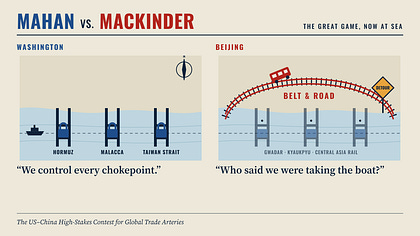
Exploring the tension in the first great power rivalry since the end of the Cold War
In May, the US Dept of the Navy released its “Fiscal Year 2027 Shipbuilding Plan, outlining the Administration’s long-term strategy to expand fleet capacity, strengthen the maritime industrial base, and deliver a more capable, ready, and lethal naval force.” The goal is to expand the fleet from 291 to 450 vessels by 2031 through a $65.8 billion investment in shipbuilding.
This plan provides the backbone and muscle in the evolving US maritime chokepoint strategy that is aimed at countering communist Chinese moves to control or disrupt various chokepoints around the world.
THE THEORETICAL FOUNDATION FOR US CHOKEPOINT STRATEGY
Since World War II, US maritime chokepoint strategy has been to secure freedom of navigation and maintain assured access through critical global sea lanes and narrow waterways—such as the Strait of Hormuz, Malacca Strait, and others—to protect US and allied economic prosperity, supply chain resilience, and military mobility while deterring adversaries, with a particular focus on countering China’s moves to control or disrupt these chokepoints as leverage in great-power competition.
The intellectual godfather of this strategy is Alfred Thayer Mahan (1840–1914), an American naval officer and historian whose 1890 masterwork The Influence of Sea Power upon History became one of the most consequential strategic texts ever written. Mahan argued that national greatness derived not from land power but from control of the seas — and that control of the seas was achieved not by defending coastlines but by dominating the narrow passages through which all commerce and naval forces must flow.
Mahan’s believed that commerce is the lifeblood of modern states, and whoever can interrupt or protect the flow of trade controls the fate of nations. He further believed that naval superiority is the key instrument, and that a dominant battle fleet, concentrated rather than dispersed, can project power globally. Most importantly, he believed that chokepoints are the lever, in which a relatively small force positioned at a narrow strait or canal can hold at risk the entire commerce and military logistics of an adversary.
THE US CHOKEPOINT STRATEGY
The Trump administration’s strategic posture, as expressed in the 2025 US National Defense Strategy, is grounded in great power competition with China as the “pacing threat.” The chokepoint logic runs through it even if not always explicitly named. Key elements:
Maintaining forward bases near critical chokepoints. The US has military infrastructure in Japan (covering the East China Sea and Taiwan Strait), Guam, the Philippines (renewed EDCA access), Singapore, Diego Garcia (Indian Ocean), Bahrain (Hormuz), Djibouti (Bab-el-Mandeb), and Rota/Naples (Mediterranean).
The Taiwan Strait as the decisive theater. The Trump administration has treated Taiwan as the linchpin. A Chinese takeover of Taiwan would give China control of the First Island Chain, threatening Japanese SLOCs (sea lines of communication) and giving Chinese submarines less-contested access to the Pacific. The AUKUS agreement (Australia-UK-US submarines) is explicitly oriented toward this.
The Quad and Indo-Pacific alignment. The Quadrilateral Security Dialogue (US, Australia, India, Japan) is partly about sharing chokepoint surveillance and denial. India, which sits astride the northern Indian Ocean, can monitor Malacca traffic from the west; Japan and Australia cover the eastern approaches. US Secretary of War Pete Hegseth’s announcement of the Major Defense Cooperation Partnership (MDCP) with Indonesia on 13 April was targeted on the Strait of Malacca, through which ~80–85% of China’s oil imports transit. This is China’s greatest vulnerability — its strategic nightmare is the US closing or threatening Malacca in a conflict.
Tariff pressure as chokepoint leverage. The Trump 2025 tariff regime, while economically controversial, has a strategic chokepoint dimension: Chinese manufacturing depends on global supply chains that transit maritime chokepoints. Economic coercion and maritime coercion are two sides of the same coin in this framework.
Denial of Chinese port access globally. Scrutiny of Chinese investments in ports from Hamburg to Piraeus to Sri Lanka is driven by awareness that commercial port access is how a future Chinese navy would sustain forward presence near the world’s chokepoints.
Execution of the US chokepoint strategy involves a robust interdiction capability: the ability to threaten or physically close a strait to enemy shipping and warships, typically through naval forces, submarines, mines, and land-based missiles. This boils down to choke-and-envelop: the full Mahanian logic is not just to hold one chokepoint, but to create a global network of overlapping chokepoint control so that an adversary has no viable maritime escape route. The US alliance network is explicitly designed this way.
A KEY ELEMENT OF CHINA’S STRATEGY
Sir Halford Mackinder (1861–1947) developed the “Heartland Theory“ in 1904, which argued the opposite: that control of the Eurasian interior — the “World Island” — was the ultimate strategic prize. Mackinder’s famous dictum: “Who rules East Europe commands the Heartland; who rules the Heartland commands the World Island; who rules the World Island commands the world.”
Mackinder believed that the Heartland is the geographical pivot of world power. The vast interior of Eurasia — drained by rivers flowing to frozen or landlocked seas, and therefore unreachable by any navy — is the one zone a power can hold without fear of the maritime world’s decisive weapon. He also believed that the supreme danger is a single power unifying the Heartland. Any state that consolidates the pivot area will command resources so vast and a position so defensible that no maritime coalition can indefinitely contain it.
Enter China. China’s Belt and Road Initiative, viewed through Mackinder’s lens, is exactly what a Heartland-adjacent power would do: build overland infrastructure to reduce dependence on the maritime chokepoints that the outer crescent (the United States, beyond the Eurasia landmass) controls.
CHINA’S COUNTER-STRATEGY
China’s leadership, acutely aware of the Malacca Dilemma, has pursued a fundamentally Mackinderian strategy to reduce dependence on sea lanes the US can threaten. The Belt and Road Initiative (BRI) is best understood as a chokepoint-bypass strategy dressed in the language of economic development.
The core logic: If US naval forces could close the Strait of Malacca in a conflict (or simply threaten to), China would be cut off from Middle Eastern oil and European markets. BRI creates overland alternatives:
China-Pakistan Economic Corridor (CPEC) — A road/rail/pipeline from Kashgar in Xinjiang to the port of Gwadar on the Arabian Sea, bypassing Malacca entirely and giving China direct Indian Ocean access through Pakistani territory.
Central Asian corridors — Rail links through Kazakhstan, Uzbekistan, and Iran connect Chinese manufacturing to European markets without touching the sea at all. The China-Europe freight rail network (through Russia and Kazakhstan) has grown substantially.
The “String of Pearls” — China’s acquisition of port access and investments in Myanmar (Kyaukpyu), Sri Lanka (Hambantota), Pakistan (Gwadar), Djibouti (first overseas military base), and potentially others creates a network of littoral presence points along the Indian Ocean rim.
Arctic route — China has designated itself a “near-Arctic state” and is investing in the Northern Sea Route through the Russian Arctic, which would connect Chinese ports to European markets entirely outside US-dominated sea lanes.
China is not purely a land power, however. Its naval buildup is the fastest in history — the PLAN (People’s Liberation Army Navy) now fields more hulls than the US Navy by number, though not by tonnage or capability. China is developing carrier strike groups, overseas basing, and long-range anti-ship ballistic missiles designed to push US carrier groups away from the First Island Chain. This is a sophisticated dual strategy: build land-based bypass routes for economic resilience while simultaneously developing naval power to contest the chokepoints the US currently dominates.
China’s strategy is explicitly designed to counter the US strategy and create a world in which:
- Its economic arteries flow through land routes the US cannot interdict;
- Its growing naval power makes US chokepoint control in the Western Pacific increasingly costly;
- Its economic relationships give it political leverage over the states (Egypt, Turkey, Singapore, Panama) that sit astride critical chokepoints.
CONCLUDING THOUGHTS
The US-China competition is the first great power rivalry since the Cold War in which the challenger has a coherent dual strategy: a Mackinderian land bypass (Belt and Road) to reduce vulnerability to the sea power dominance the US has built, paired with a rapidly growing naval capability designed to eventually contest the chokepoints themselves.
The Trump administration’s interest in Greenland (GIUK Gap), hostility toward Chinese port access in Panama, pressure on the Philippines to host more US forces, the MDCP with Indonesia, and renewed focus on Taiwan reflects a coherent if sometimes chaotically expressed awareness that America’s strategic inheritance — the Mahanian network of chokepoint control — is under pressure for the first time since World War II.
Whether the US response is sufficient, and whether the alliance relationships that make the network function can be sustained alongside the tariff conflicts that strain those same relationships, is the central strategic tension of the present era. The new US Navy shipbuilding plan is a great start.
The end.
StuinSD is a reader-supported publication. To receive new posts and support his work, consider becoming a free or paid subscriber.
This article originally appeared in Stu Cvrk’s Substack. Reprinted here with permission
If you enjoyed this article, then please REPOST or SHARE with others; encourage them to follow AFNN. If you’d like to become a citizen contributor for AFNN, contact us at managingeditor@afnn.us Help keep us ad-free by donating here.
Substack: American Free News Network Substack
Truth Social: @AFNN_USA
Facebook: https://m.facebook.com/afnnusa
Telegram: https://t.me/joinchat/2_-GAzcXmIRjODNh
Twitter: https://twitter.com/AfnnUsa
GETTR: https://gettr.com/user/AFNN_USA
CloutHub: @AFNN_USA