
In the aftermath of the assassination of Charlie Kirk, the majority of voices on the right – perhaps after some visceral expressions of justifiable anger – recognize we are being played. Our country needs peace to afford President Donald J. Trump the highest chance of success. Since he was robbed of his first term in office through endless attacks, we owe him that much. We owe ourselves that much. Nobody wins if everyone’s dead. Besides, who you think is the enemy is only a pawn of the real enemy. How we handle this battle could determine the war. Let me show you what I mean. Let’s watch “The Silence of the Lambs” together.
Everything you need to understand a movie’s subtext is provided. The color palette, the camera angles, the props – nothing is wasted in adding detail to the story. On first viewing, our emotions are caught up in the storytelling, so we miss things, a lot of things. I’ll assume you’ve seen movie at least once, so there won’t be any spoiler alerts.
We first see FBI Academy trainee Clarice Starling running an obstacle course through foggy woods outside Quantico, Virginia – alone. She’s a trailblazer in this man’s world, driven enough to wake up early to run the course on her own. Despite not being one of the boys (“outside Quantico”) and kept if not completely in the dark, certainly in the fog, she displays poise and grace throughout her professional interactions, never taking on a victim mentality. Maybe that’s why she lands the mentor of all mentors, Jack Crawford, head of the Behavioral Science Services, which is based on real-life criminal profiler, John E. Douglas who started the FBI’s Behavioral Science Unit.
Crawford sets her up to interview Hannibal “The Cannibal” Lecter, a serial killer who holds a doctorate in forensic psychiatry. Thomas Harris’ four-novel Hannibal series is well worth the read, but we’re focusing on the movie. And what do we see when we first approach Hannibal through Clarice’s eyes? Why, yes, a man standing at attention. Not the written character, his creator, or his creator’s father ever served in the U.S. Armed Forces, but the implication that the movie version of Hannibal had military association is unmistakable.
Clarice takes a seat and we see behind her a radiator and a stone wall. She’s capable of warmth or was, but the indistinguishable color palette suggests that she’s backed against a wall. Her career is all she has. Indeed, we see this when she uses her charms to disarm Dr. Frederick Chilton, the research psychologist at the facility where Lecter is housed, and with one of the entomologists she visits for information on moths. The most glaring example is when she joins her boss in presenting Lecter with a fake offer of relocation. In other words, she’s ambitious enough to compromise her integrity with lying.
Midway through the movie, in the course of their discussion about the Buffalo Bill case, Lecter tells Clarice that “our Billy” wants to change. Clarice counters that all the literature suggests that transsexuals are passive and not violent. Lecter explains that Bill is not a true transsexual, and that she should look for systematic childhood abuse involving violence. Pause the movie.
In other words, if we ever hope to defuse this societal powder keg we sit atop in America, we must look in the mirror. Hannibal using “our” in reference to the murderer is intentional. Criminals and careerists, men and women, create the monster and then seek to disassociate from our own complicity.
What a man will never tell a woman is that this man’s world is a terrifyingly ugly place, especially within male-dominated professions like the military or law enforcement. Systemic, multigenerational childhood sexual abuse presents the worst-case scenario for a boy. But even a mother who through ignorance or lack of emotional intelligence simply cannot allow her 2 ½-year-old toddler to disengage from her long enough to establish a bond with his father, contributes to an increased risk of same-sex attraction. The boy gravitates to the safety of females and never asserts his male identity or takes his place in the male world. Harsh fathers are equally damaging to a boy’s psyche. Between these two early childhood environments exist an infinite set of circumstances that can improve or worsen the boy’s sexual development.
If a young man somehow escapes sexual trauma growing up, he’s going to need to be cognizant of the ever-present dangers in this world to force him into the male-on-male power structure. Male sports teams, the military, male-dominated professions are all bastions of a system whereby acceptance and advancement are created by sexual bonds and favors created through prostate-stimulating sex. The rape itself it traumatic, but the Grafenberg-spot-like, full-body orgasm can hook a man into lifelong, and often unwated, same-sex encounters. The pleasure, self-blame, and shame ensure his silence.
The man might even marry and have children, but on the side have a “best friend” with whom he continues with male-on-male encounters. At the opposite extreme, he may never marry or limit his partners, opting for a promiscuous lifestyle or sex work, picking up where his abusers left off and abusing others in turn. He can’t confide to a woman what he’s been through because he’s afraid she’ll see him as less than a man or as a monster. We won’t even address the ongoing torture, but it ensures the evil remails invisible and silent.
And here is where women, Christian women especially, need to examine their hearts. No woman can be present for a man if she cannot look at her own level of sinning, and not just sexual sin. It could be her lack of warmth, nagging, or ridicule if her man expresses vulnerability. Whether she’s embarrassed that he’s sharing shameful experiences or shuts out all earnest expressions of emotion, she’ll never know her spouse. The Bible uses the verb “to know” regarding male-female intimacy. This knowing is where the real bond is forged between male and female. She may be incapable of addressing and healing her own traumatic childhood or early adulthood. In the deepest cut of all, she may refuse to believe that the horrors her man endured actually happened or that such an evil world actually exists. So the silence of the men continues, slaughtered by a heartless, soulless, and insatiably depraved system that requires increasingly debased actions to function.
The basement scene in “The Silence of the Lambs” is an allegory of a woman in the dark making her way through the compartments of a man’s mind, a man who according to the world is beyond redemption. (Disassociation is a blessed design of the brain, used to protect the person suffering trauma at the hands of trusted and loved people. In the movie, the plot amounts to a criminal who has run away. Clarice must pursue or he’ll hurt more people. She’s terrified, but faces her fears to be able to stop him. But in real life, God has a better way, a far more just way.
We need mothers who nurture their children without smothering them. They do this by establishing healthy relationships with their husbands. Her husband is her confidant and comforter, not her son. We need women who admit their vulnerabilities when they’d rather fight or hide, which creates an environment of healing for men who’ve been living all alone in private hells for far too long. She must be able to hear the ugliness of a man’s story and correlate it with her own moral failings.
We need men capable of exposing themselves to even more rejection for the sake of God, country, and personal healing. Family needs to take precedence. Motherhood needs to be celebrated and women need to be welcomed into the realm of men in proportion to their abilities and talents. If they want to stay home, they must be afforded that ability for the sake of their role as live-giver, homemaker, and perhaps home-schooler. Men with spines, the fruit of self-control, who can say no to sinning are the heroes in this spiritual war. We’re not talking about men who don’t want help; we’re talking about those who know they need it.

When Jame Gumb reaches out to touch Clarice’s hair and then does so again to touch her face, what was your first reaction? Fear for her? That he coveted her hair, her beauty for himself? What if he longed from the depths of his being to tell her what had happened to him as a child, but he assumes she could never even hear it, never mind accept him after hearing it. So he withdraws his hand and cocks his hammer. He’s a veteran of an elite class. He knows she’ll hear it. He never fires. Suicide by FBI recruit is representative of all the lives already lost, the living dead, and those teetering on the edge of transgender disillusionment.
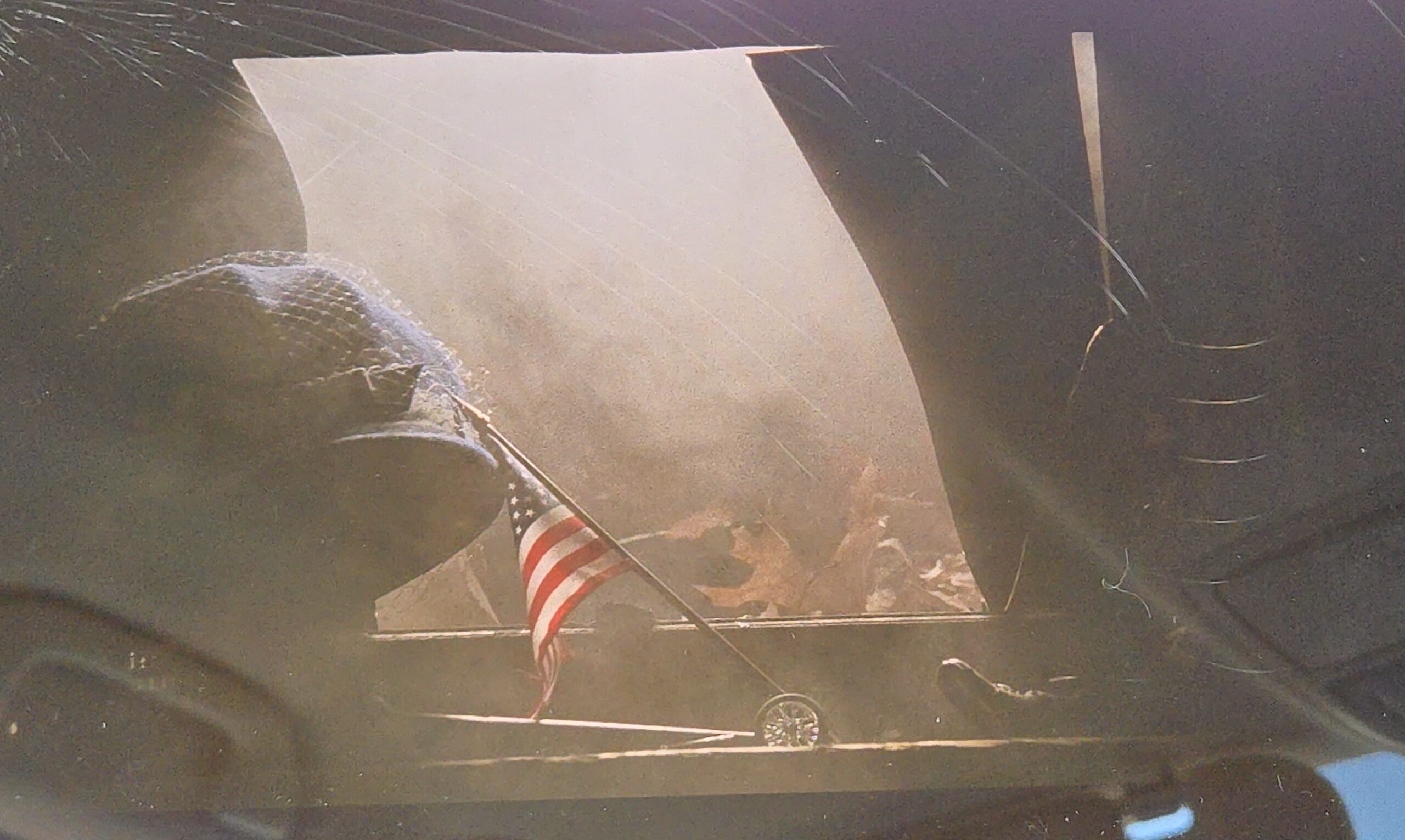
Clarice empties her firearm into Gumb and the shoot-through effect breaks the window behind him. In streams the sunlight. What do we see? Well, a Vietnam era helmet and an American flag for one. A tripod (try pod) beside Gumb’s lifeless body, suggesting two things. The first is filming: All these evil acts are filmed. It ensures silence. It ensures a steady stream of money from people who would be destroyed career-wise, financially, and family-wise if the film were released. The second is experimentation, and believe you me, the history of experimentation on soldiers (and prisoners) is long and shocking. And, in a box off to the right, a furry pink tail. This movie was released in 1991. Furries and therians are not a new phenomenon. In addition to anthropomorphism and identifying as an animal, costumes are often used in childhood sexual abuse to protect the identity of the abuser or to further terrify the victim.
There’s more. When Clarice is making her way through the maze of rooms in the cellar, there are collections of polaroids on the walls. She’s too scared and otherwise occupied trying to find Gumb to study them, but we have time. On the door to one room we see a map of the country. In other words, behind closed doors even in Middle America… In addition to the half-finished suit of women’s skins, we see mannequins attired in various forms of attention-grabbing outfits. On the wall are three photographs.
In the first we see a young, awkward Gumb wearing a baseball cap sitting with a stripper standing beside him. The woman is literally holding a star over her lower privates, as if the medal is earned through immoral acts. In the next, he’s wearing a green jacket and a gold shirt, the colors of the Green Berets, flashing three fingers. Some military unit numbers are signaled like gang signs. In the third image, he’s standing behind the woman, with both hands on her behind. Sexual sin is progressive, from thought, to seeing, to doing, and the thoughts only get increasingly depraved. If you seek an exit, evil forces with pressure play you into the next degree of perversion.
In another room in another group of polaroids, we see Gumb standing shoulder to shoulder with a stripper holding out his shirt with both hands as if he too had breasts. We see a picture in which the woman might now be Gumb, but we’re not sure. Finally, in another room, in a single shot, a woman stands behind a young and awkward man who may be wearing a sailor’s uniform. The woman is clearly Gumb. The implication is that Gumb, now transexual, is creating more and more men like him through male-on-male prostate-stimulating anal, combined with torture . Whether the man is homosexual or not, chances are high he’ll be hooked by the sensation. It’ll take a herculean effort to extract himself from the outward pleasure but body- and soul-crushing effects of the lifestyle. But it can and has been done, not by iron will, but by allowing God to do what man cannot.
A word about the pair of Freds in the movie. The excitement of Clarice figuring out that Buffalo Bill is making a suit out of the women’s skins and calling Crawford to tell him is so powerful that it overwhelms the societal message encoded in the search of Frederica Bimmel’s bedroom. We see ivy, in the vine, wallpaper on one wall and that she has a view of the coop where her father raises doves, symbols of God’s peace and the Holy Spirit. The subliminal messaging is clear: She was good, there was a godliness in this family, or at least a blessed peacefulness. But, there’s also the indication that Frederica felt cooped up.
The panning of her room tells an almost invisible but sad story. There’s the calorie-counting book. She was falling into the world’s definition of beauty; she wanted to be thin. A picture of Frederica holding a cat, holding a cat, with her friend beside her reveals an undercurrent of romantic if not sexual awakening and longing in Frederica. If it wasn’t already clear, there’s a romance novel on the credenza.
Then we see wallpaper depicting Colonial homes and a dollhouse with a popsicle-stick outbuilding, echoing the coop. Pictures of her dad, her mom holding her, and her as a child are propped up along the length of another credenza. Saddest of all, of course, are the half-naked pictures of her that we come to assume Buffalo Bill took. Her expressions are that of embarrassment. Because she was heavy? Or because she was doing something beyond her moral edge? Or because of the repeated emphasis of her backside. It’s a subtle piece of visual storytelling that reiterates the need for both parents to be actively involved in a young girl’s life, helping her value her character, her walk in life, her body.
The most intriguing pictures are of her and her father, and in the era of instamatics and polaroids, one must assume that the mother took the photos. In the first two, the father is holding a dove and Frederica is petting it. In the third, she’s pointing to the sky where the released dove is presumably flying. In the fourth and final shot, she is looking directly at her father and smiling lovingly. You can look at it as a healthy father-daughter relationship with the peace of God between them, but when they let go of the dove, does their relationship become spousified, perhaps because the mother is absent to her husband emotionally or physically?
Then we have Frederick Chilton, arrogant and vindictive, representing the worst of the psychological profession. Rarely are two characters in a movie named similarly. It’s confusing for an audience who has limited time to learn who’s who. Are they opposite sides of the same coin? A woman who is blind to the evils of the world, craving romance, to be loved, a home, and family, and a man who is so consumed by his career, so mired in the reality of the male-on-male rape culture that he’s become excessively driven and cruel? Chilton tries to hit on Clarice, but she too is career-focused and spurns him. He is representative of men who are often rejected for lack of looks or flawed personalities who become mean and vindictive as a result.
To be fair, the entomologist who hits on Clarice is also rejected, but in a much kinder manner, one could make the assumption that it’s because he’s younger and still retains a boyish innocence and honesty. Clarice is lesbian, and I’m not referring to Jodie Foster. Her biggest fan is her classmate Ardelia (our deal-ia), and they work on the case together on a bed, which is Hollywood speak for a same-sex relationship.
This is repeatedly confirmed by Clarice’s interaction with large gangs of men outside of training scenarios. We see her get into an elevator of guys all wearing red shirts, and she turns her back to them. We can read that as she was anally abused at some point in her life and/or she’s turned her back on men, period. Most likely both scenarios are true.
This could make her an understanding listener and willing sharer to a man who has been likewise abused, but she’s incapable. Paramount to the man’s ability to establish an exclusive relationship with one woman is the knowing of another person and allowing that other person to know him. We do see Clarice being open and frank with Lecter, but we also see her consumed and happiest advancing in her career at the cost of relationships that could produce a family.
The undercurrent with Crawford is clear. He’s meticulous in appearance, fastidious in dress, suggestive of same-sex attraction, and a leader in an abusive male-dominated profession. He keeps a pillow and bedding on his office couch, out in the open. We can safely assume some literal and figurative undressing between Crawford and Starling, or at the minimum a spousification. When called to Croawford’s office, note the removal of his jacket, the arms behind his head as he talks to Clarice. As seen in the plane, they work well together. As seen in the car, he is literally laidback with her, comfortable enough to take guidance from her on a perception matter. After killing Gumb, Crawford is present and physically protective of Clarice. But sticking around for her graduation celebration is too socially acceptable for him, so he ducks out.

We have to study the closing credits carefully. As Lecter blends into the crowd, following Dr. Chilton and the orderly, we see what society looks like in his wake. There is a heavyset woman, alone, holding a young boy’s hand, indicating a boy raised without a father with a higher likelihood of struggling with same-sex attraction. There is an expecting couple making its way across the flow of traffic, but there are at least two male couples, one of which gives the other a high-five, as if to say: mission accomplished, men and women incapable of bonding, having families, carrying out God’s main directive to be fruitful and multiplying, thus continuing humanity.

When Lecter kills the two police officers guarding him in the courthouse, he grabs Pembry’s face with two hands and if you freeze the frame it looks like two men about to kiss before Hannibal bites into his face. I don’t think it’s making too large a leap to suggest that this level of depravity begins at the rape of a child, or even an infant, who, without divine intervention, grows into the monster.
This is why you rarely see persecution. Offenders were raped as children themselves. Where was there justice. Victims may not want to send a loved one to jail. They might not want to be identified. Families can be destroyed, businesses ruined, military units dishonored, police departments compromised. There is only one way out of the cycle of abuse for these men and our society as a whole.
Clarice ran away from her uncle’s ranch in Montana because she was awoken one morning by screaming, “like a child’s voice.” A career in the venerable FBI won’t stop the sound of the screaming of the lambs being slaughtered – “like a child’s voice.” The screaming lambs are our children, some of whom are now grown and committing crimes in turn. They are not true transsexuals; they have been made so by years of systematic and ritualized sexual abuse. They hate their own identity, so they try to be something else, the opposite sex, an animal, a god. But there is only one God.
Only Jesus can stop the screaming. We only have to ask for God’s forgiveness and receive it. We must be God-grounded enough to forgive those who have trespassed against us. And, if capable, we need to listen to the stories of our fellow brothers and sisters. We cannot accept a continuation of evil-doing. But we can listen with the heart of Jesus. Maybe then the Lamb of God will stop screaming at the injustice of it all, too.
If you enjoyed this article, then please REPOST or SHARE with others; encourage them to follow AFNN. If you’d like to become a citizen contributor for AFNN, contact us at managingeditor@afnn.us Help keep us ad-free by donating here.
Substack: American Free News Network Substack
Truth Social: @AFNN_USA
Facebook: https://m.facebook.com/afnnusa
Telegram: https://t.me/joinchat/2_-GAzcXmIRjODNh
Twitter: https://twitter.com/AfnnUsa
GETTR: https://gettr.com/user/AFNN_USA
CloutHub: @AFNN_USA