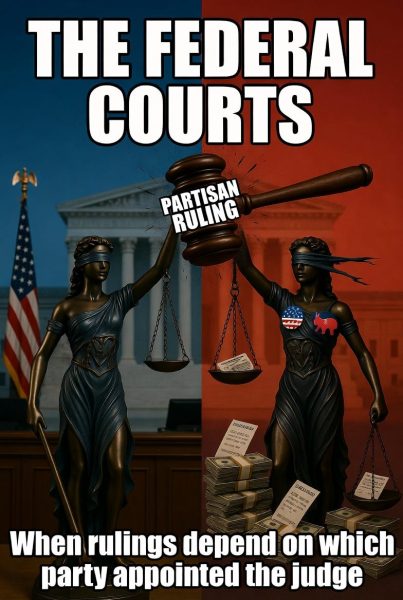
A traditionalist constitutional conservative analysis
“The accumulation of all powers, legislative, executive, and judiciary, in the same hands, whether of one, a few, or many … may justly be pronounced the very definition of tyranny.” — James Madison, Federalist No. 47
Many rank-and-file Republicans and political commentators have expressed shock at the unprecedented lawfare being employed by the Democrat Party and its political allies against President Trump during his second term. Over 700 lawsuits have been filed against the Trump administration, and the number of executive orders impeded/blocked by Democrat/leftwing activist judges currently exceeds 200 (full and partial).
This is Part I of a two-part series that examines the politicization of the federal judiciary by the Democrat left and the crisis it presents for our constitutional republic.
A CONSTITUTIONAL CRISIS UNLIKE ANY BEFORE
When President Donald Trump returned to office in January 2025 carrying one of the most decisive electoral mandates in modern American history — winning the popular vote, the Electoral College, and commanding congressional majorities — the American people had spoken with clarity. They voted for border security, executive accountability, bureaucratic reform, and a rollback of the radical progressive agenda that had reshaped federal policy during the Biden years.
What greeted that mandate was not the loyal opposition of a democratic republic but something increasingly difficult to characterize as anything other than a judicial insurrection: a coordinated, systematic campaign by Democrat-appointed federal judges to nullify the results of a free election through the mechanisms of the courtroom. The scale, speed, audacity, and ideological uniformity of the resistance was — and remains — without precedent in American constitutional history.
This analysis examines that resistance from a traditionalist constitutional conservative perspective: one grounded in the original understanding of the separation of powers, the proper role of Article III courts, the democratic legitimacy of the executive branch, and the republican principle that elections must mean something.
JUDICIAL OBSTRUCTION IN PERSPECTIVE
To appreciate how extraordinary the second Trump term’s judicial landscape truly is, one must situate it historically.
The use of federal courts to obstruct executive policy is not new. FDR faced a hostile Supreme Court that struck down key New Deal legislation in the 1930s, prompting his infamous court-packing scheme. President Nixon’s impoundment of congressionally-appropriated funds was eventually blocked by courts. Reagan’s executive orders were challenged. Clinton’s welfare reform was litigated. Even Obama faced significant judicial resistance to his executive actions on immigration (DAPA) and healthcare.
What is new — categorically, qualitatively, and constitutionally unprecedented — is the sheer volume, ideological concentration, geographic coordination, and procedural aggression of the judicial resistance to Trump’s second term. Several features distinguish this moment from anything in prior American history:
Volume: Within the first months of the second Trump administration, Democrat-appointed district court judges issued more nationwide injunctions blocking executive actions than were issued against any prior president in a comparable period. Of the 40 nationwide injunctions filed against President Trump’s executive actions in his second term, 35 of them came from just five far-left jurisdictions: California, Maryland, Massachusetts, Washington, and the District of Columbia. This geographic concentration is itself evidence of deliberate forum shopping rather than organic legal objection.
Scope: Prior judicial resistance generally targeted discrete actions. The current wave of judicial blockades has targeted the entirety of the executive agenda — immigration enforcement, agency reorganization, foreign policy, public health policy, military policy, education, and fiscal authority. Courts have barred agency restructuring, frozen reductions in force, ordered mass rehires across the federal government, blocked deportations of illegal aliens, ordered the return of deported foreign terrorist suspects, forced the continuation of DEI programs, preserved federal funding for radical child gender surgeries, compelled the U.S. to continue disbursing billions in foreign aid, and blocked executive orders on birthright citizenship.
Coordination: The lawsuits, in dozens of cases, have been initiated by the same network of left-wing NGOs, ACLU affiliates, and activist legal organizations, filed in strategically chosen jurisdictions, on coordinated timelines — suggesting a level of orchestration that transcends ordinary legal advocacy. As the Article III Foundation’s judicial sabotage tracker documents, this is not spontaneous public-interest litigation. This is a compilation of coordinated legal resistance that went from election interference — where these radicals were trying to bankrupt and jail President Trump — to stifling the Trump agenda as a whole post-election.
Speed: In prior administrations, even controversial executive actions enjoyed months or years of implementation before legal challenges progressed. In Trump’s second term, injunctions have arrived within hours of executive order signings — suggesting pre-drafted legal briefs awaiting only a presidential signature before being filed.
THE CONSTITUTIONAL DIMENSION
The Constitution is precise in its allocation of powers. Article II vests the “executive Power” in the President of the United States — not in a committee of district court judges, not in the ACLU, and not in the New York Times editorial board. The Commander-in-Chief clause, the Take Care clause, the appointments power, and the pardon power all flow from this vesting. The Founders understood executive unity and accountability as essential features, not defects, of the constitutional design.
Article III courts exist to adjudicate cases and controversies — to resolve legal disputes between parties with concrete, particularized injuries. They do not exist to set national policy, supervise the executive branch, or override presidential elections through injunction.
What Democrat-appointed judges have been doing since January 2025 is something the Founders could scarcely have imagined: the conversion of the district court into a shadow executive — a parallel government operating through temporary restraining orders and preliminary injunctions, staffed by life-tenured officials answerable to no electorate and removable by no democratic mechanism.
The Supreme Court, in its landmark June 27, 2025 ruling in Trump v. CASA, Inc., finally confronted this problem directly. Writing for the 6-3 majority, Justice Amy Coney Barrett concluded that “universal injunctions likely exceed the equitable authority that Congress has given to federal courts” and that “nothing like a universal injunction was available at the founding, or for that matter, for more than a century thereafter.”
Senator John Kennedy captured the essence of the problem in plain terms: “Anybody who knows a law book from an L.L. Bean catalog knows that federal judges just made up this concept of universal injunctions … They just made it up because they don’t agree with what a President or Congress has done.”
The White House Counsel was equally direct upon the Supreme Court’s ruling: “Today’s decision restores the proper separation of powers between the branches of government. Ending nationwide injunctions is a tremendous victory for the American people and the rule of law.”
The constitutional problem, however, runs deeper than the nationwide injunction. Even after CASA, individual plaintiffs and class actions continue to generate judicial obstruction. The underlying abuse — activist judges substituting their policy preferences for the constitutional authority of the executive — persists in modified form. The tool has changed; the intent has not.
CASE STUDIES IN JUDICIAL OVERREACH
Below are just a few examples of leftwing activist judge actions over the past 16 months.
A. Judge James Boasberg and the Alien Enemies Act Contempt Trap
Few episodes better illustrate the aggressive, results-driven nature of judicial resistance than the conduct of Judge James Boasberg, Obama appointee and Chief Judge of the U.S. District Court for the District of Columbia.
When President Trump invoked the Alien Enemies Act of 1798 to deport Venezuelan gang members affiliated with Tren de Aragua — a designated foreign terrorist organization — Boasberg issued an oral order purporting to stop flights that were already in international airspace. When the administration interpreted the scope of that order narrowly, Boasberg launched an aggressive contempt investigation, threatening criminal prosecution of executive branch officials for complying with a presidential order of unquestionable statutory basis.
For more than a year, Boasberg claimed Trump officials willfully ignored his “oral order” to return two planes carrying more than 100 illegal Venezuelans subject to the Alien Enemies Act. The Supreme Court had already overturned his initial temporary restraining order. Appellate Judge Neomi Rao, a Trump appointee, stated plainly: “This case is highly unusual, and I have found no other like it, perhaps because no district court has threatened criminal contempt against Executive Branch officials as a backdoor to coercing compliance with an order that has been vacated by the Supreme Court.”
Boasberg’s conduct was rebuked not once but twice by the D.C. Circuit Court of Appeals through the extraordinary remedy of writs of mandamus. The D.C. appellate court issued its second writ of mandamus to shut down the contempt investigation that Boasberg had opened in March 2025 — a 2-1 decision — after the Trump DOJ won back-to-back writs of mandamus in less than a year against arguably the most powerful district court judge in the nation. Even after the first writ vacated his contempt findings, Boasberg reopened the proceedings and targeted former DHS Secretary Kristi Noem.
This is not the conduct of a judge applying neutral legal principles. It is the conduct of a political adversary wearing judicial robes.
B. Judge Brian Murphy and the Vaccine Schedule Takeover
In March 2026, Biden-appointed Judge Brian Murphy issued a preliminary injunction effectively preventing HHS Secretary Robert F. Kennedy Jr. from modifying the childhood vaccine schedule or appointing new members to the federal vaccine advisory committee. Murphy took a breathtakingly aggressive stance on his powers as a federal judge. The injunction effectively takes the position that Murphy — a random federal judge — has the right to set American vaccine policy, while the executive branch does not.
Murphy acknowledged that “agencies generally have much discretion in assembling advisory committees” but found that several new committee members lacked the necessary “expertise” to serve — including Retsef Levi, a mathematician at the Massachusetts Institute of Technology who has extensively examined and written about the epidemiology of mRNA vaccines. Murphy stayed the appointments of all new members, including those he acknowledged possessed the necessary expertise.
It is not even clear how the plaintiffs — the American Academy of Pediatrics and a handful of physician groups — had standing to sue, that is, how they could say these changes harmed them directly. Standing doctrine exists precisely to prevent ideologically motivated organizations from using the federal courts as a policy lever. In the new judicial environment, standing has become a formality to be dispensed with when the political stakes are high enough.
C. Obama-Appointed Judge Blocks Immigration Court Reform
An Obama-appointed judge blocked key portions of the Trump administration’s policy to restrict the appeal process for illegal immigrants facing deportation. Immigration courts are creatures of the executive branch — they exist within the Department of Justice. The notion that a federal district court can dictate the internal appellate procedures of a separate executive branch tribunal inverts every principle of interbranch comity and constitutional structure.
D. The Forum Shopping Ecosystem
The ideological concentration of injunctions in five jurisdictions is not accidental. Activist legal organizations deliberately file in districts where they know sympathetic Obama or Biden appointees sit. The ACLU, SPLC-affiliated groups, and the network of progressive legal nonprofits have essentially mapped the federal judiciary for political opportunity, identifying which judges will reliably deliver the results their donors demand.
As the Federalist documented, CNN legal analyst Jeffrey Toobin inadvertently confessed to this dynamic in a New York Times column, admitting that Democrat-appointed judges have become a critical feature of the left’s evolving lawfare against Trump and his voters. When the left’s own commentators acknowledge what is happening, the pretense of neutral legal adjudication collapses.
CONCLUDING THOUGHTS
Part I ends here. Part II will cover Democrat lawfare coordination, the Democrats deployment of foreign judges and the associated cultural disconnect, the issue of democratic (small d) legitimacy, the Sotomayor problem, and remedies for the problem.
The end.
StuinSD is a reader-supported publication. To receive new posts and support his work, consider becoming a free or paid subscriber.
This article originally appeared in Stu Cvrk’s Substack. Reprinted here with permission
If you enjoyed this article, then please REPOST or SHARE with others; encourage them to follow AFNN. If you’d like to become a citizen contributor for AFNN, contact us at managingeditor@afnn.us Help keep us ad-free by donating here.
Substack: American Free News Network Substack
Truth Social: @AFNN_USA
Facebook: https://m.facebook.com/afnnusa
Telegram: https://t.me/joinchat/2_-GAzcXmIRjODNh
Twitter: https://twitter.com/AfnnUsa
GETTR: https://gettr.com/user/AFNN_USA
CloutHub: @AFNN_USA