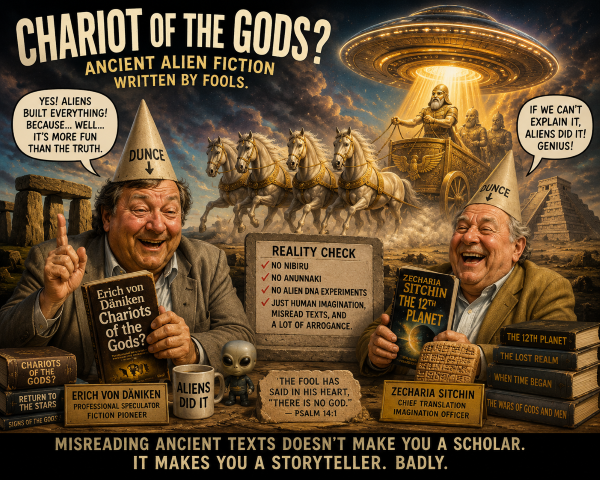
There is something almost comical about modern civilization. We scoff at the Holy Bible as an outdated relic written by shepherds and fishermen, then nod solemnly when television personalities with dramatic hair suggest that extraterrestrials engineered humanity, built the pyramids, and taught our ancestors how to pile rocks into neat geometric shapes. Apparently an all-powerful Creator is beyond belief, but a race of interstellar gold miners with advanced biotechnology and a fetish for stone architecture is perfectly plausible. Progress, apparently, means replacing God with a flying saucer.
The intellectual grandfathers of this movement were Erich von Däniken and Zecharia Sitchin. Von Däniken struck first with Chariots of the Gods?, which argued that ancient monuments, myths, and religious accounts were really evidence of extraterrestrial visitors. His method was elegantly simple: find something impressive, ignore human ingenuity, widen your eyes, and ask, “Could it be aliens?” This rhetorical question became one of the most profitable shoulder shrugs in publishing history.
Sitchin took the story further and wrapped it in a veneer of linguistic authority. In The 12th Planet, he claimed that ancient Sumerian texts described a hidden planet called Nibiru and a race of beings known as the Anunnaki who came to Earth and genetically engineered humans as a slave labor force to mine gold. It was a brilliant narrative—part science fiction, part conspiracy theory, and part theological fan fiction. The only inconvenience was that scholars of Sumerian and Akkadian have repeatedly stated that Sitchin’s translations are not accepted by mainstream scholarship. In less diplomatic language: he made it up, then sold millions of copies.
Biblical scholar Michael Heiser devoted substantial effort to dismantling these claims. Heiser, trained in Hebrew Bible and Semitic languages, showed that Sitchin’s interpretations do not reflect what the ancient texts actually say. The Anunnaki were deities in Mesopotamian mythology, not astronauts commuting from a rogue planet on a 3,600-year orbital schedule. Nibiru, as popularly imagined, is essentially the literary equivalent of a cardboard set painted to look like a planet.
Yet once a compelling story escapes into popular culture, facts struggle to catch it. The History Channel discovered that ancient astronaut speculation was ratings gold. Its long-running series Ancient Aliens has turned one speculative question into an industrial process. Monument? Aliens. Cave painting? Aliens. Bronze Age jewelry? Also aliens. At this point, if a Neolithic farmer misplaced his shovel, there is a non-zero chance the narrator will hint at extraterrestrial involvement.
The irony is that the biblical worldview already states that humans are not alone. Book of Genesis introduces a universe created by God, and the rest of Scripture describes a populated spiritual realm of angels, cherubim, and the heavenly host. Book of Job says the “sons of God” rejoiced at creation. The Bible never presents humanity as the only intelligent beings in existence. It simply insists that all such beings are created and subordinate to one sovereign Creator.
This distinction matters. In Scripture, humans are made in the image of God and entrusted with stewardship. In ancient astronaut theory, humans are engineered as a workforce for cosmic resource extraction. One worldview confers inherent dignity and purpose. The other turns mankind into a subcontractor on an interstellar mining project. “Image-bearer of God” is a rather better origin story than “temporary help for the Anunnaki.”
As discussions of Unidentified Anomalous Phenomena continue, many people are predisposed to interpret any ambiguous evidence through the cultural lens created by von Däniken, expanded by Sitchin, and endlessly recycled by television. If something unexplained appears, the reflexive assumption is that our extraterrestrial engineers have returned to check on the livestock. The script was written decades ago; reality is expected to follow along.
But the ancient alien narrative rests on speculation, unsupported translations, and a profitable appetite for mystery. The biblical account, by contrast, has been saying for millennia that reality includes intelligent beings beyond humanity while grounding human worth in the deliberate act of a Creator.
So the real question is not whether aliens built civilization. The real question is why so many educated people are willing to reject the oldest coherent explanation of a populated cosmos in favor of a modern mythology involving rogue planets, gold shortages, and space foremen. We traded theology for science fiction, and then congratulated ourselves for becoming rational. That may be the most astonishing story of all.
If you enjoyed this article, then please REPOST or SHARE with others; encourage them to follow AFNN. If you’d like to become a citizen contributor for AFNN, contact us at managingeditor@afnn.us Help keep us ad-free by donating here.
Substack: American Free News Network Substack
Truth Social: @AFNN_USA
Facebook: https://m.facebook.com/afnnusa
Telegram: https://t.me/joinchat/2_-GAzcXmIRjODNh
Twitter: https://twitter.com/AfnnUsa
GETTR: https://gettr.com/user/AFNN_USA
CloutHub: @AFNN_USA