
In Part 3 we’ll talk about the modifiers which make our American Revolution so unique. Like American Enlightenment, Dissident Protestant, 4 Regional Sub-Cultures, Well-Armed, and Ancestral Rights. Those modifiers were dropped on July 4th 1776, when they all merged to become simply and profoundly “American”.
Again, look our given statement on our American Revolution: In 1775 after a revolutionary season of 12 years, one third of the Enlightenment Era, Dissident Protestant British people across four regional cultures (in 13 separate Colonies) took up arms to keep the Rights their ancestors won in the previous century.
American Enlightenment
The Cultural Marxists celebrate the Enlightenment as separation of church from the public square and many private consciences. Their spin sit well with scholarship. The French Enlightenment was decidedly, but not exclusively, anti-cleric which meant anti-Roman Catholic in France. The British, including the Scottish, and American Enlightenments were quite different. The Deism of Jefferson and Franklin stood out in the overwhelmingly professing Protestant Christianity of our American Enlightenment.
The Scottish influence, the fierce sweeping Reformation which John Knox brought from Jean Calvin to Scotland, can be traced through the professors, like John Witherspoon. Scottish fingerprints are all over the Constitution.
Dissident Protestant
The dissident Protestants – Puritans, Quakers, German sects, Baptists and reformers within the Reformation – Methodists and Presbyterians shared a Biblical Worldview. They were willing to fight against any power (or be martyred if pacificists) for their freedom to practice their religion. They’d proved their mettle.
Additionally, they tried to live their lives according to written words which they read, discussed, and believed. They challenged any human, hierarchical authority attempting to rule them while submitting to their understanding of Biblical authority.
Their understanding of individual rights, responsibilities, and limited government was powerful. At that time, similar concepts were shared only in Calvinist Sweden, Holland, and Boer South Africa.
5 Regional Sub-Cultures
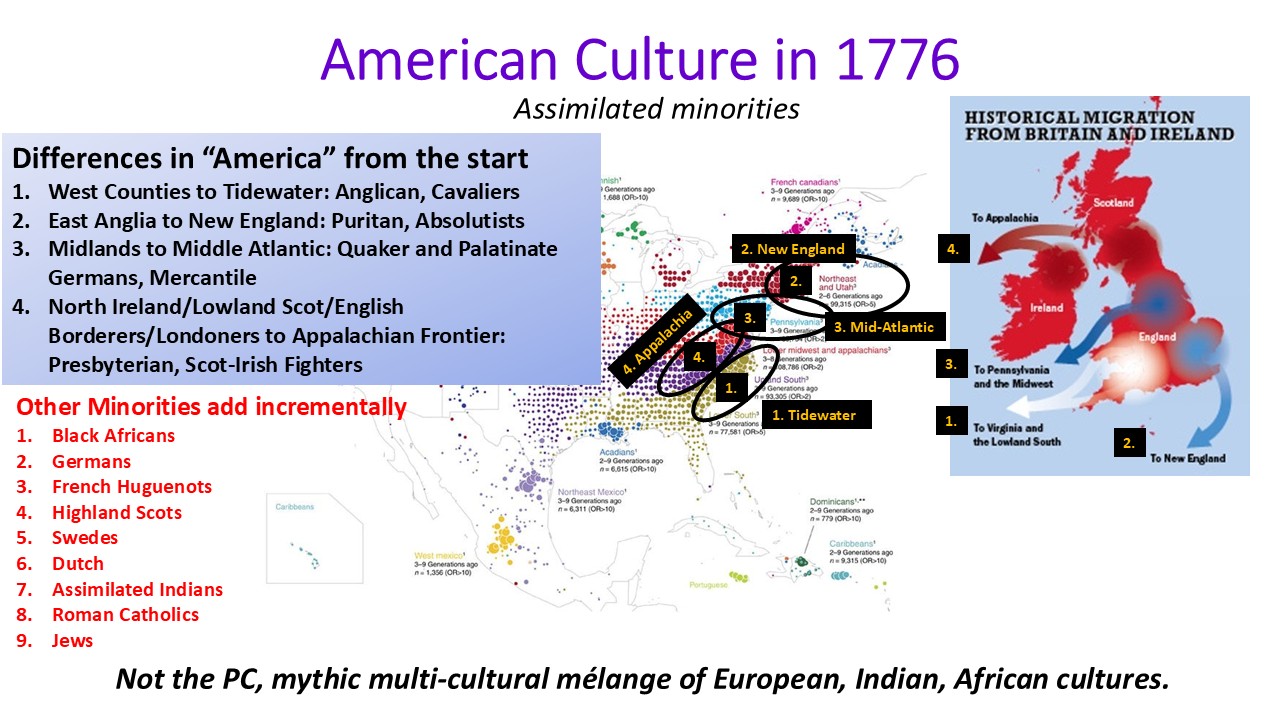
The 13 Colonies were 98.2% Protestant. But they came from regions and religious sects in the UK which had fought one another in the past. They spoke in different accents, had differences in religion, and other key aspects of culture. It mad them unique then and still different by degrees today.
All others were assimilated into the regional sub-cultures. For example after a generation of settlement by the Highland Scots in the sand hills of North Carolina, a visitor was shocked to hear the black African slaves speaking Gaelic. They assimilated which is different from fixed, diversity salad which Cultural Marxists imagine.
Took Up Arms
Every able-bodied, free man up to age 60 or so as each colony legislated was a member of the “militia”. The militia wasn’t like today’s National Guard created in the 20th Century. Every man was needed if the Indians, French, or Spanish were to attack.
The individual weapons kept over the hearth were as good as what the professional soldiers had. The 3 million people living in America were very well-armed and able with weapons of war.
Ancestral Rights
The British made a breakthrough limiting the power of kings, limiting government, with the Magna Carta in1215. In the 1600s the British people removed their Sovereign three times. We Americans weren’t the first in 1776. We were doing what our ancestors had done before.
Parliament became the supreme legal authority. Not the King.
The Rights of Englishmen, like “No taxation without representation”, were written with the blood of Englishmen. Threatening those rights was fighting words.
In Conclusion
The Biblical worldview of the American Revolution is starkly opposing the Secular worldview of the French Revolution. The ideas of the French Revolution are Human Secularist Totalitarianism.
Cancerous Human Secularist Totalitarianism grew the evolved and twisted ideas of Socialism, Communism, National Socialism, Fascism, Progressivism, Environmental Cultism, and Cultural Marxism. They are all totalitarianisms.
Today, Movement Conservatives believe in the Biblical American Revolution Worldview. We hold these ideas as still ascending concepts. They are as fresh, invigorating, inspiring, bold, and worth fighting for today as they were when the shooting started in 1775.
Unlike the Cultural Marxist cartoon of the 1619 Project or Ken Burns’ videos, our American Revolution isn’t over. It’s just begun.
We have two great totalitarian, world dominating ideologies to defeat as soundly as our British rulers were defeated to keep our Revolution alive: Human Secularist Totalitarianism and Islamist Totalitarianism.
It’s worth whatever it takes.
If you enjoyed this article, then please REPOST or SHARE with others; encourage them to follow AFNN. If you’d like to become a citizen contributor for AFNN, contact us at managingeditor@afnn.us Help keep us ad-free by donating here.
Substack: American Free News Network Substack
Truth Social: @AFNN_USA
Facebook: https://m.facebook.com/afnnusa
Telegram: https://t.me/joinchat/2_-GAzcXmIRjODNh
Twitter: https://twitter.com/AfnnUsa
GETTR: https://gettr.com/user/AFNN_USA
CloutHub: @AFNN_USA