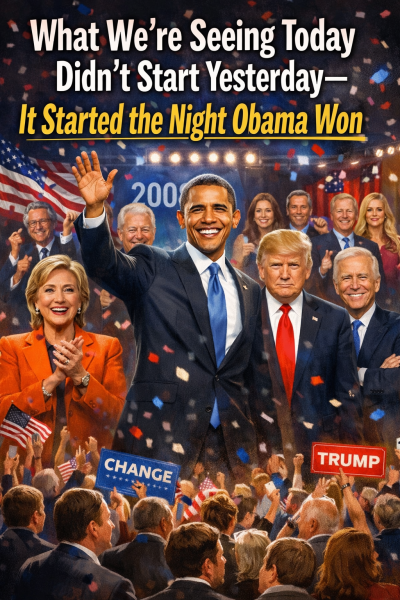
On October 30, 2008, then-Senator Barack Obama told a campaign crowd, “We are five days away from fundamentally transforming the United States of America.” That line wasn’t conspiracy theory fodder. It’s on video, in transcript, and in context. He meant political change, economic change, foreign-policy change, and a different view of America’s role in the world. Whether you thought that sounded inspiring or terrifying probably depended on your politics. But what matters now, almost two decades later, is this: the direction he laid out didn’t stay in campaign rhetoric. It turned into policy, then doctrine, then habit. And the ripple effects of those choices are still shaping what we’re dealing with today.
The first big shift was philosophical. After the wars in Iraq and Afghanistan, the Obama administration openly argued that America needed to move away from large, unilateral military commitments. The 2010 National Security Strategy said U.S. leadership could not be defined by war alone and emphasized partnerships, international institutions, and diplomacy over long-term occupation. That sounds reasonable on paper, and after two exhausting wars, a lot of Americans agreed. But it also marked a clear departure from the post-Cold War mindset where the United States acted as the unquestioned global enforcer. Instead of “we lead, others follow,” the tone became “we lead, but only if everyone signs off first.”
That change showed up immediately in Iraq. The U.S. pulled out in 2011 under the existing agreements with Baghdad, ending nearly a decade of large-scale presence. The decision was consistent with campaign promises and public opinion, but it also meant the United States deliberately stepped back from acting as the stabilizing power in the region. When Iraq later struggled, the answer was not to go back in full force. The era of massive American occupations was over, whether the world was ready for that or not.
Afghanistan followed the same pattern. There was a surge early on, but the long-term strategy shifted toward drawdown and transition. By the end of Obama’s presidency, troop levels were a fraction of what they had been at the peak. The message to allies and adversaries alike was unmistakable: the United States was no longer willing to carry the same level of global security burden indefinitely. That didn’t mean America stopped being powerful. It meant America stopped acting like the only adult in the room.
At the same time, Washington leaned heavily into multilateralism. Libya in 2011 became the model. The U.S. participated, but only with NATO and a United Nations mandate, and with a clear goal of avoiding another Iraq-style occupation. The operation removed a dictator, but it also showed the new rule: no more open-ended American nation-building. From then on, major actions would come with coalitions, committees, and conference calls. That may sound like responsible diplomacy, but it also slowed decision-making and signaled to rivals that the United States was less willing to act alone.
Budget policy reinforced the same trend. The Budget Control Act and sequestration capped spending for years, including defense. Military spending didn’t collapse, but as a share of the economy it dropped from the wartime highs of the 2000s. That matters, because global dominance isn’t just about having the biggest military. It’s about having the biggest military by a wide margin. When that margin shrinks, other countries notice.
Diplomacy-first agreements became the new preferred tool. The Iran nuclear deal was negotiated through a multi-nation framework instead of enforced through direct pressure alone. The Paris climate agreement tied U.S. policy to international commitments rather than unilateral action. Supporters called this cooperation. Critics called it constraint. Either way, it reflected a worldview that the United States should operate as one powerful country among many, not as the referee who makes the rules.
Then came the Biden administration, which didn’t invent the trend but certainly didn’t reverse it. The withdrawal from Afghanistan in 2021 ended the longest war in U.S. history and confirmed what had been building for a decade: America was done with permanent military occupations. The decision followed the framework negotiated earlier, but the outcome sent a loud message worldwide. The United States was willing to leave, even if the situation on the ground was messy. Allies saw it. Adversaries saw it. Everyone adjusted their calculations.
None of this means there was some secret meeting where someone said, “Let’s knock America off the top of the world.” That’s not how history works. What happened instead was a series of decisions, each one defensible on its own, all moving in the same direction. End the wars. Cut the footprint. Share the burden. Use institutions. Avoid occupation. Spend less. Talk more. Repeat.
Individually, those choices made sense to a war-tired country. Collectively, they changed how the world sees the United States. When a nation that spent seventy years acting like the global sheriff starts acting more like the head of a committee, the rest of the world notices. Rivals push a little harder. Allies hedge a little more. Conflicts that once would have been frozen start to thaw.
So when people say what we’re seeing today didn’t start yesterday, they’re not wrong. The current world didn’t appear out of nowhere. It grew out of a long shift in policy that began when Americans decided they wanted something different after the wars of the 2000s. The night Barack Obama was elected didn’t cause everything that followed. But it marked the moment the country chose a new direction — and once you change direction at that scale, you don’t stop on a dime. You keep going until you end up somewhere very different from where you started.
If you enjoyed this article, then please REPOST or SHARE with others; encourage them to follow AFNN. If you’d like to become a citizen contributor for AFNN, contact us at managingeditor@afnn.us Help keep us ad-free by donating here.
Substack: American Free News Network Substack
Truth Social: @AFNN_USA
Facebook: https://m.facebook.com/afnnusa
Telegram: https://t.me/joinchat/2_-GAzcXmIRjODNh
Twitter: https://twitter.com/AfnnUsa
GETTR: https://gettr.com/user/AFNN_USA
CloutHub: @AFNN_USA