There’s a quiet absurdity baked into modern America, and like most absurdities, we’ve lived with it so long we stopped questioning it.
Every day, the federal government spends billions protecting people who fly occasionally—while leaving tens of millions of children sitting in classrooms with wildly inconsistent security.
Let that sink in.
We’ve normalized a system where you can’t bring a bottle of water through an airport without federal scrutiny, but your kid can walk into a school where security depends entirely on the zip code.
That’s not strategy. That’s inertia.
Since 2001, the Transportation Security Administration has grown into a $10+ billion annual machine. Shoes off, belts off, shuffle forward, arms up, next victim. It looks serious. It feels serious. And to be fair, it was built for a serious moment in time.
But here’s the uncomfortable truth: we built a permanent system around a temporary shock—and never recalibrated.
Meanwhile, the threat landscape didn’t freeze in 2001. It evolved. It decentralized. It shifted toward soft targets—places with daily access, minimal resistance, and maximum impact.
You know… like schools.
Roughly 50 million students attend about 98,000 public schools every day in the United States. Every. Single. Day. That’s not occasional exposure—that’s a standing formation.
And what’s the federal baseline for protecting that formation?
Nothing.
Some schools have trained officers. Some have a part-time presence. Some have a locked door and a prayer. It’s a patchwork system built on local budgets and good intentions.
So here’s a radical idea—one so simple it almost sounds offensive:
What if we protected kids with the same consistency we protect airports?
Not more money. Not bigger government. Just smarter priorities.
Take the existing TSA budget—roughly $10–11 billion a year—and repurpose it into something that actually reflects daily American life.
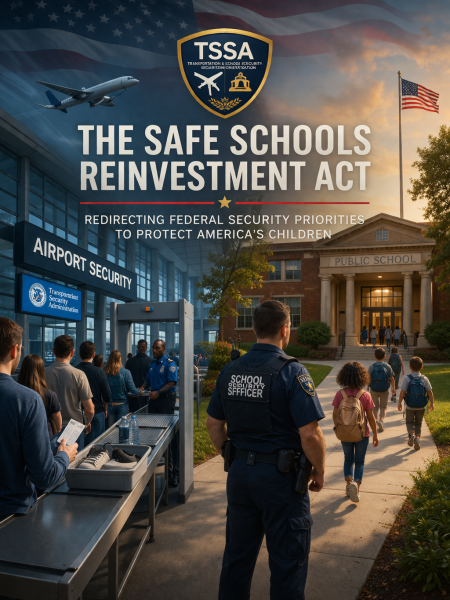
Some patriotic law-maker can have it… For Free. TSSA Act proposes restructuring the TSA into the Transportation and School Security Administration (TSSA)—a dual-mission federal agency responsible for both aviation security and nationwide school security staffing.
This proposal reallocates existing federal resources to fund one School Security Officer (SSO) in every public school, while transitioning aviation security toward a more efficient, intelligence-driven model.
The result is a budget-neutral, mission-aligned modernization of federal security priorities.
Same mission family. Updated reality.
Instead of pouring the bulk of that funding into manpower-heavy airport screening that everyone knows how to work around, you allocate it to place one trained, professional security officer in every public school in America.
Do the math.
Ninety-eight thousand schools.
Call it $70K to $100K per officer, fully loaded.
That’s roughly $6.8 to $9.8 billion a year.
In other words—you can cover every public school in the country using money we’re already spending.
No new taxes. No new bureaucracy explosion. Just a shift.
And before someone clutches pearls about “militarizing schools,” let’s get serious for a second.
We’re not talking about turning hallways into checkpoints. We’re talking about a trained adult whose job is to be present, aware, and capable of responding faster than a 911 call from a classroom.
Deterrence matters. Presence matters. Seconds matter.
Airports figured that out 20 years ago.
Schools? Still debating it.
Now, does this mean you eliminate aviation security entirely? Of course not. That’s the lazy counterargument.
You modernize it.
You move from mass, industrial-age screening theater to intelligence-driven, risk-based security. You keep what works. You cut what doesn’t. You stop pretending that confiscating shampoo bottles is the last line of defense against modern threats.
And you redirect the bulk of the manpower where it actually changes outcomes.
Because here’s the part nobody likes to say out loud:
If you were forced to choose between hardening airports or hardening schools—based purely on daily exposure and societal impact—the answer is obvious.
One is occasional.
The other is constant.
One involves a subset of Americans.
The other involves our children.
This isn’t about fear. It’s about alignment.
Right now, our security spending reflects the emotional memory of 2001, not the operational reality of 2026.
We built a fortress around air travel and left everything else to figure it out locally.
That might have made sense once.
It doesn’t anymore.
The TSSA concept isn’t radical. It’s overdue.
Same dollars. Better mission.
Stop screening grandma like she’s a national threat—and start protecting the places that actually are.
Because at some point, a serious country has to ask itself a serious question:
Why are we guarding the airplane gates……but not the classrooms?
If you enjoyed this article, then please REPOST or SHARE with others; encourage them to follow AFNN. If you’d like to become a citizen contributor for AFNN, contact us at managingeditor@afnn.us Help keep us ad-free by donating here.
Substack: American Free News Network Substack
Truth Social: @AFNN_USA
Facebook: https://m.facebook.com/afnnusa
Telegram: https://t.me/joinchat/2_-GAzcXmIRjODNh
Twitter: https://twitter.com/AfnnUsa
GETTR: https://gettr.com/user/AFNN_USA
CloutHub: @AFNN_USA
Proposed Solution
Creation of the Transportation and School Security Administration (TSSA)
Transform the existing TSA into a dual-purpose agency:
TSSA Mission:
Maintain aviation security using a modernized, intelligence-driven approach
Provide federally funded School Security Officers nationwide
Program Design
School Security Component
Coverage: ~98,000 public schools
Staffing: 1 School Security Officer per school
Total cost: $6.8B–$9.8B annually
Funding source: Existing TSA budget (~$10–11B)
Key Outcome:
Full national coverage without new federal spending
Aviation Security Component
Transition from:
Large-scale, labor-intensive screening
To:
Intelligence-led, risk-based security
Targeted screening operations
Streamlined personnel requirements
School Security Officer (SSO) Role
SSOs will be trained in:
Emergency response and active threat protocols
De-escalation and behavioral recognition
Youth engagement and school environment awareness
Coordination with local law enforcement
Guiding Principle:
Professional security presence without creating a militarized atmosphere
Benefits
1. Nationwide Security Standard
Every public school receives baseline protection
Eliminates disparities between districts
2. Daily Impact vs. Occasional Protection
Protects millions of students every day
Aligns federal resources with continuous exposure environments
3. Budget Neutrality
Fully funded within existing TSA appropriations
No tax increases or net spending growth
4. Strengthened Local Integration
SSOs embedded in communities
Improved coordination with first responders
Implementation Plan
Phase 1 (Year 1)
Establish TSSA structure and authority
Develop national training standards
Initiate pilot programs
Phase 2 (Years 2–3)
Begin nationwide SSO hiring and deployment
Gradually reduce TSA personnel footprint through attrition
Phase 3 (Year 4+)
Achieve full coverage across all public schools
Fully operational dual-mission agency
Risks and Mitigation
Concern: Militarization of Schools
Mitigation: Training emphasis on de-escalation and youth interaction
Concern: Aviation Security Gaps
Mitigation: Maintain intelligence capabilities and targeted screening
Concern: Workforce Expansion
Mitigation: Phased hiring and use of existing law enforcement pipelines
Strategic Rationale
This proposal recognizes that:
The most consistent, daily concentration of vulnerable Americans is found in schools—not airports.
Federal security policy should reflect that reality.
Conclusion
The TSSA Act modernizes federal security by aligning resources with real-world exposure and risk.
It does not expand government.
It does not increase spending.
It simply redefines priorities.
From protecting occasional travel
—to protecting America’s children every day.