Every generation thinks it’s living in the most chaotic moment in history. Scroll your feed, watch the headlines, listen to the noise—it all screams the same thing: this has never happened before.
Except it has. Over and over again.
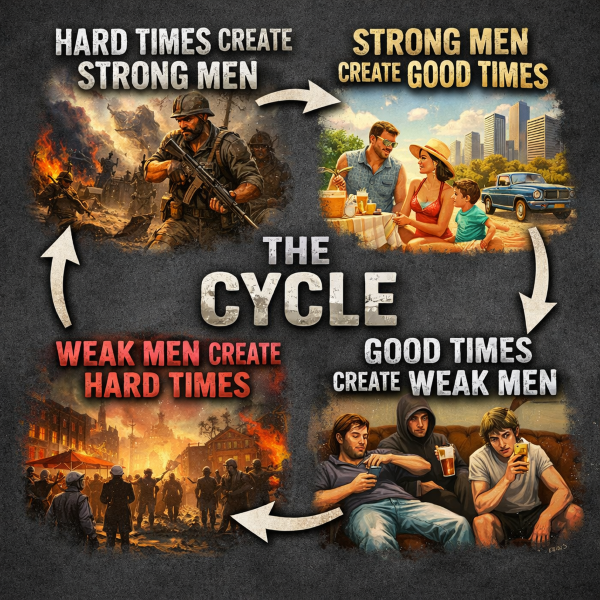
The now-famous line popularized by G. Michael Hopf—“Hard times create strong men. Strong men create good times. Good times create weak men. Weak men create hard times”—isn’t just internet wisdom wrapped in a motivational poster. It’s a stripped-down field manual for understanding why civilizations rise, peak, wobble, and then fall flat on their face.
You don’t have to like it. You just have to look at the pattern.
Start with the generation forged in the Great Depression and hardened by World War II. Those weren’t “influencer problems.” That was starvation, total war, and a world on fire. That generation didn’t have the luxury of identity crises—they had survival. And from that crucible came discipline, industrial might, and a sense of purpose that built the modern West.
Strong people created good times.
Post-war America and much of the Western world entered a golden stretch—economic expansion, technological leaps, rising living standards. The system worked. The institutions were trusted. The mission felt clear.
And then something subtle happened.
Comfort crept in.
Good times don’t just reward success—they dull the edge that created it. When life gets easier, the traits that carried you through hardship—grit, sacrifice, discipline—become optional. Then they become outdated. Then they become inconvenient.
That’s how you drift.
By the time the Cold War wound down, the West had convinced itself it had cracked the code of history. Liberal democracy, global trade, technological superiority—what could possibly go wrong?
Answer: everything that always goes wrong.
This is where the academics quietly nod while the rest of the room argues. Historians William Strauss and Neil Howe laid out a generational theory in The Fourth Turning that doesn’t rely on vibes—it relies on patterns. Roughly every 80 to 100 years, societies cycle through phases: stability, awakening, unraveling, and crisis. Each phase produces a different kind of generation, shaped by the environment they grow up in.
Translation: people are products of their times, and then they become the architects of the next one.
We’ve seen this movie before.
Look at the slow-motion collapse of the Fall of the Roman Empire. Rome didn’t lose because barbarians suddenly got stronger. It lost because Rome got softer—politically fractured, economically strained, militarily diluted. The external pressure didn’t change nearly as much as the internal capacity to deal with it.
Or rewind to the years before World War I. Europe was prosperous, interconnected, and convinced that modernity had made large-scale war obsolete. Then one bad decision, layered on top of a dozen fragile systems, lit the fuse.
History doesn’t explode out of nowhere. It cracks first.
So where does that put us?
If you’re paying attention—not just to headlines, but to the underlying systems—it feels less like stability and more like strain. Institutional trust is eroding. Economic pressure is building. Information is weaponized to the point where truth is negotiable. This isn’t traditional warfare—it’s fifth-generation conflict, where the battlefield is your mind and the objective is perception.
You don’t need a briefing slide to see it. You can feel it in the air.
The Millennials and those coming up behind them didn’t grow up in the same “good times” their parents did. They inherited a system already showing stress fractures—endless wars with unclear outcomes, financial instability, and a digital landscape that amplifies outrage over clarity. They’re not weaker by default—they’re adapted to chaos. But they’re operating in a system that no longer delivers what it promised.
That gap matters.
Because when expectations and reality diverge, pressure builds. And pressure—historically—doesn’t dissipate. It resolves.
Usually the hard way.
Here’s the part nobody likes: if the cycle holds, we are not at the beginning of something comfortable. We’re in the phase where systems get tested, narratives collide, and reality starts imposing itself again. Call it a crisis. Call it a reset. Call it whatever helps you sleep at night.
But don’t call it unprecedented.
It’s not.
The uncomfortable truth is that hard times are not an anomaly—they’re a feature. They’re the forge that strips away the excess and forces a return to fundamentals. Competence matters again. Leadership matters again. Reality, not narrative, decides outcomes.
That’s the part the meme gets right—and the part most people conveniently ignore.
Because if hard times create strong people, then the inverse is also true: good times don’t last unless someone is willing to do the hard things required to sustain them.
Right now, we’re finding out who that is.
And who isn’t.
If you enjoyed this article, then please REPOST or SHARE with others; encourage them to follow AFNN. If you’d like to become a citizen contributor for AFNN, contact us at managingeditor@afnn.us Help keep us ad-free by donating here.
Substack: American Free News Network Substack
Truth Social: @AFNN_USA
Facebook: https://m.facebook.com/afnnusa
Telegram: https://t.me/joinchat/2_-GAzcXmIRjODNh
Twitter: https://twitter.com/AfnnUsa
GETTR: https://gettr.com/user/AFNN_USA
CloutHub: @AFNN_USA