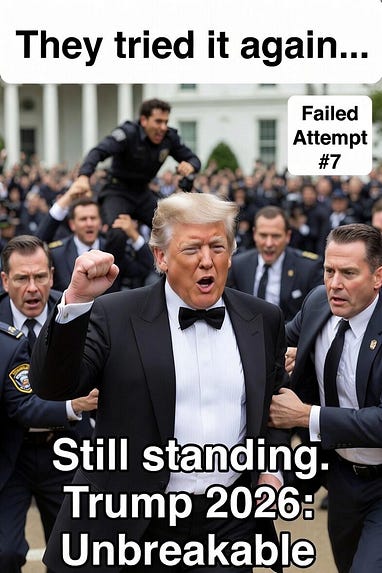
With the failed attempt at the White House Correspondents’ Dinner on Saturday night, there have been seven (7) major attempts to assassinate President Trump since 2016.
Let us examine US presidential assassination attempts and attempt to ascertain why President Trump has been the most-targeted president in US history.
The following covers confirmed, documented attempts from the Civil War era through the present. Motives are included where established. “Attempt” is defined broadly to include shots fired, credible armed plots, and confirmed murder-for-hire schemes.
1865: Abraham Lincoln – Assassinated
Shot by John Wilkes Booth at Ford’s Theatre, Washington D.C. Booth, a Confederate sympathizer and actor, led a coordinated conspiracy targeting Lincoln, Vice President Johnson, and Secretary Seward simultaneously.
Motive: Confederate loyalism; rage over the South’s defeat; desire to destabilize Union government
1881: James A. Garfield – Assassinated
Charles J. Guiteau shot Garfield at a Washington train station. Garfield died of his wounds and complications from medical treatment two months later.
Motive: Delusional personal grievance — Guiteau had sought a diplomatic appointment he was denied; a “disappointed office-seeker”
1901: William McKinley – Assassinated
Leon Czolgosz, an anarchist, shot McKinley twice at point-blank range at the Pan-American Exposition in Buffalo, NY. McKinley died eight days later.
Motive: Anarchist ideology; opposition to capitalism and government authority
1912: Theodore Roosevelt – Wounded (ex-President)
John Schrank shot Roosevelt in Milwaukee during a campaign speech. The bullet was slowed by a folded speech and eyeglass case. Roosevelt continued speaking for 90 minutes before seeking treatment.
Motive: Schrank claimed McKinley’s ghost instructed him to prevent Roosevelt from seeking a third term; likely delusional
1933: Franklin D. Roosevelt – Others killed
Giuseppe Zangara fired five shots at FDR’s motorcade in Miami. FDR was unharmed; Chicago Mayor Anton Cermak, who was with FDR, died from his wounds.
Motive: Anarchist ideology; hatred of capitalists and those in power; possible mental instability
1950: Harry S. Truman – Gunfight at Blair House
Two Puerto Rican nationalists, Griselio Torresola and Oscar Collazo, stormed Blair House. One Secret Service officer and Torresola were killed. Truman was unharmed.
Motive: Puerto Rican independence movement; armed nationalist politics
1963: John F. Kennedy – Assassinated
Lee Harvey Oswald shot Kennedy from the Texas School Book Depository during a motorcade through Dealey Plaza, Dallas. Kennedy died at Parkland Memorial Hospital.
Motive: Disputed; Oswald was a Marxist with Soviet ties and Cuban sympathies; official finding was a lone gunman, though controversy remains
1972–74: Richard Nixon – Multiple plots
Arthur Bremer twice tried to ambush Nixon (though ultimately shot Governor George Wallace instead). Samuel Byck attempted to hijack a plane in 1974 to crash it into the White House.
Motive: Bremer — personal desire for infamy; Byck — rage against Nixon over economic policies and Watergate
1975: Gerald Ford – Two attempts (17 days apart)
Lynette “Squeaky” Fromme (Manson Family cult member) pointed a .45 at Ford in Sacramento; her gun did not fire. Sara Jane Moore fired a revolver at Ford in San Francisco; a bystander deflected her arm.
Fromme: Manson cult ideology, environmentalism; Moore: leftist radicalism, desire to “trigger a revolution”
1981: Ronald Reagan – Shot, survived
John Hinckley Jr. fired six shots at Reagan outside the Washington Hilton, wounding Reagan, Press Secretary James Brady, and two officers. Reagan underwent emergency surgery.
Motive: Obsession with actress Jodie Foster; attempted to impress her by replicating a scene from “Taxi Driver”; found not guilty by reason of insanity
1994: Bill Clinton – Unharmed
Francisco Duran fired 29 rounds from an assault rifle at the White House fence. Clinton was on the other side of the building. Three bystanders tackled Duran.
Motive: Anti-government militia ideology; paranoid delusions about a “mist” emerging from Clinton
2005: George W. Bush – Unharmed
Vladimir Arutunian threw a live hand grenade at Bush during a speech in Tbilisi, Georgia. The grenade, wrapped in a cloth, did not detonate.
Motive: Anti-American, anti-Western ideology; Arutunian was a Georgian national
2011: Barack Obama – White House shots fired
Oscar Ramiro Ortega-Hernandez fired 25 rounds from an automatic rifle at the White House, striking a window. Separately, four militia members were arrested in 2012 for plotting to kill Obama.
Ortega-Hernandez: Believed Obama was the Antichrist; militia group: white supremacist ideology
DONALD TRUMP – A CATEGORY APART (2016-2026)
No president in US history has faced as many separate, credible, documented attempts across as wide a range of perpetrators — domestic lone actors, organized foreign state actors, and far-left political operatives — as Donald Trump.
Sept 2017: Trump — Bismarck, ND – Foiled (1st term)
Gregory Lee Leingang stole a forklift and drove it toward Trump’s presidential motorcade, intending to flip the limousine. He was arrested after the forklift became jammed. He confessed to the attempted murder and received 20 years.
Motive: Political rage; expressed anti-Trump views
July 12, 2024: Trump — Iranian IRGC murder-for-hire – Foiled (FBI sting)
Pakistani national Asif Raza Merchant, with ties to Iran’s Islamic Revolutionary Guard Corps, was arrested in Houston the day before the Butler shooting — charged with recruiting assassins to kill Trump. Convicted March 2026.
Motive: Iranian state revenge for Trump’s 2020 assassination of General Qasem Soleimani
July 13, 2024: Trump — Butler, Pennsylvania – Shot, wounded
Thomas Matthew Crooks, 20, opened fire at a campaign rally from a rooftop 150 yards away, firing eight rounds from an AR-15. A bullet grazed Trump’s right ear. Attendee Corey Comperatore was killed shielding his family; two others were critically wounded. Crooks was killed by USSS counter-snipers 12 seconds after opening fire.
Motive: FBI found no clear motive after investigating 17 social media accounts; Crooks had donated to a progressive voter turnout PAC in 2021 but was registered Republican
Sept 15, 2024: Trump — West Palm Beach, FL – Foiled, armed suspect
Ryan Wesley Routh hid in the bushes at Trump International Golf Club with an AK-style rifle, 300-500 yards from Trump on the course. A Secret Service agent fired at Routh; he fled and was captured by Florida law enforcement. Found guilty on all counts Sept 2025; sentenced to life in prison Feb 2026. Planning had begun as early as Feb 2024 with an accomplice.
Motive: Far-left political ideology; had made 19 donations to ActBlue; authored a self-published book inviting Iran to assassinate Trump; pro-Ukraine zealotry; social media posts calling Trump “dangerous”
Nov 2024: Trump — Second Iranian IRGC plot – Foiled
The DOJ charged Farhad Shakeri, an Afghan citizen with IRGC ties who had previously been imprisoned in the U.S., with a second murder-for-hire plot. An IRGC official had urged Shakeri to “set aside other efforts” to focus on killing Trump. Two U.S. accomplices were convicted in January 2026; Shakeri remains at large.
Motive: Iranian state revenge for Soleimani assassination; geopolitical retaliation
Feb 22, 2026: Trump — Mar-a-Lago – Attacker shot and killed
Austin Tucker Martin, 21, of North Carolina, crashed his vehicle into the security perimeter of Mar-a-Lago armed with a shotgun and a gas canister. Secret Service agents shot and killed him. Trump was in Washington at the time.
Motive: Under investigation at time of reporting
April 26, 2026: Trump — WHCD, Washington Hilton – Active shooter, arrested
Cole Tomas Allen, 31, of Torrance, California, opened fire in the lobby of the Washington Hilton Hotel during the White House Correspondents’ Dinner. Trump and Cabinet members were present. Allen was arrested; charges were pending. It remained unclear at time of reporting whether Trump was the primary target.
Motive: Under investigation; anti-Trump manifesto discovered
ANALYSIS AND COMPARISON OF ASSASSINATION ATTEMPTS
Here is a brief summary of the major analytical findings:
On the historical record: Four presidents have been assassinated (Lincoln, Garfield, McKinley, Kennedy), three wounded and survived (T. Roosevelt, Reagan, Trump), and dozens of serious attempts have been foiled. Gerald Ford’s two attempts in 17 days in 1975 was the previous high-water mark for attempts against a single president in a short period.
On Trump’s uniqueness: No president in American history has faced the combination Trump has: domestic politically-motivated lone actors, two confirmed foreign state (Iranian IRGC) murder-for-hire plots, and ongoing security breaches across multiple years and locations. Axios concluded bluntly as recently as April 26, 2026: “No modern president has faced this many threats.”
On rhetoric: The documented record shows a sustained pattern of language from Democratic officials, the Lincoln Project, and entertainment figures that went beyond political criticism into existential, eliminationist framing. As Newsweek noted, since Trump’s 2016 election, Democrats including Biden, Clinton, and other major figures made a regular habit of calling the leader of the opposition a “threat to our democracy.” Political experts cautioned against drawing a direct mechanical link between campaign rhetoric and individual acts of violence, while also acknowledging that close to a decade of near-constant verbal and social media attacks had created a charged environment.
On Secret Service reform: As of mid-2025, the USSS had implemented fewer than half of the 46 congressional reforms recommended after Butler, with Senate Homeland Security Chairman Rand Paul concluding that “bureaucratic incompetence nearly cost President Trump his life.”
The report intentionally tries to be fair — noting documented facts from multiple sides — while taking seriously the legitimate concern that demonizing rhetoric creates conditions in which violent actors feel justified.
WHY SO MANY ATTEMPTS AGAINST PRESIDENT TRUMP?
This question has multiple overlapping answers, ranging from the structural to the rhetorical.
1. Unprecedented demonization rhetoric from political opponents
For nearly a decade, prominent Democrat officeholders, media figures, and celebrities deployed language about Trump that went well beyond standard political criticism — characterizing him not merely as a bad president but as an existential, Nazi-like, democracy-destroying threat who “must be stopped” or “eliminated.” Some of the documented rhetoric:
“It’s time to put Trump in the bullseye.”
— President Joe Biden, in a private donor call, leaked July 2024 — five days before the Butler shooting. Biden later acknowledged the remark to NBC.
“He has to be eliminated.” (Said of Trump in a televised interview, in the context of his being “destructive to our democracy.”)
— Rep. Daniel Goldman (D-NY), November 2023. Goldman condemned political violence after both assassination attempts, but the quote circulated widely.
“Trump is a threat to our democracy and fundamental freedoms.” / “It’s on us to recognize the threat he poses.”
— Vice President Kamala Harris, repeated throughout 2023–2024. House Majority Leader Steve Scalise noted that the second would-be assassin, Routh, “was regurgitating the same language as Kamala.”
“When was the last time an actor assassinated a president? Maybe it’s time.”
— Actor Johnny Depp, at the Glastonbury Festival, June 2017. He later apologized.
“I have thought an awful lot about blowing up the White House.”
— Madonna, Women’s March, January 2017. She later claimed her words were taken out of context.
“They’re still going to have to go out and put a bullet in Donald Trump.”
— Rick Wilson, co-founder of the Lincoln Project NeverTrump group, on MSNBC, 2015.
Rep. Maxine Waters encouraged supporters to confront and “push back” on Trump administration members in public. House delegate Stacey Plaskett told MSNBC that Trump “needs to be shot.”
— Documented by Newsweek and Fox News, 2024.
The documented link between rhetoric and action: Ryan Wesley Routh had made 19 donations to ActBlue and had extensively posted anti-Trump material online echoing Democrat messaging before his armed appearance at Trump’s golf club. House Majority Leader Scalise (R-LA) stated publicly: “Kamala needs to stop saying that President Trump is a threat to democracy. There are unhinged people that are taking that as a call to go and try to eliminate President Trump.”
2. The “threat to democracy” framing — a uniquely dangerous rhetorical construct
Throughout American history, political opponents have called each other names, accused each other of bad policies, and engaged in fierce rhetoric. What was different in the Trump era was the systematic framing of one individual as an existential, civilizational threat — not just a political opponent with bad ideas, but a Hitler-like figure whose continuation in public life represented an emergency requiring action. When leaders repeatedly tell their followers that an opponent is literally destroying democracy and must be stopped, a small percentage of those followers may interpret that as license for violence. Political violence experts note this phenomenon without excusing the actors themselves.
3. Iranian state targeting — a geopolitical dimension with no modern precedent
The two documented IRGC-directed murder-for-hire plots against President Trump (the Merchant plot and the Shakeri plot) represent something entirely outside the historical norm: a foreign government actively recruiting assassins on American soil to kill a major presidential candidate and then a sitting president. This reflects Trump’s unique position as the architect of the Soleimani assassination in 2020 — Iran has explicitly stated that killing Trump would constitute “revenge.” No other modern American president has faced this level of documented, ongoing foreign state assassination targeting.
4. Social media’s amplification effect
Prior to the digital age, violent rhetoric circulated more slowly and among smaller audiences. Today, a single post calling for President Trump to be “eliminated” can reach millions in hours, is algorithmically amplified by engagement metrics, and can be screenshot and reshared indefinitely. The ecosystem of Twitter/X, Facebook, TikTok, and fringe platforms has created an environment in which the most extreme anti-Trump content — including explicit fantasies about his assassination — circulates constantly, potentially normalizing violence in susceptible individuals.
5. Secret Service institutional failures
Independent investigations found that prior to July 2024, the Secret Service had no formal procedure for reviewing or approving protective asset requests, suffered from a culture of “doing more with less,” had communications failures at the Butler rally including agents using a “chaotic mixture of radio, cell phone, text, and email,” and failed to understand the unique and elevated threat level facing President Trump. The independent panel said flatly: “Another Butler can and will happen again” without major reforms. These structural gaps created windows of vulnerability that a more capable protective detail might have closed.
6. Trump’s own high-visibility, open-format events
President Trump’s political brand has always centered on massive, open-air rallies with enormous crowds — a format that is inherently difficult to secure. Unlike more cautious presidents who prefer controlled, ticketed events in indoor venues, Trump regularly appeared at venues with exposed sightlines, adjacent buildings, and thousands of attendees. This combination of political choice and the magnitude of his public presence created more opportunities for determined attackers than a president who rarely appears in such settings.
7. The polarization multiplier
President Trump is arguably the most politically polarizing figure in American history since the Civil War era. The intensity of both his support and opposition — combined with genuine policy disputes over immigration, election integrity, the courts, and executive power — has created a political climate in which a small subset of those who hate him most intensely have been pushed toward violence. Historical analogues exist (Lincoln was similarly polarizing), but the sheer volume and visibility of anti-Trump sentiment is without modern parallel.
CONCLUDING THOUGHTS
The marked increase in assassination attempts by leftwing actors over the past 10 years directly parallels the rise in violent rhetoric – particularly against President Trump – from elected Democrats and their media allies. The most impactful single change would be for prominent Democrat politicians to assume some rhetorical responsibility and consciously step back from existential, civilizational framing of their opponents.
Calling someone a bad president, even a terrible one, is fundamentally different from calling them a Hitler-like threat to democracy who “must be eliminated.” A bipartisan compact on language — particularly from the most senior officials — would directly address the rhetoric-to-violence pipeline without requiring any legal coercion or free speech limitations. Republicans would almost certainly sign onto such an agreement. It would take a miracle for Democrats to do so.
The end.
StuinSD is a reader-supported publication. To receive new posts and support his work, consider becoming a free or paid subscriber.
This article originally appeared in Stu Cvrk’s Substack. Reprinted here with permission
If you enjoyed this article, then please REPOST or SHARE with others; encourage them to follow AFNN. If you’d like to become a citizen contributor for AFNN, contact us at managingeditor@afnn.us Help keep us ad-free by donating here.
Substack: American Free News Network Substack
Truth Social: @AFNN_USA
Facebook: https://m.facebook.com/afnnusa
Telegram: https://t.me/joinchat/2_-GAzcXmIRjODNh
Twitter: https://twitter.com/AfnnUsa
GETTR: https://gettr.com/user/AFNN_USA
CloutHub: @AFNN_USA