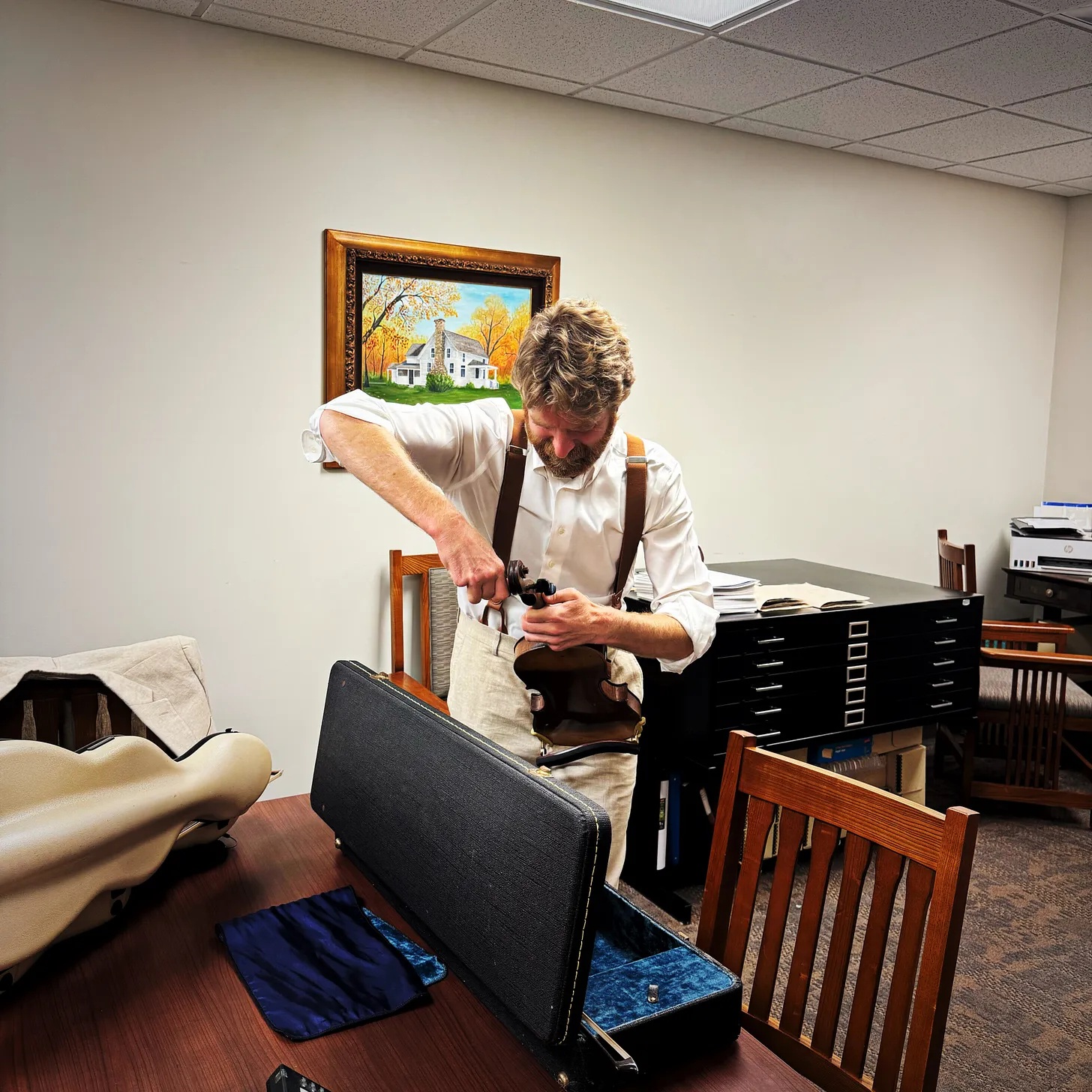
Pa Ingalls’ fiddle was sitting on the table of the museum archive room. Still in its case.
The curator, Tana Redman, smiled at me.
“You’ll need to wash your hands before you play it,” she said.
Pa Ingalls’ fiddle is one of the most well-known and sacred literary objects in American history. Second only to Huck’s raft, Hester Prynne’s scarlet ‘A,’ or the Leg Lamp.
The fiddle is on display at the Laura Ingalls Wilder Museum in Mansfield, Missouri. It is the star attraction of the museum.
I inspected the fiddle.
The fingerboard was not made of ebony but softwood. Pearwood maybe. There were divots worn in the fingerboard from Pa’s fingers. Millions of little nicks from his fingernails, peppering first position, carving grooves in the wood.
The fiddleback was adorned with a pattern of scratches, maybe from Pa’s collar, or perhaps the clips of his suspenders, scraping the varnish.
I tuned it, but the tension pegs weren’t holding. Dry weather makes tension pegs about as cooperative as an IRS auditor.
Charles Ingalls learned to play this fiddle around age 16. This instrument might’ve been his first fiddle.
He learned to play by hanging out at local dances in Campton Township, Illinois, in the 1850s. Charles attended monthly dances at the Garfield House Inn, like all the young people in the area. Except Charles gravitated toward the band.
After about ten minutes of struggling against the tuning pegs, I finally got the fiddle up to pitch. I wedged the instrument beneath my chin. I positioned the bow against the strings, and…
The fiddle had already fallen out of tune.
The tension pegs kept slipping. In Pa’s day, he would have simply removed one of these pegs and sucked on it. The moisture from his saliva would have made the peg stick. But I wasn’t about to suck on a piece of cherished American history. At least, not unless someone could distract Tana.
So, I waged battle with the old tuning pegs, squeezing and twisting, pressing and pushing, cranking and winding, until my hands ached.
And I thought about how many times Pa must have done this exact thing. I thought of how many snowstorms this fiddle had gotten his family through. How many rainy days.
I thought of the Ingalls family’s first Christmas in Kansas. A young family, snowed-in, stuck in a prairie cabin on Christmas morning.
I thought of how Laura and Mary danced that morning, to the sounds of the very instrument in my hands.
I thought of how the fiddle’s wood grains soaked in the scent of Ma’s roasting turkey. I thought of how Mister Edwards brought sweet potatoes, and gifts from Santa, then tapped his foot in time as Pa played “Money Musk” on this very instrument.
This fiddle would have seen them through hard times. This fiddle would’ve led the Ingalls’ impromptu church services, in the prairie’s open air. The fiddle would have been played at the girls’ birthdays. At every celebration. At every funeral.
This instrument would’ve played sweetly for young Mary as she lay in bed, ravaged by scarlet fever at age 14. This old violin would have played around the campfire, before the family slept beneath a covered wagon, whispering prayers to their maker for safety.
I tightened the bow.
I played an old tune.

The fiddle sang merrily to itself, like clear drops of water into the stillness. But truthfully, I could not hear the music over Laura’s voice, which spoke softly in my mind:
“But Laura lay awake a little while, listening to Pa’s fiddle softly playing and to the lonely sound of the wind in the Big Woods.
“She looked at Pa sitting on the bench by the hearth, the firelight gleaming on his brown hair and beard and glistening on the honey-brown fiddle.
“She looked at Ma, gently rocking and knitting. She thought to herself, ‘This is now.’ She was glad that the cosy house, and Pa and Ma and the firelight and the music, were now. They could not be forgotten, she thought, because now is now. It can never be a long time ago.”
“…I see it now,” Laura said to herself, “though I didn’t then—we never could have gotten through it all without Pa’s fiddle.”

Questions: SeanDietrich@gmail.com
Visit the Sean of the South Website
Find out where you can see Sean live.
Originally published on Sean’s website. Republished here with permission.
If you enjoyed this article, then please REPOST or SHARE with others; encourage them to follow AFNN. If you’d like to become a citizen contributor for AFNN, contact us at managingeditor@afnn.us Help keep us ad-free by donating here.
Substack: American Free News Network Substack
Truth Social: @AFNN_USA
Facebook: https://m.facebook.com/afnnusa
Telegram: https://t.me/joinchat/2_-GAzcXmIRjODNh
Twitter: https://twitter.com/AfnnUsa
GETTR: https://gettr.com/user/AFNN_USA
CloutHub: @AFNN_USA