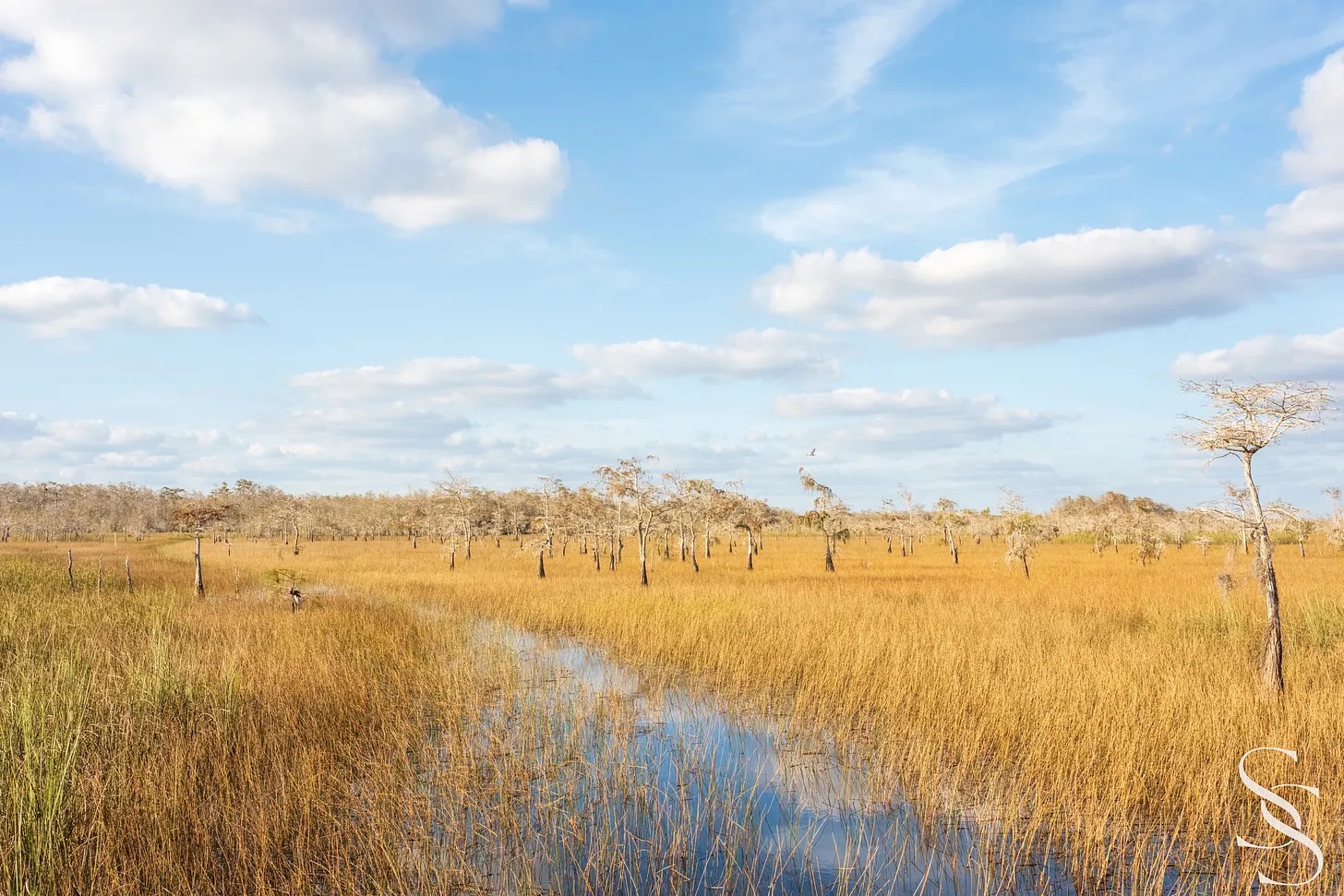
The first time I visited the Florida Everglades, I was entranced. Layers of beauty, patterned chaos, teeming wildlife, and that unmistakable feel-good energy.
It is roughly 1.5 million acres of subtropical wetland often referred to as the “River of Grass”. A place with endless complexity that invites one to contemplate our natural world. While there are many locales around the world that exude such mystery, this is my place.
During this visit, I realized something new. The swamp beckons. The best way to experience this living breathing ecosystem is to accept the invitation and venture in. Go by foot, boat or better yet, both.
I often stay at Clyde Butcher Gallery Big Cypress, my Everglades home away from home. In addition to the gallery and two comfortable accommodations, the 14-acre property is alive with alligators, wading birds, orchids and good people.

Clyde Butcher is a legendary Everglades photographer whose large-format black-and-white images have inspired me on every visit. This time our stays overlapped, and I finally had the chance to tell him in person how much I admire his work and its significant impact on how I see this wonderful place.

Airboats are noisy and fast, yet they’re often the best option for the shallow cypress prairies and strands. I always go with Down South Airboat Tours, owned by a 5th generation local. They go in just north of Route 41 on the edge of Big Cypress National Preserve. If you want to truly immerse yourself in the River of Grass, skip the typical tourist rides near Everglades City and choose them.

I was concerned on this visit, however. Even considering the severe drought, the water levels seemed lower than expected. Normally the levels rise with the summer rains and fall through the winter dry season, but last December they looked more like March or April. Changes in water levels ripple through the entire ecosystem, affecting both wildlife behavior and the people who depend on the swamp for their livelihood.
I asked many locals what was happening. Opinions varied, but a common theme emerged. All mentioned the drought but also raised questions about the South Florida Water Management District. The District controls the water flow from Lake Okeechobee to Big Cypress and Florida Bay and has control over how much water each region receives. This is a rabbit hole I intend to enter, one that starts with Big Sugar. Stay tuned.
Even though high water creates more dramatic photos, one can still capture the essence of the beautiful cypress prairies. There is always an invitation to carry on and explore further.

Or we can narrow our gaze as the tiniest of baby gators swims by.

Under the canopy of a cypress strand, the swamp’s quiet magic is always waiting.

Over the years I’ve also explored Big Cypress by pole boat with Everglades Adventure Tours. It’s a completely different, whisper-quiet experience in the Turner River area, where alligators are almost always present.
Don’t let fear of alligators keep you from accepting the swamp’s invitation. Attacks are extremely rare, and nearly all are preventable by following basic safety guidelines.

These fascinating creatures are air-breathing reptiles that typically hold their breath for 15–30 minutes and up to several hours in cold water. As “cold blooded” ectotherms,
they control their body temperature externally, basking in sunlight to warm up or retreating to shade or water to cool down. If you see a gator with its mouth wide open, it doesn’t want to eat you, it’s simply cooling down.
There is one inhabitant of the swamp, however, that I would rather avoid – mosquitos. They can carry you away in the warm, wet months. Fortunately, they were tolerable on this visit, and one even posed for my first mosquito portrait.

The Loop Road used to be one of my favorite places, teeming with birds and alligators, especially around Sweetwater Strand. It is quieter now. The powers that be graded and widened the dirt road and made it easier to drive the 26-mile stretch at speed. Consequently, people do. Lots of them. Between that, the pythons and other environmental factors, much of the wildlife has moved on.

With limited photographic options, I decided to take a walk. My preference was to do the Gator Hook Trail which is mostly underwater, its limestone base riddled with holes, muck, roots, and cypress knees. Based on my first attempt on this trail when the water was high, the footing treacherous and our path literally and figuratively blocked by a very large snake, I thought Gator Hook on my own was a questionable idea. So I opted for a walk down the Loop Rd instead.
As I walked, this safe but boring choice started to gnaw at me. I wondered if I could turn low water lemons into lemonade. Would the underwater obstacles on Gator Hook be easier to see now? Would my new mud hikers ensure me and my heavy camera gear would stay vertical when slipping and sliding? Yes.
I quickly hiked back to the car, loaded up the backpack, laced up ankle high shoes with good traction, grabbed my sturdy varnished mop handle and headed down the trail. It was a magical few hours.
When the path dipped into a wooded area, a baby gator, one of my favorites, leaped from a log just ahead of me. I let the little one swim off before I continued down the trail.

I also spotted what looked like fossils embedded in the limestone.

As I walked back, I crossed paths with a young man. We looked at each other and smiled broadly. Two strangers, decades apart, both moved by how special this place felt that day.
The photo below captures that gorgeous day on the limestone path and tells the moral of the story – when presented with two paths, always take the more interesting one.

That afternoon, I ventured into another unknown.
Years ago I had seen a handwritten sign in a remote driveway in the middle of nowhere. I had questions, lots of them. The overgrown and cluttered driveway was definitely not an “invitation to enter”.

Last year I was surprised to see a man sitting in a wheelchair at the top of the drive. I had parked nearby to photograph a wood stork, but curiosity got the better of me. I walked back, keeping my distance, and we began to talk.
It bothered me afterwards that I never asked his name. So I went back to that driveway. From the gravel road, I yelled up asking if I could enter. He yelled back but I was not sure if it was welcoming or he was saying “don’t come down that driveway if you know what is good for you”. After a few more rounds of yelling, I finally understood: “I can’t walk, come down the driveway”. I texted my friends at Clyde Butcher to let them know I was headed in.

His name is Raymond. We talked for a long time and I listened as he shared stories of the Everglades from his childhood. Next time I pass by, will yell down the driveway again. If he is willing, I would love to tell his story.
The next morning, I was greeted with dew-soaked spider webs – nature’s jewels. Of the literally hundreds of sparkling webs draped over shrubs and trees, only one spider was in residence.

Not far down the road I came upon an astonishing sight — hundreds, if not thousands, of tree swallows. I know it’s typical winter roosting behavior for them, but for me it was a first…one I will always remember.

That afternoon I headed out from Chokoloskee into Ten Thousand Islands with Captain Craig, an excellent guide. This is where the birds are. What a treat. On the way dolphins rode our wake and roseate spoonbills flew by.


Then our eyes feasted on the white pelicans. There is something deeply mesmerizing about these magnificent birds. With wing spans of 8-9 feet and weighing 20-30 lbs, they move with surprising grace. Their synchronized movements are especially captivating.

I wondered why they followed single file off the tiny point rather than fanning out from the sides. It seems this is a prelude to their coordinated foraging strategy. By entering the shallows single file, it is easier to form a single line and corral fish, scooping up a meal with their distinctive pouched beaks. Even their military like precision when walking has purpose – if they need to take flight, the formation prevents those giant wings from colliding.
I also love it when they stand at ease.

Near the pelicans we found an eagle pair. So majestic.


I then left Big Cypress and headed to Everglades National Park to meet Captain Jason Sullivan from Rising Tide Charters. We have enjoyed many successful trips together exploring Florida Bay, but this day was rough and windy. Sadly the flamingos were no where to be found, but the crocodiles sunning on the mud banks more than made up for it.

I showed the photos below to a friend who looked at me quizzically and asked why I would ever want to photograph such things. I smiled and said, “because crocodiles are incredible”. I admire their evolutionary consistency. Though they have evolved over millions of years, they still look like living dinosaurs. When I’m in their presence, I feel as though I’ve stepped back in time.

American crocodiles are shy and relatively docile compared to the aggressive and dangerous Nile or Saltwater crocodiles who view us as tasty treats. Even so, as with alligators, it is very important to follow basic safety measures. Don’t feed them, corner them or get too close.
I wish I could speak crocodile. Among many other things I would ask how they feel about their teeth sticking up through their snout.

We also saw a group of roseate spoonbills. One in particular caught my attention. A brent goose was pestering the larger spoonbill with great success. I could not help but wonder why the spoonbill didn’t just ignore the smaller bird.

On land I spent much time in Pahayokee, one of my favorite spots in the park. Things seemed unusually quiet, but luckily the photography gods were smiling. Out of the corner of my eye, I caught sight of a group of wood storks in beautiful afternoon light. The trees on the side of the road made it impossible to capture the full scene but on tip toes I found a singular opening.

Then I had an idea. If I circle around through the water, perhaps I could capture the whole scene. I pulled on rubber boots and stepped beneath the cypress canopy. I stopped in my tracks. It was stunning. I had driven by this exact spot at least 100 times and had no idea this hidden gem was here.
After letting the wood storks get used to my presence, I began slowly moving in their direction but unfortunately a car stopped, then another. Between my walking and their talking, the wood storks had enough.
No worries. I turned my attention to this new “discovery” instead. I slipped into my waders, wedged myself between a cypress tree and my tripod, and waited. When the light finally came right, the invitation to enter was revealed in all its quiet glory.

Thanks for joining me on this little Everglades adventure. Until next time…