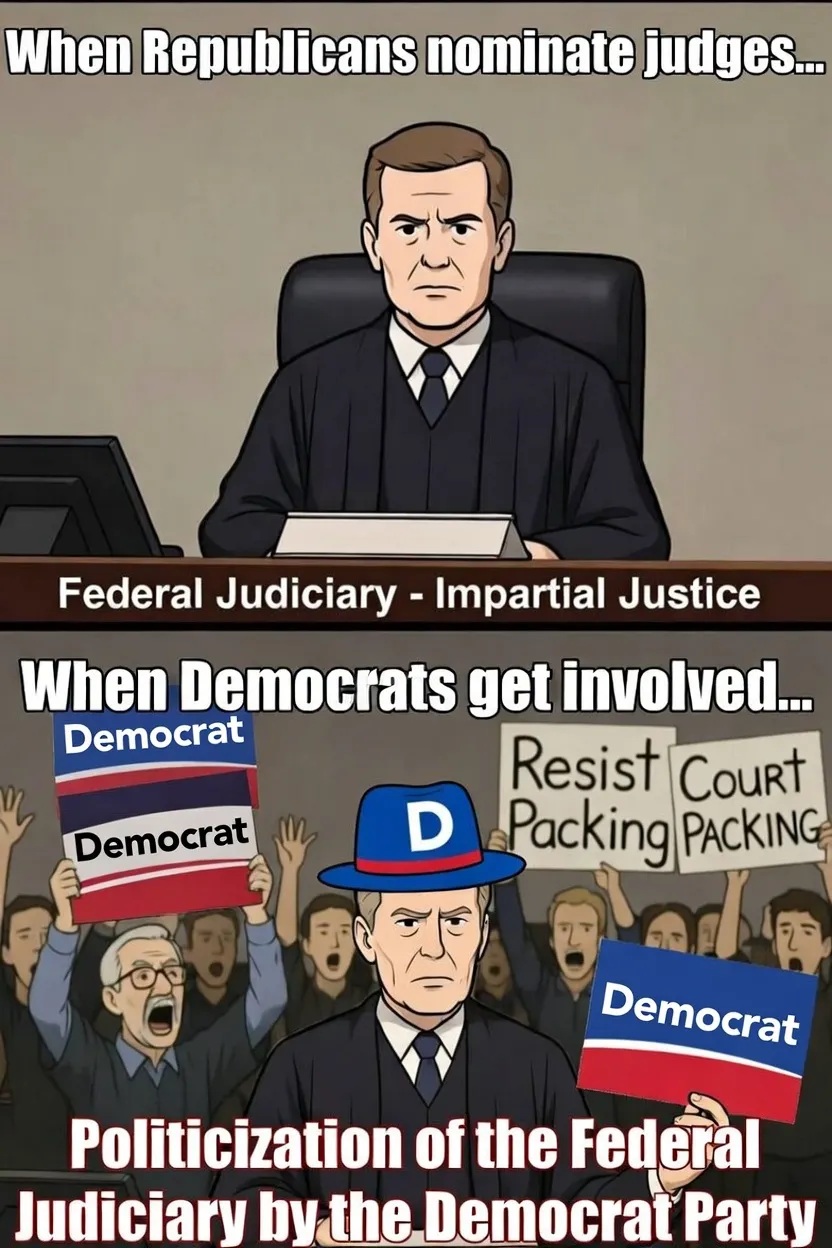
A traditionalist constitutional conservative analysis continues
This is Part II of a two-part series that examines the politicization of the federal judiciary by the Democrat left during the second term of President Trump and the crisis is presents for our constitutional republic. Part I covered a brief history, the continuing encroachment of Article III (the Judiciary Branch) on Article II (the Executive Branch), and some case studies in judicial overreach. This part covers Democrat lawfare coordination, the Democrats deployment of foreign judges and the associated cultural disconnect, the issue of democratic (small d) legitimacy, the Sotomayor problem, and remedies for the problem.
THE LAWFARE COMPLEX
Traditional legal challenges to executive action involve private parties with genuine grievances, represented by counsel, seeking redress for concrete injuries in appropriately chosen forums. What has emerged since January 2025 is something qualitatively different: a three-part lawfare complex operating in coordinated fashion between courts, legacy media, and leftwing activist organizations all of whom support the Democrat political agenda.
The Legal Arm consists of a network of left-wing nonprofits — the ACLU, the National Immigration Law Center, Democracy Forward, Protect Democracy, and dozens of others — many of which share funders, leadership alumni, and strategic communications infrastructure. These organizations maintain standing legal teams whose full-time purpose is to challenge Trump administration actions. They drafted lawsuits before the executive orders were even issued, filing within hours of presidential action.
The Judicial Arm consists of Democrat-appointed federal judges concentrated in favorable jurisdictions who have demonstrated, through their rulings, a willingness to stretch standing doctrine, ignore circuit precedent, and issue sweeping injunctive relief that serves the policy preferences of the progressive movement. The relationship is not conspiratorial in a formal sense — it is ideological. Judges appointed by Obama and Biden share the worldview of the organizations before them. The result is a reliable pipeline from activist filing to favorable ruling.
The Media Arm consists of legacy news organizations — the New York Times, Washington Post, CNN, MSNBC — that frame every judicial resistance as heroic and every executive assertion of constitutional power as tyrannical. The media complex provides political cover for activist judges by ensuring their rulings receive favorable framing, by celebrating injunctions as “victories for the rule of law,” and by demonizing executive efforts to push back against judicial overreach as threats to democracy.
The circularity of the system is its greatest strength. Activist organizations generate lawsuits that produce favorable rulings that generate favorable media coverage that generates donor funding that generates more lawsuits. The elected president — who won a popular majority — stands alone against an interlocking infrastructure of unaccountable institutions.
FOREIGN-BORN JUDGES AND CULTURAL DISCONNECT
One dimension of this crisis that remains underexamined involves the growing number of federal judges who were not born in the United States and whose formative legal and cultural experiences did not take place within the American constitutional tradition.
This is a matter of culture, not nativity. The American constitutional tradition is rooted in a specific intellectual heritage: English common law, the Magna Carta, the colonial charters, the Declaration of Independence, the Federalist Papers, and two centuries of American jurisprudence. It reflects a distinctly American understanding of limited government, individual liberty, federalism, and the democratic accountability of power. A judge who was educated in the legal traditions of another country, who came to America as an adult, and whose deepest intuitions about law and governance were formed in a non-American context may not share those foundational commitments — even if they have formally sworn an oath to uphold the Constitution.
The concern is not discriminatory. It is constitutional. Federal judges wield enormous power. The life tenure that insulates them from political pressure presupposes that they share the republic’s foundational commitments — that they are, in some meaningful sense, products of the civilization whose law they administer. When that presumption fails, the counter-majoritarian nature of judicial power becomes not a feature of constitutional design but a vehicle for the imposition of alien values on the American people.
This concern is not hypothetical. Several of the most aggressive judicial opponents of the Trump agenda are judges whose biographical profiles suggest significant distance from the American constitutional tradition — its history, its founding documents, its civic culture, and its understanding of democratic legitimacy. The remedy is not to exclude foreign-born citizens from judicial service, but to ensure that the confirmation process rigorously examines whether nominees possess deep, genuine fidelity to the American constitutional tradition rather than a sophisticated academic familiarity with its surface features.
THE “LITTLE D” DEMOCRATIC LEGITIMACY PROBLEM
At the heart of this crisis is a profound question about democratic legitimacy. In a republic, elections are the mechanism by which the people exercise sovereign authority. The people chose Donald Trump in 2024 by decisive margins, having been informed of his specific policy intentions on immigration, executive authority, bureaucratic reform, and national security. The results of that election are not merely a preference to be accommodated — they are a democratic mandate that the constitutional system is designed to honor. In fact, democracy was SAVED in 2024 in a manner that turned the Democrat Party’s current favorite slogan on its head!
When unelected, life-tenured judges nullify that mandate through injunctions, they are not merely checking executive power. They are substituting their judgment — and that of the activist organizations who filed the suits — for the judgment of the American electorate. This is not democracy. It is not even a recognizable form of republican government. It is rule by judicial oligarchy, cloaked in the language of constitutional principle.
The Founders were acutely aware of the danger. Alexander Hamilton, in Federalist No. 78, described the judiciary as the “least dangerous” branch precisely because it possesses “neither force nor will, but merely judgment.” A judiciary that deploys its institutional authority as a political weapon — that issues injunctions as a form of partisan opposition — has abandoned judgment for will. It has become, in the Framers’ terms, dangerous.
The Supreme Court’s CASA decision was an important corrective. The ruling focused on eliminating the nationwide injunction — a tool that has been used to pause policies from presidents of both parties — but it does not resolve the fundamental problem. Lower courts continue to find creative mechanisms for obstruction. Class action certifications, APA challenges, and individual injunctions multiplied across sympathetic districts continue to generate the same practical effect as the nationwide injunctions CASA curtailed.
What CASA established is a principle. The application of that principle — the restoration of a judiciary that adjudicates rather than governs — remains an ongoing struggle.
JUDICIAL POLITICIZATION AT THE HIGHEST LEVEL
The infection of political partisanship has not spared the Supreme Court itself. Justice Sonia Sotomayor’s conduct during the CASA deliberations illustrated how thoroughly the progressive judicial project has compromised the norms of judicial impartiality even at the nation’s highest court.
As Justice Sotomayor read her dissent aloud from the bench, she called the opinion striking down the use of universal injunctions “shameful.” In her written dissent she warned: “No right is safe in the new legal regime the Court creates. Today, the threat is to birthright citizenship. Tomorrow, a different administration may try to seize firearms from law-abiding citizens or prevent people of certain faiths from gathering to worship.”
These are not legal arguments. They are political speeches delivered from the bench. They are designed not to persuade judicial colleagues but to generate media coverage, energize donor bases, and delegitimize a majority ruling. This is behavior appropriate to a senator or a cable news commentator, not to an Associate Justice of the United States Supreme Court.
Senate Minority Leader Chuck Schumer echoed the sentiment with characteristic hyperbole, calling the majority’s decision “an unprecedented and terrifying step toward authoritarianism, a grave danger to our democracy.” When the Senate Minority Leader and a Supreme Court Justice are issuing essentially identical talking points on the same day, the boundary between judicial adjudication and partisan politics has effectively ceased to exist.
A CONSERVATIVE CONSTITUTIONAL PROGRAM
The crisis demands structural responses commensurate with its severity. A traditionalist constitutional conservative framework suggests several categories of remedy:
Legislative Reform of Injunctive Power. Congress possesses authority under Article III to define and limit the equitable jurisdiction of federal courts. The No Rogue Rulings Act of 2025, which passed the House in April 2025, would provide that federal district courts could generally only issue injunctive relief to limit the actions of a party to the case with respect to the party seeking injunctive relief. This and similar legislation should be enacted and signed into law. Congress should also legislate against forum shopping by requiring random assignment of cases challenging executive orders across multiple circuits.
Judicial Impeachment. The Constitution provides for the impeachment and removal of federal judges for “high crimes and misdemeanors.” The sustained, deliberate abuse of judicial power to nullify democratic elections arguably meets this standard. Congress has been too reluctant to exercise this power. Restoring its credibility as a real constraint on judicial misconduct would deter the most egregious overreach.
Article III Jurisdiction Stripping. Congress may, within constitutional limits, strip federal courts of jurisdiction over specified categories of cases. Immigration enforcement, executive branch personnel decisions, and certain national security matters are plausible candidates for jurisdiction-stripping legislation that would return these questions to the political branches where the Constitution places them.
Executive Resistance to Unlawful Orders. The executive branch has a constitutional obligation to obey lawful court orders. It has an equally fundamental obligation to resist unlawful ones. Where district court orders clearly exceed the court’s constitutional jurisdiction — as in Boasberg’s attempt to control the disposition of aircraft already outside U.S. jurisdiction — the executive is entitled, indeed obligated, to refuse compliance and appeal immediately. The administration has been more assertive in this regard than any of its predecessors, and rightly so.
Confirmation Reform. The Senate Judiciary Committee should interrogate nominees on their understanding of the limits of Article III power, their views on nationwide injunctions, their understanding of the original meaning of the vesting clauses, and their commitment to the democratic accountability of the elected branches. A judge who does not understand, or does not accept, the structural limits on judicial power has no business on the federal bench.
CONCLUDING THOUGHTS
What is at stake in this conflict is not merely the policy agenda of a single president. At stake is whether the American system of self-governance retains any meaningful content.
The American republic rests on a foundational bargain: the people, through elections, choose their representatives and executives; those officials exercise power within constitutional limits; courts adjudicate disputes and police those limits within their own constitutionally assigned sphere. When one branch — particularly an unelected branch — systematically arrogates to itself the functions of the others, the bargain collapses.
The judicial insurrection against the second Trump presidency represents precisely such a collapse. A network of Democrat-appointed judges, operating in coordination with a well-funded activist legal complex and a sympathetic media establishment, has attempted to govern the United States by injunction — to substitute the preferences of the progressive movement for the expressed will of the American electorate.
The Supreme Court’s CASA ruling was a beginning, not an end. The restoration of constitutional order will require sustained commitment from Congress, the executive, and ultimately the American people themselves — who must understand that the rule of law requires not only that presidents be constrained by courts, but that courts be constrained by the Constitution.
A judiciary that has become a political weapon is not a guardian of liberty. It is a threat to it. And that explains everything about the modern Democrat Party and its continuing leftwing lawfare against the Trump administration.
The end.
StuinSD is a reader-supported publication. To receive new posts and support his work, consider becoming a free or paid subscriber.
This article originally appeared in Stu Cvrk’s Substack. Reprinted here with permission
If you enjoyed this article, then please REPOST or SHARE with others; encourage them to follow AFNN. If you’d like to become a citizen contributor for AFNN, contact us at managingeditor@afnn.us Help keep us ad-free by donating here.
Substack: American Free News Network Substack
Truth Social: @AFNN_USA
Facebook: https://m.facebook.com/afnnusa
Telegram: https://t.me/joinchat/2_-GAzcXmIRjODNh
Twitter: https://twitter.com/AfnnUsa
GETTR: https://gettr.com/user/AFNN_USA
CloutHub: @AFNN_USA