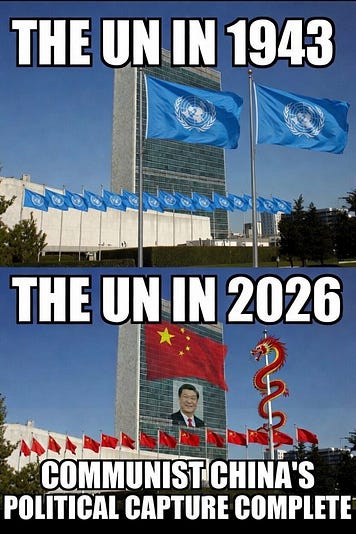
The United Nations was chartered in 1945 as a creation of American strategic vision – a Pax Americana scaffolding dressed in multilateral language that was intended to be a cornerstone of the American-made international order shaped after World War II. That calculus has been fundamentally altered over time. The institution has been methodically infiltrated, staffed, and redirected by the Chinese Communist Party over the past 25+ years, transforming the UN from a tool America shaped into a platform Beijing increasingly controls – and paid for in large part by the American taxpayer.
In 2025, the US was responsible for 22 percent of the UN regular budget and approximately 26 percent of the UN peacekeeping budget. According to the Congressional Research Service, the 2025–2026 UN peacekeeping budget alone is $5.4 billion.
The grotesque irony: China was assessed at roughly 20 percent of the regular UN budget in 2025 – up from just 0.77 percent in 1994 – and nearly 23 percent of the peacekeeping budget, making it the second-largest contributor to both after the United States. While China grew its financial footprint and bought influence accordingly, the US simultaneously funded the organization China is using against American interests. US voluntary contributions alone are seven times more than the entire amount China contributes to the UN system, as noted by the Heritage Foundation. Yet, Beijing has leveraged its smaller investment far more effectively.
US unpaid assessments stand at $1.5 billion for the regular budget and $2.4 billion for peacekeeping – a vivid indicator that even successive American administrations have sensed, however inconsistently, that the value proposition is broken.
CHINA’S 25-YEAR INFILTRATION CAMPAIGN
Beijing’s political takeover of the UN was not accidental. It was a deliberate, patient, multi-vector strategy executed across personnel, finance, voting blocs, and norm-setting.
Financial Escalation. China’s mandatory and voluntary contributions to the UN rose by 1,096% and 346% respectively from 2010 to 2019 alone. Money buys access, gratitude, and votes in any institution.
Seizing Agency Leadership. Until 2006, a Chinese national had never led a UN specialized agency. In recent years, China has led more UN specialized agencies than any other nation – a Chinese national led four agencies in six of the seven years from 2015 to 2021. The agencies targeted were not chosen randomly. China carefully chose clusters whose work could be interwoven with its domestic agendas like “Made in China 2025,” creating new global standards for technology led by Chinese national corporate champions, linked to Beijing’s foreign policy through the Belt and Road Initiative. The International Telecommunications Union has had Chinese representatives serving two terms, ensuring that Huawei’s standards become embedded in sparsely penetrated markets across Africa, the Pacific, and Southeast Asia.
Capturing the Bureaucracy. The Lowy Institute points out that Communist Chinese officials have led the UN Department of Economic and Social Affairs since 2007, with diplomats noting “DESA is a Chinese enterprise, everybody knows it and everybody accepts it.” DESA sets the intellectual direction for economic, environmental, and social policy across the entire UN system. Peer-reviewed research confirms the mechanism: China forms coalitions with weaker states to control leadership appointments, and those China-friendly leaders then align UN bureaucratic language with Chinese-produced documentation. China installs its people; those people rewrite the institution’s discourse.
Building a Voting Bloc. China wields significant influence in the G77 – a grouping of 134 countries comprising almost 70% of all UN members. African nations, as the largest regional bloc with a 28 percent voting share, have played a crucial role in supporting China’s rise, electing Chinese nationals to lead four UN principal agencies and securing deputy slots in nine others. China’s Belt and Road Initiative (BRI) investments in Africa have paid significant geopolitical dividends to Beijing.
Weaponizing the Secretary-General. Beijing has cultivated UN leaders, such as Secretary-General António Guterres, to champion the BRI and align it with the UN Sustainable Development Goals. The UN’s own Secretary-General has effectively become a marketing vehicle for Chinese geopolitical infrastructure.
UN SECURITY COUNCIL: A CHINESE-RUSSIAN ANTI-AMERICAN VETO BLOC
All nine of China’s formal Security Council vetoes in the past decade were cast in tandem with Russia. The two established a functional diplomatic counterbalance against the US, UK, and France – leaving the three Western powers effectively powerless – and the China-Russia alliance has only hardened as a result of the Russo-Ukrainian war.
China has blocked US-backed resolutions on Syria, Venezuela, North Korea, Myanmar, and Zimbabwe, using “sovereignty and non-interference” as cover for protecting regimes serving Chinese interests. Most recently, on 7 April China vetoed a resolution drafted by Bahrain that would have authorized countries to use military force if necessary to open the Strait of Hormuz for the free flow of shipping and commerce.
China leverages its P5 position by threatening vetoes to water down resolutions it considers unfavorable – including resolutions against North Korea and Iran. Every time the US has sought to use the Security Council as a pressure tool, it has had to seek Chinese permission first.
HUMAN RIGHTS AND NORM REENGINEERING
An oft-stated CCP goal is the replacement of the American-designed international order by a new Chinese-dominated world order. A Chinese strategy to help achieve that is the systematic degrading of the UN Human Rights system. A UN whistleblower alleged China’s use of intimidation, bribery, and document editing to remove unflattering facts about COVID-19’s origins and Xinjiang abuses. Despite its abysmal human rights record, China has been reelected to the UN Human Rights Council many times and sits in judgment of other nations while running its own concentration camps.
At the deepest level, Beijing seeks wholesale reform of global governance – what Xi Jinping calls “a new type of international relations” – amounting to a systematic effort to undermine US global leadership as the rivalry intensifies. Chinese attempts to steer away from human rights-related goals toward pure economic development are most visible in the UN’s social-economic bodies, where Beijing has a relatively free hand as Western countries have gradually retreated.
CONCLUDING THOUGHTS
The US pays roughly 22% of the UN’s regular budget and 26% of its peacekeeping costs – the single largest financial subsidy to an institution a hostile power has spent 25 years systematically capturing. China, assessed at nearly 20% today versus less than 1% in 1994, has leveraged that smaller investment with far greater strategic discipline: seizing agency leaderships, building a G77 voting bloc, creating a veto partnership with Russia, and redirecting UN institutional legitimacy to launder Belt and Road geopolitics.
Every purported benefit of US UN membership – international legitimacy, multilateral burden-sharing on security, global norm-setting – depends on the assumption that the institution reflects shared values sympathetic to American ideals and is not captured by a hostile power. That assumption is now empirically false. An institution that Beijing controls cannot simultaneously serve as an extension of American foreign policy. The cost-benefit equation cannot be rescued by pointing to programs that still function; the question is who controls the overall direction, and the above summary is unambiguous about the answer.
Finally, from a pure America First standpoint, the United States is the majority financier of its own strategic containment. The logical conclusion is straightforward: continued full-spectrum US support for the UN as currently constituted subsidizes Chinese power at American expense. The UN must be fundamentally restructured or terminated accordingly.
The end.
StuinSD is a reader-supported publication. To receive new posts and support his work, consider becoming a free or paid subscriber.
This article originally appeared in Stu Cvrk’s Substack. Reprinted here with permission
If you enjoyed this article, then please REPOST or SHARE with others; encourage them to follow AFNN. If you’d like to become a citizen contributor for AFNN, contact us at managingeditor@afnn.us Help keep us ad-free by donating here.
Substack: American Free News Network Substack
Truth Social: @AFNN_USA
Facebook: https://m.facebook.com/afnnusa
Telegram: https://t.me/joinchat/2_-GAzcXmIRjODNh
Twitter: https://twitter.com/AfnnUsa
GETTR: https://gettr.com/user/AFNN_USA
CloutHub: @AFNN_USA