The Emerging Military Project Janus Solution And Future Potential Applications
An ongoing modern day “sky is falling” narrative concerns the increasingly ubiquitous theme of massive data centers from hell moving into unsuspecting cities, towns and states, inflicting on those locales increasing utility costs and also high demand for water that combine to threaten their very existence.
What is behind these stories, what does it portend for society and what–if anything–can be done about it?
The bottom-line answer up front is that the fruition of the dream of modern-day computing is upon us—the idea of having the information highway readily available at everybody’s fingertips—and the price of it is the infrastructure required to build and maintain the back end that powers it.
Also emerging is the potential solution to this problem-on the power side of the equation-called Project Janus that is coming to a military base near you in the near future.
I’m going to suppress my natural tendency to do my own version of a trip down memory lane to describe personal experiences with computers and data centers over the last 50 years or more starting with early military computers–although that threat is real and I will likely cover some of it in what will extend this article into a bit of a series—but it seems only fitting to ease into this story with a discussion of the challenge and the innovative solutions underway that are going to soon debut on military–Army–installations.
Be aware up front that basic Artificial Intelligence (AI)–“like” capabilities at your actual—vice proverbial—fingertips via your computer have pretty much gone viral but have a cost that is already being borne by somebody (that nametag) and much like every other innovation touted to improve your life–there is a burden involved that has to be paid: most certainly by you, either funded directly through subscriptions or via your tax dollars funded by your state and local government (on your behalf—no free lunch.)
The old dog in me will forever couch such matters in terms of the innovation of commercial free cable television: how did that work out for us???
The benefits of the availability of basic information—facts–are obvious. For instance, I listened to a Podcast this week where the message (surprisingly from a black podcaster) was about how few slaves were actually in the United States in comparison with South America, with an absolutely ridiculous number given for each (450 and 10M, respectively) that is easily debunked (the US number) with a generic search that any 7 or 70-year-old can accomplish in today’s compute environment. The chart below is a snapshot of a longer response that can be expanded—courtesy of AI–into an actual report with citations, including candidate arguments about the facts.

The point here is somewhat peripheral to this issue but has everything to do with how the availability of information has become so ubiquitous in our lifetimes that you spout inanities and lies at your own peril and risk from a reputation standpoint, as even your kids are going to be debunking ignorant (as in lacking knowledge,) erroneous and false beliefs in real time.
In my simple little vignette that has nothing to do with AI and everything to do with the availability of information, the internet provides documentation within seconds of a query with information up to the late 1900s and the Civil War and it doesn’t take a genius to do a little math. This was ~ 166 years and generations ago—providing grist for a little thinking about things like reparations to help work through that topic (as well.)
Particularly about those who came to this country in the 20th century where they missed the slave period and had absolutely zero to do with it, but did get the opportunity to participate in a World War or two and even more conflicts short of war…
What will in the near future optimistically come to be known as the legacy modern data center providing High Performance Computing (HPC) involves somewhat simplistic approaches to deal with massive heat challenges as Moore’s Law continues to play out amid ever increasing and denser chip stacks.
Characterized as voracious power and water consuming challenges that require novel cooling techniques to produce an air conditioned, refrigeration-like environment that demands extraordinary amounts of both (power and water) far in excess of normal demands. With chillers and Computer Room Air Conditioning (CRAC) units and miles of refrigeration lines and vents and power sucking components.
Many legacy data centers employ any one of a number of legacy solutions and will face tough decisions going forward as the cost of more elegant solutions is factored in to keep up with the cool kids (pun intended) represented by ever increasing and more powerful, massive processing solutions.
As in everything these days that attracts public attention often funded via anti-growth groups, there has been an allergic reaction to these data center projects across the country, notwithstanding that entire corridors dotted with these massive data centers have sprung up in this century along innovation corridors in places like Virginia (for instance,) where taxpayers have “helped” incentivize the builds through generous tax incentives provided by state and county legislatures.
This AND Substack article has good information on the power and water requirements but somewhat wanders off too quickly-like immediately–to the Surveillance State allegedly driving some of these developments. Which is understandable given government agency somewhat massive data capability expansions over the last decade and the use of some of these facilities in spying and censorship efforts against US citizens, often in violation of US law.
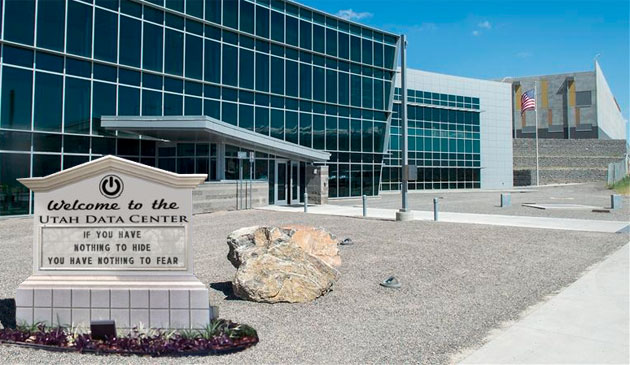
Long before the recent expansion of the past several years specifically focused on data capture and AI, the National Security Agency completed a hybrid cloud analytics solution to power the Real Time Gateway to facilitate targeting operations in Iraq and Afghanistan, among other hot spots around the world. NSA Director GEN Keith Alexander’s philosophy increasingly based on the belief that you “can’t analyze data you do not have,” which led to a massive NSA Data Center project in Utah some 5 or so years later code named Bumblehive that enabled massive storage capability on a scale never approached before that only increased the already somewhat paranoid and conspiracy focused public to think the worst: many of whom would be proven right.
NSA has somewhat a sense of humor about all this, as their literature encourages you to “learn more about these secrets…” While reviving my tongue in cheek observation about data storage terms.
Data Storage Units Chart: From Smallest to Largest
| Unit | Shortened | Capacity |
| Bit | b | 1 or 0 (on or off) |
| Byte | B | 8 bits |
| Kilobyte | KB | 1024 bytes |
| Megabyte | MB | 1024 kilobytes |
| Gigabyte | GB | 1024 megabytes |
| Terabyte | TB | 1024 gigabytes |
| Petabyte | PB | 1024 terabytes |
| Exabyte | EB | 1024 petabytes |
| Zettabyte | ZB | 1024 exabytes |
| Yottabyte | YB | 1024 zettabytes |
To which I add-to humor our data scientists-“a lotta”-LB, which is 1024 Yottabytes, and Schift Lotta, “SL,” which is 1024 Lotta bytes.
We will leave that for another time and a later article, but some good information from the And Substack piece:
What Makes AI Data Centers Different?
Traditional data centers focus on storage, websites, and general cloud services. AI data centers are optimized for training and running massive models using dense clusters of GPUs and accelerators.
- Power Density: AI racks routinely draw 30–120+ kW (and up to 300+ kW in advanced designs), versus 5–15 kW for standard racks. Large campuses can demand 100 MW to over 1 GW — enough electricity for hundreds of thousands of homes.
- Cooling Demands: Extreme heat requires liquid cooling systems that consume millions of gallons of water daily.
- Infrastructure: These facilities need reinforced structures, massive electrical systems, and ultra-high-bandwidth interconnects.
Projections indicate U.S. data centers could consume 6.7–12% of national electricity by 2028, with AI as the main driver. The question lingers: how much of this power-hungry infrastructure is truly advancing human knowledge versus enabling unprecedented surveillance?
I’m going to ignore the bait of going into the topic of unprecedented surveillance (he cried) in favor of perhaps addressing that topic in a later article. Notwithstanding it is one of my favs—for instance, the recent disclosures by the Director of National Intelligence (DNI) of abuses and the earlier reports of some 270K Foreign Intelligence Surveillance Act (FISA) requests that were erroneously—and improperly—illegally–undertaken by the Federal Bureau of Investigation (FBI) in 2020-2021 alone.
Never mind the Department of Justice Inspector General report on FISA abuse that found 17 FISA violations–inaccuracies and omissions–in the Trump focused FBI spying effort alone: 17 (whaaat, the DOJ subordinate agency FBI spied on Trump?)
So kudos to the paranoid, conspiracy theorists who were on to something and have been proven right time-and-time again.
I know, I know, who cares, old news.
Break—break. Have you heard of Project Janus?
In 2015 the then DoD now DoW stood up the Defense Innovation Unit Experimental (DIUX, now DIU) out at Mountain View California by Menlo Park by the Stanford Research Center where the somewhat infamous CIA led In-Q-Tel (IQT-putting James Bond’s “Q” in the intel community)-with headquarters in Tyson’s Corner-has a presence in the heart of Silicon Valley.
To make a long story somewhat short, our agency InnoVision Directorate was tapped as somewhat of an advisor to DIUX standup efforts as a natural progression to our Pathfinder Project (where we were experimenting with a deep dive on intelligence reporting from purely and totally unclassified information sources.) I was the senior advisor to the Pathfinder effort (which resulted in the Director of National Intelligence, National Geospatial-Intelligence Agency Tearline effort, here and also here) and also the NGA lead for our IQT investments.
We would later establish a fledgling–and ill-thought through–too wide eyed, optimistic initiative–called the NGA Outpost Valley (NOV) where we placed a team in the Valley to coordinate leading edge technology efforts to leverage the momentum of our IQT investments (which were doubled,) provide synergy with DIUX, and to establish a presence in an emerging Amazon Web Services (AWS) data center collaboration with other agency partners in the ODNI Intelligence Community Information Technology Enterprise (ICITE) initiative built close to Menlo Park to serve as a data hub for “schtuff.”
Which–full disclosure–I initially supervised as well (NOV) but as our Deputy Director (DD) increasingly adopted the project as “her baby,” while substituting kindness and a sympathetic ear for accountability, milestone accomplishment and supervision, I “jumped” off that bandwagon.
The IG would later–after the departure of the DD for greener and higher pastures at DNI and also my retirement–produce a scathing report about the lack of accountability and supervision and care of taxpayer dollars that resulted in personnel from that initiative retiring ahead of any potential repercussions or accountability.
To which your correct and proper response would be-what in the name of Great Ceasar’s Ghost does this have to do with this topic?
Well, it turns out that DIU-which I still follow somewhat closely given the above history–is the DoW agency on point leading government contracting for Project Janus, which is scheduled to throw the switch 4 July 2026 on the first microreactor nuclear powered solution for military bases, starting with the Army.
A fund I subscribe to is also a big fan of the solution at the heart of this project, the TRISO Fuel Pebble concept emerging with these microreactors and recently had a very informative marketing pitch where the Janus Project and TRISO Fuel Pebbles were discussed in detail, while also disclosing one of the main companies involved in the project: BWXT.
Which I had already been following closely with all the hoo hah about the Janus Project. But what a coincidence to find out on 5 June that Maryland Representative April McClaine Delaney had invested in the stock as well. The fund pitch was about the other four companies being touted for investment, which were touched upon, but the names were not given. But for the special price of whatever XXXX you could get all 5, including the slicing, dicing, etc., etc… NVIDIA is not some great shakes mystery company involved to figure out, neither was Centrus Energy Corp (but I digress.)
Two takeaways from the above information. Number one is the fact that these TRISO Fuel Pebbles powering these microreactors are likely coming soon to a military installation near you and they have the potential to solve the challenging problems these data centers present for communities.
Secondarily I think the Maryland Congresswoman—Delaney—has some splaining to do, as she just outed herself as a Nanny Peloozi acolyte when it comes to her investing habits, a product of her service on the House Science, Space and Technology Committee.
The bottom line down the bottom is the Janus Project plans to throw the switch on the first microreactor 4 July 2026 in celebration of the US 250th Anniversary Celebrations and it potentially heralds a breakthrough on the power front that could pave the way to revolutionize how cities/counties and states solve the power problem for these facilities without bankrupting themselves or impacting citizens lives through artificial and burdensome conservation restrictions.
If they work as advertised.
More to follow.
Max Dribbler
15 June 2026
LSMBTGANF: Lamestream media echo chamber (LMEC-L) social media (SM) big tech tyrants (BT,) government (G,) academia (A,) non-government officials (N) and foreign (F)
If you enjoyed this article, then please REPOST or SHARE with others; encourage them to follow AFNN. If you’d like to become a citizen contributor for AFNN, contact us at managingeditor@afnn.us Help keep us ad-free by donating here.
Substack: AmericanFreeNewsNetworkSubstack
TruthSocial:@AFNN_USA
Facebook: https://m.facebook.com/afnnusa
Telegram: https://t.me/joinchat/2_-GAzcXmIRjODNh
Twitter: https://twitter.com/AfnnUsa
GETTR: https://gettr.com/user/AFNN_USA
CloutHub: @AFNN_USA