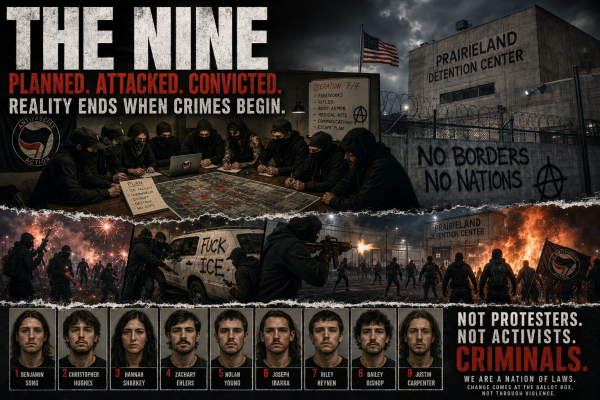
The Prairie Land Nine case should serve as a wake-up call to anyone who believes political violence is just another form of activism. In America, there is a bright line between exercising your constitutional rights and committing crimes. Once you cross that line, the Constitution doesn’t disappear—but neither do the consequences.
For years, social media has rewarded outrage. It has turned vandalism into content, riots into livestreams, and criminal behavior into political theater. Too many people have convinced themselves that if they believe strongly enough in a cause, the law somehow becomes optional. It doesn’t.
America was never designed to operate through intimidation or mob rule. We settle our differences with ballots, debate, legislation, and the courts—not Molotov cocktails, bullets, fireworks, or organized attacks on public institutions. You don’t have to like the outcome of an election or agree with a government policy. In fact, you’re free to criticize it loudly. That’s one of the greatest strengths of a constitutional republic. But freedom of speech is not a license to commit violence.
History is filled with examples of nations that abandoned the rule of law in favor of political violence. It rarely ends with more freedom. It usually ends with fear, retaliation, and ordinary citizens caught in the middle while extremists convince themselves they’re the heroes of the story.
One of the most dangerous lies of the social media era is the belief that the real world works like an online echo chamber. On the internet, people cheer reckless behavior with likes, reposts, and hashtags. In a courtroom, none of that matters. Jurors don’t count followers. Judges don’t weigh retweets. Federal prison doesn’t care how many people agreed with your political manifesto.
That’s the disconnect many activists—on both the far left and the far right—fail to understand. Politics is not a video game. There is no reset button after someone gets shot, a building burns, or a federal crime is committed. Real people bleed. Real officers go home injured—or don’t go home at all. Real defendants spend decades behind bars.
The genius of the American system isn’t that it always produces the outcome everyone wants. It’s that it provides peaceful mechanisms to change direction. If you don’t like immigration policy, campaign for different candidates. If you don’t like taxes, organize voters. If you think Congress has failed, elect a new Congress. Every major reform in American history has ultimately required persuading enough citizens to support change.
Direct political violence isn’t courage. It’s an admission that you’ve abandoned the democratic process because you couldn’t convince your fellow Americans.
The rule of law is one of civilization’s greatest inventions. It protects the powerful from arbitrary government, but it also protects ordinary citizens from those who believe their cause entitles them to ignore the law. Once society accepts that political violence is justified whenever someone feels morally certain, every faction eventually claims that privilege.
That’s a road America should never travel.
The Prairie Land prosecutions send a simple message: protest is protected, violence is prosecuted. Peaceful dissent is an American tradition. Organized criminal acts are not. Our republic is imperfect, often frustrating, and sometimes painfully slow. But if you want to change it, the ballot box will always be a better tool than a brick—and infinitely better than a gun.
Democracy is messy. The alternative is usually much worse.
If you enjoyed this article, then please REPOST or SHARE with others; encourage them to follow AFNN. If you’d like to become a citizen contributor for AFNN, contact us at managingeditor@afnn.us Help keep us ad-free by donating here.
Substack: American Free News Network Substack
Truth Social: @AFNN_USA
Facebook: https://m.facebook.com/afnnusa
Telegram: https://t.me/joinchat/2_-GAzcXmIRjODNh
Twitter: https://twitter.com/AfnnUsa
GETTR: https://gettr.com/user/AFNN_USA
CloutHub: @AFNN_USA