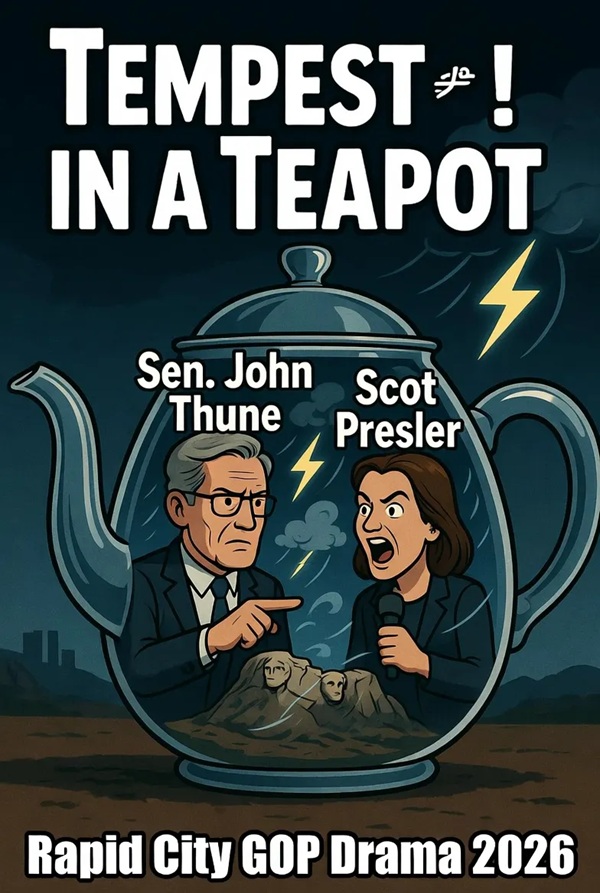
How a VIP dinner dustup became a social media myth
The South Dakota Republican Party’s 2026 State Convention had barely adjourned on 27 June before the story began morphing into something unrecognizable — a cautionary tale about how political social media can transform a minor kerfuffle into a dramatic narrative of martyrdom and persecution.
Let’s examine what happened in detail (note: your scribe was a delegate there throughout the events below).
Scott Presler was there. Let’s be clear about that from the start.
The prominent conservative activist and voter registration crusader arrived in Rapid City with a clear agenda: he wanted to look US Senator John Thune (R-SD) in the eye and ask why the senior senator from South Dakota — the Senate Majority Leader — had not marshaled his considerable institutional power to get the SAVE Act across the finish line.
It was a reasonable grievance. The Safeguard American Voter Eligibility Act, which would require proof of citizenship to register to vote in federal elections, commanded support from more than seventy percent of Americans across every major demographic group. Yet it languished in the US senate. Presler intended to say so loudly.
He attended the Convention’s Resolutions Committee sessions on both days of deliberations, seated in the designated guest areas, checking in through the same process as every other non-delegate visitor. When the floor sessions opened, he was there too — seated in the back of the hall behind the several hundred credentialed delegates, watching the proceedings like any invited guest. The Convention did not throw Scott Presler out. The Convention welcomed Scott Presler as a guest, because that is what he was.
What the Convention did not do was seat him at a private VIP dinner.
THE VIP DINNER EVENTS
Thursday evening, the SDGOP had organized a dinner that was sponsored by Senator Thune — a ticketed event, one of those quiet political dinners where senators decompress with donors and loyalists and others. The special guest was DHS Secretary Markwayne Mullin. Presler wanted in. The problem was that he didn’t have a ticket, at first.
Presler obtained a ticket from someone who had purchased one – either a delegate or a Convention guest who possibly wanted to help instigate a scene.
Regardless of how he obtained his ticket (he didn’t purchase one), Thune’s staff were firm: Presler was not to be admitted. The state party chairman agreed as a preventive measure to avoid a disruptive scene that would detract from the Convention, as well as to simply maintain decorum. He asked one of the sergeants-at-arms — a role filled throughout the Convention by several formidable individuals — to prevent Presler from entering the room.
That confrontation at the entry door went sideways.
The sergeant-at-arms, apparently operating on personal conviction rather than professional restraint, turned what should have been a brief, quiet barring of entrance situation into a verbal tirade. He exceeded his authority. The Party took it seriously: he was relieved of his duties, and an apology was subsequently issued to Presler by State GOP Chairman Jim Eschenbaum.
Presler did not attend the dinner. He did not leave the Convention.
THE FATE OF THE CENSURE RESOLUTION
The following day, Presler’s primary interest bore fruit in committee — though the fruit would prove bitter on the floor.
A censure resolution targeting Thune had been submitted to the Resolutions Committee, focused narrowly and specifically on his handling of the SAVE Act. The resolution did not attack Thune’s tenure broadly. It did not relitigate his Senate leadership race. It did not challenge his confirmation work — the state party had in fact commended him warmly for his efforts on Trump appointee confirmations back in May 2025 through a separate resolution! The proposed censure was a single, pointed message: get the SAVE Act done.
The arguments assembled in support were substantive. Senate leadership had orchestrated a full-court press to pass the One Big Beautiful Bill — coordinated communications strategies, passionate floor remarks, aggressive public appearances by multiple senators, sustained pressure. None of that energy had been applied to the SAVE Act. No walking filibuster to put pressure on Democrats who were blocking a measure most of their constituents supported. No use of the Senate Leadership Fund to bring wavering Republicans into line. No threats regarding committee assignments for foot-draggers. And in Thune’s own public appearances — interviews, floor remarks ahead of procedural votes — critics detected no fire, no urgency, no sense that this was a battle being waged rather than managed.
The committee was persuaded. The resolution passed out of committee by an overwhelming margin.
The floor was a different story.
Thune had loyalists among the delegates, and they understood parliamentary time. The debate period was finite. They used it. Speaker after speaker rose to warn of catastrophe — that a censure resolution, however narrow, would “destroy” Thune’s standing as Majority Leader, would hand Democrats a weapon, would fracture the South Dakota delegation’s influence at the precise moment it was greatest. The floor echoed with alarm. The pro-censure voices, carrying the more technical but arguably more substantive argument about legislative tactics and leadership accountability, ran out of time before they could make their case fully.
The resolution failed in the floor vote.
CONCLUDING THOUGHTS
By the time the Convention adjourned, and as delegates drove home across the South Dakota prairie, social media had already written a different story – without knowledge of the above facts.
Presler himself framed the evening’s dinner incident in dramatic terms in a series of posts on X. His followers, many of them passionate and virtually all of them absent from Convention in Rapid City, amplified the account. Other influencers, operating entirely on secondhand information, added their own embellishments. Within hours, the narrative had calcified: Scott Presler had been thrown out of the South Dakota State Convention by Party establishment forces desperate to silence dissent.
It was false. It was demonstrably, documentably false. And it spread anyway.
What actually happened was this: a man attended a political convention as a guest, sat through two days of committee hearings, watched floor sessions from the back of the hall, got turned away from a ticketed dinner for which he himself had not purchased a ticket, and endured a sergeant-at-arms behaving badly enough to lose his position. The censure resolution he had tracked with interest passed committee convincingly and then died on the floor when debate time ran out before its supporters could finish their argument.
A sergeant-at-arms lost his job for cause. An apology was issued. A censure resolution failed. A dinner was missed.
A tempest in a teapot — brewed strong, served hot, and poured across ten thousand timelines before anyone stopped to ask whether the kettle had actually boiled.
The end.
Note: The SAVE Act remains pending in the United States Senate.
If you enjoyed this article, then please REPOST or SHARE with others; encourage them to follow AFNN. If you’d like to become a citizen contributor for AFNN, contact us at managingeditor@afnn.us Help keep us ad-free by donating here.
Substack: American Free News Network Substack
Truth Social: @AFNN_USA
Facebook: https://m.facebook.com/afnnusa
Telegram: https://t.me/joinchat/2_-GAzcXmIRjODNh
Twitter: https://twitter.com/AfnnUsa
GETTR: https://gettr.com/user/AFNN_USA
CloutHub: @AFNN_USA