The partial government shutdown over Immigration and Customs Enforcement (ICE) protocols and the heated debate over the proposed Save Act demonstrate how deeply divided our political leaders have become over immigration. Politicians’ actions and rhetoric are driven by concrete motives, and immigration is no exception. Because immigration policy, both current and future, will significantly shape the long-term trajectory of our country, it is important to separate actual motives from the often misleading rhetoric that bombards us daily. Historical context is an essential tool for this task.
When stated justifications for a policy don’t match the actual consequences, it is a sign to dig deeper.
For example, Republicans emphasize enforcing existing immigration laws and safeguarding American citizens by prioritizing the deportation of criminal illegal immigrants. However, deportations have gone well beyond the stated priority of targeting criminals, resulting in the removal of many long-term productive residents. Critics argue the real objective may be the removal of all illegal immigrants and that aggressive enforcement has caused unnecessary harm to legal immigrants and American citizens.
Democrats, by contrast, have prioritized the rights and due process of undocumented immigrants. Their proposals, coupled with existing sanctuary policies, would significantly slow deportations. Critics contend that significantly slower deportations may be the actual goal. They also point out that sanctuary policies have frequently led to criminal illegal immigrants being released into communities rather than referred to ICE, resulting in several high-profile murders and other serious crimes.
This ongoing conflict reached a flashpoint during Operation Metro Surge in Minneapolis-St. Paul. Clashes between ICE agents and protesters, some of whom turned violent, escalated into a deadly confrontation. Federal agents fatally shot two American citizens amid the chaos. Both parties have blamed the other, with some facts still in dispute.
The proposed SAVE Act (Safeguard American Voter Eligibility Act) would require documentary proof of U.S. citizenship for voter registration in federal elections and photo identification when casting a ballot. The majority of Republicans, Democrats and Independents support the bill. Democratic leadership argues the Save Act is Jim Crowe 2.0 and potentially disenfranchises groups who might have difficulty obtaining the necessary documents. Critics view these as questionable arguments raising questions about ulterior motives. Republicans frame the bill straightforwardly as protecting the vote from potential fraud. Even so, critics worry it could make voting more difficult.
The stakes are substantial. According to Federation for American Immigration Reform (FAIR) there are approximately 18.6 illegal immigrants in the country, a number that increased significantly under the Biden administration. Assuming legalization and naturalization of these individuals, there could be electoral consequences that shift the balance of power for decades.
Please note that the Census count includes illegal immigrants. Since the 435 congressional seats are apportioned on this population data, in 2030 the size and location of the illegal immigrant population could have an impact on who wields power in Washington.
The constant drumbeat of media messaging in both Democratic and Republican echo chambers reinforces the skepticism noted above. Generally, this messaging from the politicians and their media outlets intentionally targets our emotions. For example, right-wing media highlights murders and crimes by illegal immigrants while left-wing media highlights family separation and the two fatal shootings by ICE. While these stories are relevant, it is important to discern if they speak to the overall policy or the process of implementing that policy. Emotional stories can short-circuit this evaluation and obscure the big picture.
To complicate matters, some stories are told minus salient facts while others are so mischaracterized they become lies. In short, the “emotional story” tactic is often targeted manipulation for political gain. Both sides employ this tactic.
To be informed voters, we must navigate the constant barrage of influence campaigns and carefully discern the facts. One of the most effective tools for doing so is placing the issue in its proper historical context.
To understand how the political parties are leveraging immigration policy now, this series of articles examines how they leveraged it in the past. Even though it is a brief overview, it will be eye opening, connect the dots between the past and the present, and offer avenues for additional exploration. Let’s dive in.
19th Century Political Machines, 1840s through Early 20thCentury
“Political machines were highly organized, hierarchical party structures—usually urban or local—that centralized political power in the hands of a single “boss” or small inner circle. They operated like efficient, semi-private organizations that traded tangible benefits (patronage jobs, city contracts, housing assistance, food, coal, legal help, or outright cash) for votes, loyalty, and campaign support.” Both parties operated political machines.
The Democratic Party’s urban political machines, which dominated most big-city machines, built a powerful voter base by courting successive waves of Irish, German and later, Southern/Eastern European immigrants. It was brute, hands on politics. With an organized hierarchy deeply embedded in the community, the machines provided jobs, social services, housing aid and expedited naturalization in exchange for loyal votes, voter turnout and organizational support.
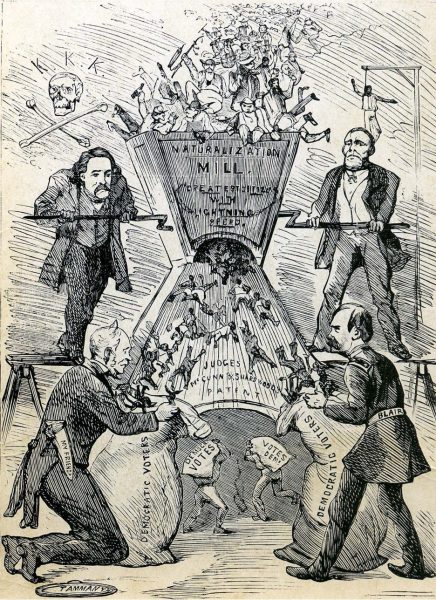
Since the Naturalization Act of 1795, the minimum naturalization period was 5 years. While the political machines did assist immigrants who had met the requirements, they also gamed the system to fast-track naturalizations especially during election years. Their tactics included bribing judges, backdating arrival dates and paying witnesses to lie about applicants’ arrival dates.
Tammany Hall was a notorious New York City machine that earned its reputation in part for creating “naturalization mills” during election seasons – high volume, rapid, frequently fraudulent processing of naturalization applications. In 1868 it is estimated that 41,000 – 44,000 immigrants were naturalized in September and October with 85% of the new citizens voting Democrat.
While Tammany Hall in New York City was a notorious example of a Democratic party machine that traded services for votes, this model was replicated successfully in other urban cities such as Chicago, Boston, Jersey City, Kansas City and Albany. Their efforts resulted in solid Democratic control for decades.
While the Democratic machines were dominant in many urban areas, Republicans also built political machines employing many of the same tactics. Republicans had their share of colorful corrupt bosses. The difference is they targeted different constituencies such as business interests, Protestants, Union veterans and specific immigrant groups like Germans and African Americans. They were more closely aligned with industry and railroads whereas Democrat machines offered welfare-style services to newly arrived immigrants.
After over 60 years the era of the political machines came to a close: “By the early 1900s, this had become a national scandal. Observers feared it was corrupting elections and devaluing genuine citizenship. A 1903 report by Special Agent C.V.C. Van Deusen (to the Attorney General) declared that the administration of naturalization laws was “contemptuous, perfunctory, indifferent, lax, and unintelligent, and in many cases … corrupt.”” Public outrage and Progressive lobbying efforts in favor of centralized government control led to the Naturalization Act of 1906 which federalized the process.
Act to Encourage Immigration (1864)
This Act was a Republican effort led by Lincoln to address severe labor shortages caused by the Civil War and the only bill ever passed that encouraged immigration. Secondary goals included settling the Western territories and supporting the Union economy. It was repealed in 1868 due to opposition from labor organizations who claimed it undercut wages and working conditions.
Ironically, it was Democrats, not Republicans who reaped the political rewards of this Act since Democratic machines were ready and willing to welcome the new immigrants into their organizational structure in exchange for their votes.
The Immigration Act of 1924 (Johnson-Reed Act, National Origins Quota Act)
While it does not appear that either party derived immediate electoral benefit from the passage of the Immigration Act of 1924, it is a key historical event in immigration history. It was passed under Republican President Calvin Coolidge with broad bipartisan support: 323-71 in the House and 69-9 in the Senate. The Act dramatically cut overall immigration rates and imposed quotas heavily favoring Northern and Western Europeans while restricting Southern/Eastern Europeans.
The Act effectively banned Asians on racial grounds and severely restricted applicants from African countries. Interestingly, immigration from the Western Hemisphere was not subject to quotas even though it was curbed by “literacy tests, public charge rules, head taxes, visa fees, and contract labor prohibitions”. Uncapped but regulated western hemisphere immigration was driven by the desire to continue good relations with our neighbors but more importantly to satisfy the demands of cheap-labor interests of American employers.
Competing against industry, labor unions were a driving force behind the restrictionist policies of the 1924 Immigration Act. The American Federation of Labor (AFL) under Samuel Gompers, led a sustained and organized lobbying effort based on the argument that waves of immigrants served to depress wages and undermine working conditions. Immigrants also provided ready-made pools of strikebreakers which created a major barrier to unionization.
Beyond labor and industry’s competing economic interests, the US State Department stated the goal was “to preserve the ideal of US homogeneity”.
Yet another justification for the bill was widespread adoption of the new “science” of eugenics, that era’s shiny new theory. “It drew from the ideas of Francis Galton (who coined the term in 1883) but had evolved in the United States into a prominent movement emphasizing both positive eugenics (encouraging reproduction among those deemed “fit” or superior) and negative eugenics (preventing reproduction or entry among those deemed “unfit” or inferior)”
The “science” of eugenics was adopted first by Progressive elites followed by the universities, institutions and then the general public across party lines.
For example: “Harry Laughlin (who served as “Expert Eugenics Agent” to the House Immigration Committee) testified and lobbied that Southern and Eastern Europeans carried higher rates of “feeblemindedness,” criminality, and other undesirable traits that would “adulterate” America’s “germ plasm.” Rep. Albert Johnson (R-WA), the bill’s chief House sponsor and a eugenics advocate, chaired the committee; the quota formula itself originated in a eugenics subcommittee report. The explicit goal was to “change the character of immigration, and hence of our future population, by bringing about a preponderance of immigration of the stock which originally settled this country.””
Support for national origin quotas was also driven by high unemployment and a broader desire for isolationism after the WW1 and concern that Bolsheviks and anarchists would enter the country via immigration.
The Immigration Act of 1924 set the stage for the Immigration Act of 1965, which we will outline in Part 2 of this series. The 1965 Act established the basic framework of our current immigration system. Understanding how this bill evolved will shed important light on how we arrived at today’s situation.
DETAILS
- June 12, 2026 update: further research indicated I had understated union influence on the 1924 Act and I made the appropriate correction. For more information please consider this companion pierce on the impact of labor unions on immigration policy over the decades.
- I published “The Clash Over Immigration: Part 2” on April 6, 2026.
- Links are provided though out for deeper dives on individual subjects.
- We can expect the rhetoric between the parties over Birthright Citizenship will be equally divisive.
- For additional history of immigration laws considering Cato Institute’s “Brief History of US Immigration Policy from the Colonial Period to the Present Day” and Federation of American Immigration Reform’s “History of U.S. Immigration Laws”.
- For those interested in following the history, links are included below:The Clash Over Immigration, Part 1 – the article aboveThe Clash Over Immigration, Part 2The Clash Over Immigration, Part 3The Clash Over Immigration, Part 4The Clash Over Immigration, Part 5
If you enjoyed this article, then please REPOST or SHARE with others; encourage them to follow AFNN. If you’d like to become a citizen contributor for AFNN, contact us at managingeditor@afnn.us Help keep us ad-free by donating here.
Substack: American Free News Network Substack
Truth Social: @AFNN_USA
Facebook: https://m.facebook.com/afnnusa
Telegram: https://t.me/joinchat/2_-GAzcXmIRjODNh
Twitter: https://twitter.com/AfnnUsa
GETTR: https://gettr.com/user/AFNN_USA
CloutHub: @AFNN_USA