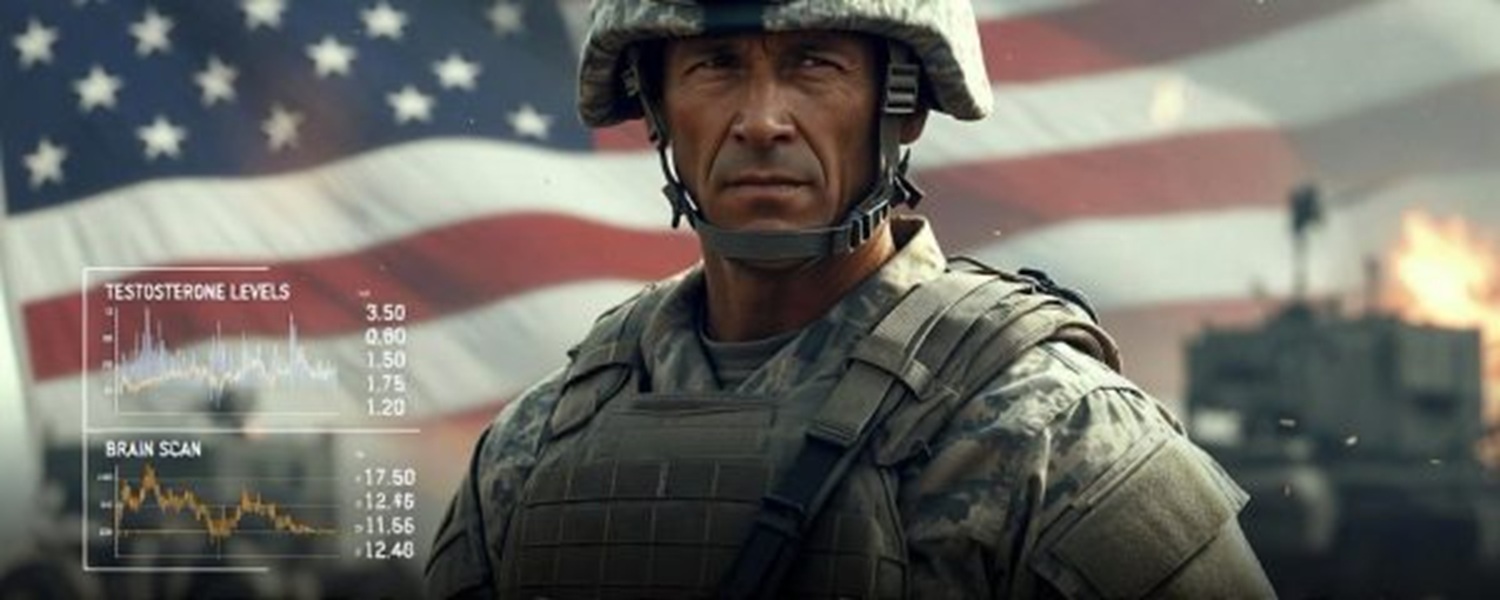
THE DEPARTMENT OF WAR JUST DID IN ONE VIDEO WHAT THE VA COULDN’T DO IN TWENTY YEARS. SOME PEOPLE FOUND THAT HILARIOUS.
Let me set the scene. Secretary Hegseth posts a video Wednesday announcing that service members thirty and older will now get annual testosterone screenings, with treatment available if they need it. Troops under thirty can opt in voluntarily. He calls it keeping warfighters on “the leading edge of lethality.” Reasonable people would call it overdue.
Instead, within hours, a Congresswoman and a rotating cast of X commentators decided the funniest response to a medical screening program for combat-injured troops was to turn it into a punchline about gender. So today’s lesson is going to cover two things: what actually happens to a combat veteran’s hormones, and why the people laughing about it should sit down and take notes, because apparently nobody assigned them the reading.
— WHAT A BLAST WAVE ACTUALLY DOES TO A BODY —
Here is the part everybody skipped. Testosterone deficiency in combat veterans is not a vanity issue. It is not a lifestyle preference. It is a documented, measurable, physiological injury with a name, a mechanism, and a body of research behind it.
Traumatic brain injury, especially the blast-related kind that has defined the last two decades of war, frequently damages the pituitary gland. That gland is the control center that tells the testes how much testosterone to produce. Break the control center and the signal drops, sometimes catastrophically. Studies on severe TBI cases show up to eighty percent involve low testosterone. Even mild, blast-related concussions carry meaningfully elevated risk. TBI alone has been shown to more than double the odds of hypogonadism in veterans.
Then stack on the rest of what a deployment does to a body: months of four hours of sleep a night, chronic cortisol flooding the system from sustained combat stress, energy deficits from running hard on an MRE and adrenaline, and in many cases direct injury from blast exposure to the reproductive organs themselves, which has occurred in numbers most Americans would find hard to believe. Add burn pit exposure on top of that. The smoke from those pits contained dioxins and other compounds that function as endocrine disruptors, the same family of chemicals linked to reproductive hormone disruption in Agent Orange-exposed Vietnam veterans. This is not a new mechanism. It is an old one wearing a new uniform.
Put all of that together and you get a documented clinical framework called Operator Syndrome, first formalized by Dr. B. Christopher Frueh in 2020 and validated further in 2025 research on active-duty special operations personnel. It describes a predictable cluster of injuries from cumulative operational stress: hormonal collapse, sleep disorders, chronic pain, cognitive impairment, and mood disruption, all traceable back to a body that was run past its design limits in service to this country. Roughly ninety percent of studied operators show measurable impact across these domains. This is not a theory. This is a body of clinical literature.
— THIS IS NOT AN EXPERIMENTAL PROGRAM, EITHER —
For anyone worried this is untested medicine being forced on soldiers, the safety data already exists. The TRAVERSE trial, published in the New England Journal of Medicine in 2023, followed over five thousand men with confirmed low testosterone and high cardiovascular risk for an average of nearly two years. Testosterone replacement therapy showed no increase in heart attack, stroke, or cardiovascular death compared to placebo. There were some secondary signals worth monitoring, a modest bump in atrial fibrillation and blood clot risk, which is exactly why the DOW program calls for supervision by actual medical professionals rather than a self-serve pill dispenser. This is standard, monitored, evidence-based endocrine care. It has more research behind it than half the things Congress votes on without reading.
— WHY THIS ISN’T “GENDER-AFFIRMING CARE,” CONGRESSWOMAN —
Rep. Summer Lee’s response to all of this was to ask, “so now y’all support gender-affirming care?” I want to walk through exactly what is wrong with that sentence, slowly, because I don’t think the distinction registered.
Gender-affirming care, as your own party has defined it in law and in policy for a decade, is treatment aligning a person’s body with a gender identity that differs from their biological sex. What the Department of War announced is treatment restoring a documented, service-connected hormone deficiency to a combat veteran’s own biological baseline. One is about changing what the body is. The other is about repairing what the war took from it. These are not the same category, and pretending otherwise is either a failure to understand basic endocrinology or a deliberate attempt to score a cheap political point off a guy who can’t produce enough of his own hormone because an IED rearranged his pituitary gland. I’ll let you pick which one is worse.
Quinn’s Law Number Two applies here nicely: pay close attention to what liberals accuse conservatives of doing, because it is usually a confession. Your party spent the better part of a decade insisting that hormone therapy is basic healthcare, a human right, something insurers must cover without question for anyone who requests it, no argument, no debate. Now a documented combat injury gets a hormone panel and suddenly it’s a meme for you to post at 1:42 in the afternoon. Quinn’s Law Number Six fits just as well: facts are the enemy of liberalism, and the fact here is inconvenient. Blast-exposed troops have a measurable hormone problem. You turned that into a punchline instead of a policy conversation. That’s a choice, and it says more about you than about the program.
— MEET THE COMEDY HOUR —
Rep. Lee wasn’t alone in finding a documented combat injury funny. A few others deserve their own paragraph, mostly so the actual veterans dealing with this can see exactly who thought their bodies were a punchline.
One account, posting as
, joked that the military would apparently rather fund a hormone panel than pay for LASIK, framing the whole thing as though eyesight matters more than a soldier’s endocrine system working correctly. Cute joke. Doesn’t change the fact that one of these conditions is optional vision correction and the other is a documented combat injury affecting sleep, mood, muscle mass, and long-term cardiovascular health.
Another,
, skipped the veterans entirely and went for a lazy jab at the Secretary himself, insinuating his own testosterone levels explain his temperament. That’s not a critique of policy. That’s a schoolyard insult standing in for an argument, which tells me the argument wasn’t there to begin with.
A third,
, framed the entire screening program as older generations being insecure about their masculinity, questioning why the government should get to tell a thirty-year-old soldier whether he’s “man enough.” Except nobody at the Department of War is grading anyone’s manhood. They’re running a lab test. The only person bringing manhood into a conversation about a hormone panel is the person writing the tweet.
I’ll be direct about something here too: I was not able to independently verify every one of these accounts through my own research, and I’d encourage anyone sharing this to confirm the exact wording before piling on. Get the receipts right. Precision matters, especially when the people you’re correcting got the facts wrong first.
— THE CONTRAST NOBODY’S TALKING ABOUT —
Here’s what actually deserves attention today: how fast this moved. Compare this to the fight burn pit veterans had to wage just to get the government to admit toxic smoke exposure was making them sick. That fight took the better part of a decade, multiple failed votes, and Jon Stewart showing up to Congress to shame lawmakers into finally passing the PACT Act in 2022. Compare it further to the Major Richard Star Act, which still hasn’t passed after years of advocacy, discharge petitions, and combat-wounded veterans calling their own representatives begging for a floor vote on H.Res. 1247. Fifty-four thousand medically retired veterans are still waiting on Congress to stop clawing back their own earned retirement pay.
And yet here we are. One video. One Wednesday. No act of Congress required, no ten-year campaign, no celebrity testimony needed. The Department of War identified a documented physiological gap in veteran care and closed it before lunch. Under Biden’s Autopen, veterans got task forces and studies. Under this administration, they got an actual lab order.
So my thanks to Secretary Hegseth, genuinely, for not making combat veterans fight a decade-long war just to get their hormones checked. That’s what leadership looks like. It looks nothing like a tweet mocking the guy who needed the test.
— CLOSING —
I was a combat medic in Iraq. I’ve seen what a blast wave does to a body long after the deployment photos stop getting posted, and it does not stop at the eardrums. It reaches the pituitary gland, the sleep cycle, the mood, the marriage, the years afterward when a thirty-four-year-old feels like he’s eighty and nobody can tell him why. A hormone panel isn’t a culture war. It’s medicine. It’s about time somebody in Washington treated it that way instead of turning it into a punchline for engagement.
But what do I know? I am only a medically retired combat medic who has actually read an endocrine panel, watched TBI wreck a body over years, and had to explain to a soldier why he felt decades older than his ID card said he was.
 Mike Borowski is a medically retired Army combat medic with 23 years of service, including a combat deployment to Iraq, and a high school Anatomy and Physics teacher at a high-need Career Technical district in Northeast Ohio — where he also wrote and published the textbooks for both courses. He runs “Bski’s Classroom,” a platform dedicated to cutting through political noise with data, history, and the kind of blunt honesty that comes from someone who has seen both war and the American classroom up close.
X (Twitter): x.com/BskiMike22802
Substack: substack.com/@bskimike22802
YouTube: www.youtube.com/@BskiMike22802
AFNN: https://afnn.us/author/mikeborowski/
If you enjoyed this article, then please REPOST or SHARE with others; encourage them to follow AFNN. If you’d like to become a citizen contributor for AFNN, contact us at managingeditor@afnn.us Help keep us ad-free by donating here.
Substack: American Free News Network Substack
Truth Social: @AFNN_USA
Facebook: https://m.facebook.com/afnnusa
Telegram: https://t.me/joinchat/2_-GAzcXmIRjODNh
Twitter: https://twitter.com/AfnnUsa
GETTR: https://gettr.com/user/AFNN_USA
CloutHub: @AFNN_USA
, framed the entire screening program as older generations being insecure about their masculinity, questioning why the government should get to tell a thirty-year-old soldier whether he’s “man enough.” Except nobody at the Department of War is grading anyone’s manhood. They’re running a lab test. The only person bringing manhood into a conversation about a hormone panel is the person writing the tweet.
Funny, liberals have been using the service as a lab test (transexuals, gays, etc) for decades, never caring how these changes damage the force.