History remembers General George S. Patton for roaring tanks, pearl-handled revolvers, and speeches that could peel paint off a Sherman. Hollywood gave us the swagger. History books gave us the victories. But one of Patton’s greatest weapons rarely gets the spotlight.
It wasn’t steel.
It wasn’t gasoline.
It was faith.
That statement makes modern historians squirm. In an age where every success must be explained by logistics, algorithms, or technology, the idea that one of America’s greatest battlefield commanders openly depended on prayer seems almost embarrassing. Yet that’s exactly what Patton did.
During the Battle of the Bulge in December 1944, Patton faced one of the greatest crises of World War II. His Third Army was preparing to pivot north and smash into the German offensive. There was just one problem.
The weather.
Snow, sleet, rain, and dense fog grounded Allied aircraft. Without air support, German armor could move with far greater freedom. Trucks couldn’t be resupplied efficiently. Wounded soldiers couldn’t be evacuated as quickly. Every military planner knew the weather had become another enemy.
So what did Patton do?
He didn’t call another staff meeting.
He didn’t commission another study.
He called his chaplain.
“Do you have a good prayer for weather?”
That question alone would probably trigger a dozen congressional hearings today.
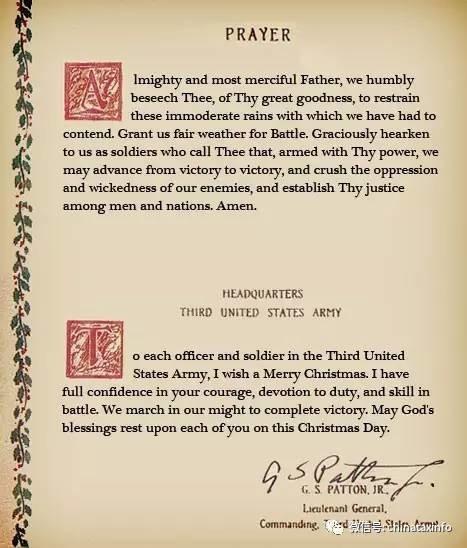
Chaplain James Hugh O’Neill wrote a prayer asking Almighty God for clear skies so Allied forces could destroy tyranny. Patton loved it. He ordered roughly a quarter-million copies printed and distributed to every soldier in Third Army along with a Christmas message reminding them that the birth of Christ represented hope in the darkest times.
Days later, the skies cleared.
Was it coincidence?
Was it providence?
Everyone is free to answer that question according to his own beliefs.
What isn’t debatable is what happened next.
Allied aircraft filled the skies. Fighter-bombers devastated German columns. Supplies poured into Bastogne. Air superiority returned. The momentum shifted, and Hitler’s last major offensive in the West began to collapse.
Patton didn’t shrug it off.
He called Chaplain O’Neill into his office and pinned a Bronze Star on his uniform.
“This is for the part you played in the Battle of the Bulge.”
Imagine that happening today.
Can you picture a four-star general publicly crediting prayer as a contributing factor in victory?
Neither can most Americans.
Yet Patton never saw a contradiction between military excellence and dependence on God.
He believed in relentless preparation. He demanded discipline bordering on obsession. His soldiers trained until they hated him. He planned every movement in painstaking detail.
Then he prayed.
To Patton, those weren’t competing ideas.
They were complementary.
You prepare as though everything depends on you.
You pray as though everything depends on God.
Modern culture often caricatures faith as something reserved for the weak or uncertain. Patton would have laughed at that idea. He considered prayer another weapon in the commander’s arsenal—not a substitute for preparation, but an essential companion to it.
He attended church whenever circumstances allowed. He valued his chaplains as indispensable members of the fighting force, believing they strengthened morale, courage, and resolve just as surely as artillery strengthened an attack.
That doesn’t mean Patton was a perfect man.
Far from it.
He had a volcanic temper. He made mistakes. He famously slapped soldiers suffering from what we now recognize as combat stress. He also held an unusual personal belief that he had lived previous lives as soldiers throughout history—a belief that falls outside traditional Christian doctrine.
But imperfect people often accomplish extraordinary things.
King David did.
The Apostle Peter did.
Patton did.
Perhaps the bigger lesson isn’t whether every one of Patton’s beliefs aligns neatly with a theological checklist. The lesson is that one of America’s greatest battlefield commanders never believed human strength alone was enough.
He understood something our increasingly technological society often forgets.
Technology wins battles.
Character wins wars.
Today we place extraordinary confidence in artificial intelligence, satellite constellations, drones, precision-guided munitions, and billion-dollar defense programs. All are remarkable tools.
But tools don’t create courage.
Algorithms don’t inspire sacrifice.
Software doesn’t build conviction.
A nation can possess every technological advantage imaginable and still lose the moral confidence to use it wisely.
Patton understood that military power rests on something deeper than machines. It rests on the spirit of the people operating them.
Perhaps that’s why, more than eighty years later, one of the most enduring images of General George S. Patton isn’t standing on a tank.
It’s standing beside a chaplain.
One held maps.
The other held a prayer.
Patton understood that America needed both.
Whether you’re a believer or a skeptic, that combination of fierce competence, personal humility before God, and unwavering commitment to duty is a reminder worth revisiting. History remembers Patton for defeating armies.
It should also remember him as a general who wasn’t afraid to bow his head to his creator before asking his soldiers to march forward.
If you enjoyed this article, then please REPOST or SHARE with others; encourage them to follow AFNN. If you’d like to become a citizen contributor for AFNN, contact us at managingeditor@afnn.us Help keep us ad-free by donating here.
Substack: American Free News Network Substack
Truth Social: @AFNN_USA
Facebook: https://m.facebook.com/afnnusa
Telegram: https://t.me/joinchat/2_-GAzcXmIRjODNh
Twitter: https://twitter.com/AfnnUsa
GETTR: https://gettr.com/user/AFNN_USA
CloutHub: @AFNN_USA
Patton’s pistols were ivory-handled, not pearl-handled. He famously stated that only a “pimp from a cheap New Orleans whorehouse would carry a pearl-handled pistol.
I had a chance to hold the S&W .357, along with the one used for the movie, which was pretty cool to say the least. What’s interesting about the famous quote is that, while generally accepted, I do not recall ever seeing the quote in any primary sources I’ve worked with (and I’ve written three books dealing with Patton).
Also, Patton liked to carry different models of handguns, and he had several that had ivory handles (the S&W, a Colt .45, and if memory serves me correctly, a Colt .380 automatic with three stars on it). Photo evidence demonstrates that he preferred the Colt .45, but Charles Province notes that near the end of the war, Patton started to carry the Colt .380. Yet, Patton felt it necessary to still tote the larger Colt .45, thinking his men would believe he was worn out if not carrying it.
While it is often thought today that a GO carrying a handgun was just bravado, in reality it was a critical necessity. It was not unusual for GOs and other senior officers, often just with their driver, to run into loose enemy personnel in what were thought to be “safe” rear areas.
I have several of your books, a huge fan of the classic pictures. Anybody who spent any time in the military (Army) eventually studies Patton’s battles and his career–particularly his efforts to write armored doctrine in the desert pre-war and his incredible attention to detail on the logistics front.
I served under his son in 2d Armored Div at Fort Hood and was later in 2d Armored Div (FWD) in Germany, a unit Patton would have loved for it’s independence as the only US combat force in Nord Deutschland and our war plan contingency to resupply from dead enemy when ammunition ran short. We had Czech AKs in our arms room and a significant amount of Sov ammunition in our ASP–we did fam training with the AKs during every range fire…
All the references I’ve read over the years cite a classic Patton response to a reporter, but no time, place or names…It is contextually classic Patton….
It is interesting to consider his pistol choices when you think about Army standard supplies–the .357 and .45 Colt (so called long Colt) were not exactly standard sidearms as Patton served into his third decade…although most modern Colt chambered pistols also fire 45 ACP.