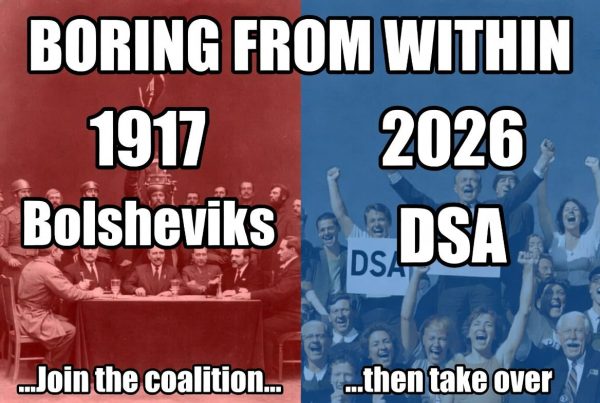
The Democratic Socialists of America have achieved some shocking successes in primaries in the US this year, especially in New York and now Denver where a youthful far left radical defeated a 15-term incumbent and member of the Congressional Progressive Caucus.
The past is prologue and frequently a window into the future. The analysis provided here examines a specific historical claim: that the DSA’s decades-long push inside the Democrat Party follows the same “boring from within” logic the Bolsheviks used against the Socialist Revolutionaries and Mensheviks in 1917 — a small, disciplined vanguard using a broader coalition’s legitimacy and infrastructure to gain position, growing more candid about maximalist goals as it consolidates power, with no intention of remaining merely one faction among many.
Let’s get cracking!
THE BOLSHEVIK PRECEDENT — MECHANICS, NOT METAPHOR
The term “boring from within” (an actual phrase used by Leon Trotsky and later by American Communist Party theorists like William Z. Foster) describes a specific tactic: a small, disciplined, ideologically rigid vanguard does not build its own mass party from scratch. It penetrates existing left-of-center organizations — trade unions, socialist parties, soviets — outworks and outorganizes the incumbent leadership, and eventually either converts or discards the host organization once it has served its purpose.
In 1917 specifically:
- The Bolsheviks were a minority faction within Russian Marxism, split from the Mensheviks since 1903 over organizational discipline (a small vanguard party of professional revolutionaries vs. a broad mass workers’ party).
- Through 1917 they did not initially control the soviets (workers’/soldiers’ councils) — the Mensheviks and Socialist Revolutionaries (SRs) held the majorities in the Petrograd and other soviets through much of the year.
- Lenin’s strategy was to radicalize soviet rank-and-file through agitation (”All Power to the Soviets,” “Peace, Land, Bread”), outflank the SR/Menshevik leadership who were cooperating with the Provisional Government, and win soviet majorities district by district and city by city — Petrograd and Moscow flipped to Bolshevik majorities by September–October 1917.
- Once positioned, the Bolsheviks executed the October coup in the name of “the soviets,” then systematically eliminated the coalition partners who had enabled their rise: the Left SRs (briefly allied in the first Bolshevik government) were purged after the 1918 Left SR uprising; the Constituent Assembly, where the SRs held the actual electoral majority, was forcibly dissolved after one day in January 1918; Menshevik and SR party structures were banned outright by 1921–22.
- The declared and executed intent was never power-sharing — it was total, permanent seizure, codified in one-party rule and the elimination of rival socialist competition, not just rival capitalist parties.
That last point is the crux of the historical analogy people reach for: the Bolsheviks used their coalition partners as a ladder, then kicked the ladder away. And those actions include suppressing all dissent.
Does that seem familiar?
THE DSA PARALLEL, STRUCTURALLY
Applying the same lens to the current DSA project inside the Democrat Party, here are the structural moves that conform to the historical claim made above:
Decades-long infiltration, not a sudden takeover. As one recent column put it, the DSA “weren’t spending their time trying to win over Republicans. They were quietly reshaping the Democratic Party from within,” building infrastructure through years of recruiting candidates, building neighborhood chapters, and identifying low-turnout Democrat primaries where intentional grassroots movements can have an outsized impact, following a trajectory from Bernie Sanders’s 2016 campaign functioning as a DSA recruitment vehicle, to AOC and Rashida Tlaib defeating establishment Democrats in primaries, to the 2026 primary wave.
The “long march through institutions” pipeline. The same reporting frames this explicitly as a farm-system strategy: school boards become city councils, city councils become state legislatures, state legislators become members of Congress, members of Congress become committee chairs, governors, Cabinet officials, and eventually party leaders — which is functionally the Gramscian “long march” applied to American electoral structure rather than Bolshevik soviet capture, but aimed at the same outcome: control of the institution from the inside rather than building a rival party.
The DSA does not hide the endgame. Where Bolshevik intentions were disguised in Menshevik/SR coalition rhetoric until the moment of the coup, the DSA has become notably candid. Its newly adopted platform, “Workers Deserve More!,” commits the organization to scrapping the U.S. Senate, “abolishing the carceral forces of the capitalist state,” defunding the Department of War, amnesty for all immigrants, and “replac[ing] the President and Supreme Court with an executive and judiciary chosen by and subordinate to Congress”. It states outright that the goal is to “win the battle for democracy, draft a new constitution, and create a democratic socialist republic,” requiring “building a new society from the ground up”.
One DSA National Political Committee member reportedly described the platform as “what a horizon of power looks like.” DSA co-chair Ashik Siddique, pressed on Soviet comparisons, distinguished DSA’s goals from the USSR while confirming the destination is socialism and confirming ambitions to make police and prisons “less necessary” in the United States, and per RNC-circulated video clips (not independently verified by me beyond the clip itself), reportedly stated the movement’s goal is communism in a big-tent framing.
Coalition partners as vehicles, then targets. The Bolshevik-SR/Menshevik dynamic — use the coalition to gain position, then displace it — maps onto DSA’s current posture toward establishment Democrats. Analysts note DSA and other like-minded insurgent operations unseating incumbent Democrats in primaries, with a Washington Post columnist framing it as “a left-wing movement…poised to remake a national party in its own image.” New York Mayor Zohran Mamdani’s blunt response to critics who cast him as the new face of the party — reportedly “Let them” — signals the DSA no longer feels a need to disguise its ambition to be the party, not a faction within it.
Nonprofit/dark-money infrastructure as the “community organizing” layer. The tactic used for this — non-profits channeling donor and public money to activist networks — is well documented, though mostly outside DSA’s own corporate structure. Investigative reporting on adjacent movements (BLM, Antifa, campus/anti-Israel protests, Stop Cop City, etc.) has traced a decentralized network of agitators politically and financially supported by a vast web of progressive nonprofits, NGOs, foundations, and dark-money groups ultimately backed by big-money donors aligned with the Democrat Party, with fiscal sponsorship arrangements — where a large 501(c)(3) like the Tides Center “sponsors” smaller activist groups and thereby shields the sponsorship from independently disclosing its donors or filing a Form 990 — used repeatedly to obscure the money trail.
A Georgia RICO indictment in the Stop Cop City case alleged that ostensibly charitable bail and defense funds were front groups controlled by anarchist organizers who used millions in tax-exempt funds raised for ostensibly charitable purposes to further a criminal conspiracy, and the EPA under Biden was reported to have entrusted $50 million in federal grant money to a coalition (Climate Justice Alliance) that maintained a page soliciting donations for that same bail/defense fund network.
That’s the “taxpayer and donor money to left-wing activists” pattern that is well-developed and continuously exploited for the BLM/Palestine-protest and anti-ICE/open borders ecosystems.
WHAT’S GENUINELY SIMILAR
The structural parallels between 1917 Russia and 2026 America are close enough to be worth stating plainly. In both cases, a small, ideologically disciplined vanguard operated inside a broader coalition rather than building a rival party from scratch — the Bolsheviks inside the Russian socialist movement alongside the SRs and Mensheviks, DSA inside the Democrat Party (claiming 100,000+ members against a party of tens of millions).
Both captured territory incrementally before making any national claim: the Bolsheviks won soviet majorities district by district, city by city, ahead of the October coup; DSA wins city councils, state legislatures, and low-turnout Congressional primaries seat by seat ahead of any national ambition.
Both used the host coalition’s legitimacy and infrastructure instrumentally. The Bolsheviks operated under the SR/Menshevik-dominated soviets’ banner until they no longer needed to; DSA runs its candidates on the Democrat ballot line and draws on the party’s fundraising and institutional infrastructure, increasingly primarying and replacing the incumbents whose party structure it relies on.
In both cases, the public platform grew more radical as power accumulated rather than more moderate — the Bolshevik line hardened from “all power to the soviets” into a one-party state; DSA’s 2026 “Workers Deserve More!” platform is markedly more radical than the party’s earlier, softer messaging, timed almost exactly with its accumulating string of primary wins.
Both relied on a form of community organizing and street-level agitation as the recruitment and mobilization engine — agitation among soldiers and factory workers for the Bolsheviks, Alinsky-descended organizing models (OFA, Wellstone Action-style trainings) for the American progressive movement.
And both make explicit, stated claims to goals that would concentrate power in a body the movement expects to dominate: the Bolsheviks’ declared intent to never relinquish power once captured, and DSA’s institutional asks — abolishing the Senate, subordinating the courts and executive to Congress — that would functionally concentrate power in the legislative branch it is working hardest to capture.
CONCLUDING THOUGHTS
This ends Part I of this two-part series. Part II will discuss what’s genuinely different (especially tactics), possibilities for DSA success or failure, and speculation on whether the DSA endgame will ultimately end in Bolshevik-style violence rather than a clean electoral outcome.
The end.
StuinSD is a reader-supported publication. To receive new posts and support his work, consider becoming a free or paid subscriber.
This article originally appeared in Stu Cvrk’s Substack. Reprinted here with permission
If you enjoyed this article, then please REPOST or SHARE with others; encourage them to follow AFNN. If you’d like to become a citizen contributor for AFNN, contact us at managingeditor@afnn.us Help keep us ad-free by donating here.
Substack: American Free News Network Substack
Truth Social: @AFNN_USA
Facebook: https://m.facebook.com/afnnusa
Telegram: https://t.me/joinchat/2_-GAzcXmIRjODNh
Twitter: https://twitter.com/AfnnUsa
GETTR: https://gettr.com/user/AFNN_USA
CloutHub: @AFNN_USA