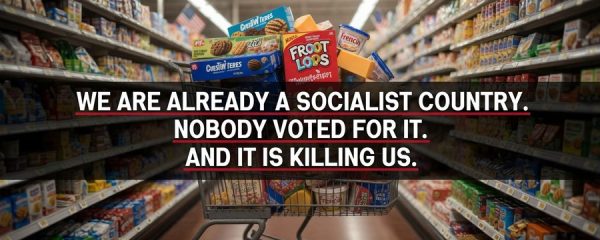
I want to start with a grocery cart.
Not a statistic. Not a chart. A cart. Somebody filmed one recently and the internet lost its mind over it, and I understand why, but almost everybody watching took away the wrong lesson. Three boxes of cookies. Two blocks of cheese. Marshmallow Froot Loops. Three tubs of French onion dip. THREE. Not one, not two, three tubs of a product that exists solely so you have something to do with a potato chip.
And the reaction was the same reaction I have when a kid hands me a lab report with no data in it. How did we get HERE?
Here is the part nobody wanted to say out loud. That cart is not the problem. That cart is a SYMPTOM. The disease is a system that has spent sixty years quietly severing the connection between what a person chooses and what a person experiences.
There is a word for that system. We are just not allowed to use it in polite company.
Buckle up. This one is going to take a while, and it has to.
— FIRST, DEFINE YOUR TERMS, OR SIT DOWN —
Socialism is government control over the means of production AND DISTRIBUTION.
Read that again, because the second half is the half everybody skips. The left has spent a decade insisting America is nowhere near socialism because nobody has nationalized a steel mill lately, and technically, sure. We do not own the factory.
We own the PAYCHECK.
Roughly sixty-five to seventy percent of federal spending is now mandatory. Not debated. Not voted on annually. Not subject to a single floor speech. It goes out automatically, by formula, whether Congress bothers to show up or not. In 1973 that number sat around forty-seven percent. Fifty years later it is closing on three quarters of everything we spend.
That is not a budget. That is an autopilot with a cracked altimeter.
So when a Democratic Socialist stands at a podium promising government-owned grocery stores, understand what is actually on offer. Not a revolution. A FINAL PHASE. The distribution machine is already built and running. He just wants to hang a sign on it.
And here is the number that should end the argument entirely. According to the OECD, the United States ranks somewhere around twenty-first out of thirty-eight member nations in GROSS PUBLIC social spending. Sounds thrifty. Sounds like a country with no safety net. But count total NET social spending, meaning public programs plus mandated private benefits plus everything we run through the tax code, and the United States leaps to SECOND IN THE ENTIRE DEVELOPED WORLD.
Second. Behind France.
France. The country that sets things on fire when you suggest retiring at sixty-four instead of sixty-two.
We are the second largest social spender on the planet, and half this country has been persuaded we have no safety net whatsoever. That is not a policy disagreement. That is a marketing achievement that deserves an award.
— THE NUMBERS, BECAUSE FACTS ARE THE ENEMY OF LIBERALISM —
Jim Quinn’s Sixth Law of Liberalism holds that facts are the enemy of liberalism. I did not write it. I just keep watching it get proven in public.
So here are the facts. Sit in them a second.
The national debt is now past THIRTY-NINE POINT SEVEN TRILLION DOLLARS. That is roughly $115,188 for every person breathing in this country, or about $292,217 per household. My household has six people in it. Run that math and then tell me again about all the help my family is receiving.
The projected FY2026 deficit is around $1.8 TRILLION. The gap between what we spend and what we collect has been running north of $1.5 trillion a year.
Let me put $1.5 trillion in terms a sophomore can hold onto, because abstract numbers do not stick and I have twenty years of evidence on that.
Stack it in one-dollar bills and the stack climbs roughly 102,000 MILES. That is 408 TIMES TALLER THAN MOUNT EVEREST. It is nearly HALFWAY TO THE MOON, which sits about 238,900 miles out. Lay those same bills end to end and they wrap the EARTH’S EQUATOR 5,884 TIMES. Divide it by taxpayer and you get about $18,750 a head. Except nobody is handing anybody $18,750. We are ADDING $18,750 per person to the tab.
Now the part that should genuinely frighten you. Net interest on the debt is running about $1.1 TRILLION this fiscal year. For the first time in the history of this republic, we spend MORE SERVICING OUR DEBT THAN WE SPEND ON NATIONAL DEFENSE. Defense sits near $895 billion. Interest blew past it and never looked back.
We have not had a real budget since Moses walked the earth, and the fastest-growing line item in the entire federal government is now a payment that buys us nothing. Not a road. Not a rifle. Not a ventilator. Not one hour of a teacher’s time. It is rent on money we already spent.
That is what socialism feels like in a country rich enough to hide it for a while. It does not arrive with tanks in the street. It arrives with an interest payment.
— 1913: THE YEAR THEY BUILT THE MACHINE —
You cannot understand any of this without understanding one calendar year, and most Americans were never taught it as a single connected story.
February 1913. The 16th Amendment is ratified. Eight words do the damage: Congress shall have power to lay and collect taxes on incomes, from whatever source derived. No rate cap. No exemption floor written into the text. No sunset. No limit on who could eventually be reached.
Read the pitch they used to sell it. The base rate was ONE PERCENT. The top rate was SEVEN, and only above half a million dollars. The exemptions were set so high that less than one percent of the country paid a nickel in year one. Congressmen called it the fairest and cheapest of all taxes. A New York paper actually predicted that clerks would show off their tax receipts as a status symbol, because only rich people would ever get one.
I have been teaching long enough to recognize when someone is setting the class up for a lesson they do not intend to reveal until the test is over.
December 23, 1913. Two days before Christmas. Most of Congress already gone home. Wilson signs the Federal Reserve Act.
People file those two events under the same year and never connect them. They are two halves of one mechanism. A central bank creates money as debt, and every dollar it puts into circulation carries an interest obligation. To borrow at the scale required to fund wars and bureaucracies and the accumulated ambitions of every Congress that would follow, you need collateral. Something reliable. Something that extracts wealth from the population year after year without needing a vote.
The income tax was that collateral. Your future labor, pledged as security.
Now watch the ratchet, because a ratchet is the right metaphor and I want it lodged in your head. A ratchet turns one direction. Each notch holds. The next crisis starts from the NEW floor, never the old one.
1913: seven percent at the top, almost nobody pays. 1917: America enters the war and the top rate hits sixty-seven. By 1918, seventy-seven. The war ends. Rates come down. To TWENTY-FIVE. Not seven. The ratchet held. 1932: back up to sixty-three in a single year. Seventy-nine by 1936. World War II: ninety-four percent at the top. And while everybody stared at the ceiling, the FLOOR collapsed. Exemptions were slashed so hard that the number of Americans paying income tax went from about 7 million in 1940 to roughly 42 million by war’s end.
The class tax became a mass tax and nobody was asked.
But the single most consequential change of that whole era was not a rate at all. In 1943 a man named Beardsley Ruml, treasurer of Macy’s and a former chairman of the New York Fed, proposed that employers deduct the tax BEFORE the worker ever touches the check. Automatic. Silent. Gone before the stub prints.
Milton Friedman helped design that system during the war and later said it was one of the worst things he ever did.
He was right, and the reason is pure psychology. When you write a check, you FEEL it. Your hand moves. You watch a number leave. When the money vanishes before you ever see it, you stop asking how much of what you earned you get to keep, and start asking how much you are receiving. Same transfer. Completely different human experience. And political resistance to invisible extraction is approximately zero.
Meanwhile the dollar itself. A 1913 dollar buys what takes about thirty-two dollars today. That is roughly ninety-seven percent of its purchasing power, gone, under the stewardship of the institution created to stabilize it. M2 went from around $4.6 trillion in 2000 to over $19 trillion by 2021. Something close to a fifth of every dollar that has ever existed in this country was conjured in the single year 2020. Prices always lag. They never forget.
Quinn’s First Law of Liberalism: liberalism always generates the exact opposite of its stated intent. A tax on the rich became a tax on everybody who works. A bank built to steady the currency ate ninety-seven cents of it.
And here is the elegant, infuriating part. The genuinely wealthy do not experience any of this the way you do, because they do not have a W-2. Their wealth compounds inside appreciating assets, and appreciated assets are not income until sold. So they do not sell. They pledge the assets as collateral, borrow against them at low rates, and live on loan proceeds, which are not income and are not taxed. At death the basis steps up to market value, the loans get settled by the estate, and decades of accumulated gain are never taxed at all. Legally. It is called buy, borrow, die.
The exits were not an oversight. They were built in by people with the lawyers to build them.
Quinn’s Twenty-Fifth Law: liberals are great at giving away OTHER people’s money. The worker has wages, withholding, and no exit. That is not a bug in the system. That is the system.
— THE CONTROLLED EXPERIMENT NOBODY WANTS TO GRADE —
I teach science. Which means I get paid to care about exactly one thing above all others. What happened to the CONTROL GROUP.
So let us run it. Over the last twenty-five years, separate everything the federal government does NOT heavily subsidize from everything it does.
Televisions. Toys. Computer software. Cell service. Clothing. Household furnishings. Prices FELL. Some fell through the floor. A television that cost a month’s wages in 1998 is now an impulse buy at a warehouse club on a Saturday.
Now the other column. College tuition. Hospital services. Medical care. Childcare and nursery school. Textbooks. Prices EXPLODED. Not drifted. Not crept. Exploded, on the same chart, over the same years, in the same economy, denominated in the same currency.
What is the variable? Say it with me. GOVERNMENT SUBSIDY.
They subsidized college to make college affordable. College became unaffordable. They subsidized healthcare to make healthcare affordable. Healthcare became unaffordable. They subsidized childcare and housing and student lending so all three would be within reach, and all three took off like green grass through a goose.
If a student handed me that data set and concluded we need MORE of the independent variable, I would hand it back and tell him to try again. In Washington, that same conclusion gets you a committee chairmanship and a cable hit.
— THE FOOD DESERT MYTH, AND WHY I TAKE IT PERSONALLY —
Back to that grocery cart.
For twenty years we were told poor Americans eat badly because they cannot REACH good food. Food deserts. No store within a mile. Structural. Systemic. Nobody’s fault.
Then somebody measured it.
Work out of the National Bureau of Economic Research and the University of Chicago found that handing low-income households the exact same products at the exact same prices as high-income households closes the nutrition gap by NINE PERCENT. Nine. The other NINETY-ONE PERCENT is preference. What people choose to put in the cart. Households in so-called food desert ZIP codes already do around ninety percent of their grocery shopping at actual supermarkets, same as everybody else.
The store was never the problem.
And here is the number that should retire the affordability talking point permanently. In the early 1900s the average American family spent roughly FORTY PERCENT of its income on food. Today the average household spends UNDER TEN PERCENT of disposable income on food, and splits that roughly evenly between groceries and restaurants. Is food more expensive than it was three years ago? Absolutely, and anybody who says otherwise has a leak in the think tank. But measured against the whole span of human history, Americans have never eaten this cheaply.
I feed a family of SIX on a teacher’s salary using paper envelopes. The Dave Ramsey method, where the envelope empties and the shopping stops. Last time I priced out a week at Aldi it came in between $120 and $130, which is $520 to $560 a month, and my kids ate chicken piccata, homemade chili, and stuffed thighs that guests ask me for the recipe on. Meanwhile the maximum SNAP allotment in Ohio for a family of six runs around $1,421 a month. Nearly triple. And the program costs roughly $8.2 BILLION every single month nationwide.
I am not angry at the family getting the benefit. I am angry at the architecture. Because I fund the garbage food with my taxes and then I fund the diabetes with my taxes, and I am financing the same health crisis from both directions while shredding my own cheddar like a chump because pre-shredded is for quitters.
Remember when Michelle Obama fixed school lunches? She was RIGHT about the nutrition. I will hand her that without hesitation. And the kids threw every bit of it in the garbage and brought Lunchables from home. I watched it happen in my own building, in real time, tray after tray. Government cannot legislate a choice. It can only pay for the consequences of one, forever, with money it does not have.
— THE GOVERNMENT GROCERY STORE: A CENTURY OF RERUNS —
Since the government grocery store is back in fashion, let us do what a scientist does before running an experiment. Ask whether anybody has run it before, and what happened.
Kansas City, Missouri. A city-backed market opened in 2018 as the crown jewel of an east side revitalization plan. Taxpayers poured somewhere between seventeen and twenty-nine million dollars into it over the years. Weekly customers collapsed from around fourteen thousand to roughly four thousand. Empty shelves. Theft so severe that employees reportedly carried tasers to work. An emergency cash injection could not save it. It shut down for good in August 2025, and the closing statement blamed unforeseen circumstances. Unforeseen by everyone except every economist who has ever drawn breath.
Erie, Kansas. A town of about a thousand people bought its struggling grocery store in 2020 for roughly four hundred thousand dollars to prevent a food desert. It had exactly ONE profitable month in 2022 and lost a hundred thirty-two thousand that year. The mayor’s word for it was bleeding. They leased it out to a private operator and it is still not viable.
Baldwin, Florida. City took over the last store in town in 2019 and put the staff on the municipal payroll, aiming for break even. Its purchasing power was so weak that prices went UP and the shelves still ran thin. Losses stacked. Closed in March 2024.
Illinois launched a fresh food fund and opened six stores in food deserts. FOUR of the six closed.
Now, in the interest of honesty, because I am not a propagandist and my students would catch me: there IS one relative success. A town of about six hundred people in Kansas runs a small municipal grocery that clears a razor-thin one to three percent. Read the fine print, though, because the fine print is the whole story. It works because it faces almost NO competition, the town oversees it rather than micromanaging it, and it is roughly the size of a large convenience store serving six hundred souls.
That is the model. Now go apply it to a city of eight and a half million with fifty thousand bodegas and a Costco on every horizon, at a reported thirty million dollars for a single nine-thousand-square-foot store, in a city its own mayor describes as worse than broke. For comparison, a full-size Aldi runs one and a half to three million and opens in about six weeks.
And when a city sat the bodega owners down and asked them their margins, their best sellers, and what people keep coming back for, before announcing a plan to compete against them tax-free and rent-free, that is not market research. That is asking your opponent for his playbook and then acting surprised he noticed.
None of this is new, and the biggest version already ran.
In 1989 a Soviet official named Boris Yeltsin walked into an ordinary supermarket in Houston, Texas. Not a showcase. A Tuesday. Free cheese samples and thousands of products sitting on shelves waiting for somebody to want them. He was a member of the Politburo of a nuclear superpower, and with all of that power he could not make one of those stores exist in his own country. He later wrote that the sight made him sick with despair for his own people.
That is the actual documented output of the government grocery store. Not a theory. A man in a Houston grocery aisle realizing his entire system was a lie.
— MAKING AFFORDABLE HOUSING ILLEGAL, ONE ORDINANCE AT A TIME —
Here is the one nobody wants to touch, because it does not sound sinister. It sounds BORING. Minimum lot sizes. Single-family-only zoning. Setbacks. Parking minimums. Density caps. Environmental review that lets one neighbor with a lawyer stall a project for years. The vocabulary of American zoning was engineered to put you to sleep before you notice what it does.
What it does is set a PRICE FLOOR on land. Require every home to sit on a big lot and the developer will build the most expensive house that lot can carry, because that maximizes his return. Entry-level ownership becomes structurally impossible in that town. Nobody has to write a single ugly word into the code. The math does the excluding.
Then notice which towns run the most aggressive exclusionary zoning in the country. It is not rural Alabama. It is the wealthiest self-described progressive suburbs in America, the ones with the most yard signs about inclusion per square foot. They campaign on compassion and legislate on exclusion, and homeownership, the single largest engine of generational wealth in American life, gets walled off from the families the ordinance was engineered to keep on the other side of the town line.
Then comes the sequel, which is rent control.
Freeze the rent and you have frozen what comes IN. You have not frozen insurance, up double digits in a year. Or fuel. Or property taxes. Or water rates. So the small owner, the woman with four units in Brooklyn and a mortgage and tenants who owe her back rent she will never see, does the only arithmetic available and sells. Buildings trade at enormous losses. A nonprofit lender whose entire mission is affordable housing ran the numbers and found stabilized buildings in the poorest borough crossing from positive to NEGATIVE income per unit before a single mortgage payment.
We have receipts on this from two directions. New York already ran it in the 1970s and the Bronx burned, with something like a hundred thousand apartments falling out of private hands because the buildings could not pay their own taxes. And Argentina ran it in 2020, watched rents soar and availability drop by nearly half, repealed it in 2023, and then watched prices fall and listings explode.
A rent freeze does not create one new apartment. It only decides who gives up first.
— TAX THE RICH, SAID THE RICH —
I keep watching the same performance and I keep having the same reaction.
A politician worth eight figures, in a suit that costs more than my monthly mortgage, explains to me that the rich need to pay their fair share. A senator who owns three houses charters aircraft at fifteen thousand dollars an hour to tour the country denouncing oligarchy, and when a reporter asks about it, the answer is that he is not going to stand in line at the airport like the rest of us. The Speaker Emerita is worth north of a hundred million. And every one of them files their taxes with an accountant who knows every provision, because their own party helped write the provisions.
So here is my standing offer, and it does not expire.
Before I hear another syllable about the wealthy, LEAD BY EXAMPLE. Cut the IRS a check for DOUBLE what you legally owe. Standard deduction only. No itemizing. No carried interest. No conservation easement on the ranch. No family foundation, no trust, no clever structure. Do it three years running, publish the returns, and then come talk to me about sacrifice.
They will not. They never will. Because some hogs have all four feet and their snout in the trough.
And notice the shape of the argument they are actually making. It is argumentum ad misericordiam dressed as economics. An appeal to pity, offered in place of arithmetic, and if you ask for the arithmetic you get called cruel.
Fine. Let us do the arithmetic.
— AFTER THE NINE MONTHS, THEN WHAT —
Take the demand at its word. Confiscate all of it. Every dollar of billionaire wealth in America.
First, understand what that wealth IS, because this is where the entire conversation goes off the rails. People picture a vault. Gold coins. Cash sitting idle while somebody goes hungry. That is not remotely what it is. It is Tesla and SpaceX. It is Amazon warehouses and server farms and the logistics network. It is factories, patents, software, supply chains, and the accumulated productive capacity that thousands of people spent decades building. It is the MACHINERY of the American economy, and the number attached to it is just what the market thinks the machinery is worth this morning.
Now watch what happens before anybody touches a dollar.
The announcement alone craters the market, because markets price the future and every pension manager and 401(k) fund in the country immediately asks the same question. If Washington seizes assets from the wealthiest today, what exactly stops it from reaching further down tomorrow? Capital does not wait for the answer. Foreign investors holding trillions in American assets start moving. The dollar weakens. Import prices climb.
Then comes the part nobody models, and this is the one that actually makes me angry.
About seventy million Americans hold 401(k) accounts. Tens of millions more hold pensions, IRAs, and mutual funds. Those accounts are not stuffed with savings bonds. They hold the STOCK of the companies being seized or the stock of everything crashing alongside them. Your neighbor who fixed machines at the plant for thirty years and finally has $180,000 put away is not a billionaire. He is a fifty-eight-year-old who is finally close to stopping. He is the one who loses.
Quinn’s Twenty-Fourth Law: every time a liberal tries to fix something, somebody somewhere loses a job. And a retirement. And thirty years of doing everything right.
Now suppose the seizure actually proceeds. Three options, all bad.
SELL IT ALL. Put trillions in assets on the market at once. Who buys? Nobody domestic, because you just proved the government will seize private assets, which means any buyer is purchasing something that can be seized again. The fire-sale price is a fraction of face value, and the most likely purchasers are foreign sovereign wealth funds. Congratulations, you handed American industry to somebody else’s state investment vehicle at a discount.
KEEP IT AND RUN IT. The federal government now operates Amazon’s supply chain, Apple’s product roadmap, and Tesla’s factories. This is not a hypothetical horror story. This is the Soviet Union, which built world-class nuclear weapons and could not manufacture a reliable refrigerator. Same people, same language, same history, split down the middle at the Berlin Wall. One side produced BMW. The other produced the Trabant, a vehicle so comprehensively bad that Western mechanics initially struggled to determine how it was supposed to function. And the Wall was not built to keep West Germans out.
DESTROY IT IN THE TAKING. Companies are not buildings. Remove the people who run them under the chaos of a confiscation order and the degradation starts immediately and quietly. Missed deliveries. Delayed updates. Engineering decisions stuck in review. The senior engineers and logistics architects who could work anywhere start leaving for anywhere. You got the house and let the carpenter walk out the door.
Now the math, since apparently somebody has to do it.
Roughly a thousand American billionaires. Combined net worth somewhere around six trillion dollars, and that is the paper number, not the forced-liquidation number. The federal government spends over seven trillion PER YEAR.
Even at full theoretical value, you have bought NINE MONTHS.
And then it gets worse, because you have also destroyed the tax base that was funding everything before you started. Those companies were paying tens of billions a year in taxes and cutting hundreds of billions in paychecks. In month ten you are not merely broke. You are broke with a hole where the revenue used to be.
I have asked this question in classrooms, in comment sections, and in person. AFTER THE NINE MONTHS, THEN WHAT? I have never once received an answer that survives contact with a calculator.
— WHAT THE PEOPLE THEY DEMONIZE ACTUALLY BUILT —
Here is the section that never makes it into the speech, and I want it on the record.
While Washington was writing and rewriting tax policy ostensibly aimed at helping the disadvantaged, watch what the people being demonized were actually doing with their own money.
Andrew Carnegie sold his steel empire and then spent the last eighteen years of his life systematically giving the proceeds away. 2,509 public libraries. And the geography is the whole point. Not in the neighborhoods that already had libraries. In mill towns and working-class communities where the children of miners and immigrants had never owned a book and had no reason to believe a building full of them would open the doors for free.
John D. Rockefeller, the man the progressive movement most loved to hate, put a million dollars in 1909 into eradicating hookworm across eleven Southern states. Hookworm caused severe anemia, exhaustion, stunted growth, and cognitive impairment, and an entire region of Americans had been mocked for generations as lazy when a substantial share of them were simply SICK. His commission put doctors and nurses in the field, treated people at scale, taught sanitation, and trained locals to continue after the campaign ended. Infection rates collapsed. School enrollment rose. Test scores rose. Wages in treated communities rose relative to comparable untreated ones for a generation afterward.
Julius Rosenwald, president of Sears, partnered with Booker T. Washington and helped build 5,357 SCHOOLS for Black children across the rural South between 1912 and 1932, in fifteen states, in counties where the government responsible for providing that education had simply declined to. And the design required matching funds raised locally, because Washington understood that people protect what they have invested in.
Henry Ford doubled his minimum wage to five dollars a day in January 1914 and cut the workday from nine hours to eight, at a moment when turnover was running so high he had to replace his entire workforce three and a half times a year just to stay even. Economists called it insane. Turnover collapsed. Productivity rose. And Ford said out loud that if he paid his workers enough to buy the cars they built, he had created his own market. He accidentally invented the consumer middle class. Congress arrived twenty-four years later to mandate twenty-five cents an hour and take credit.
Milton Hershey was seventy-two when the Depression hit, and instead of cutting he launched a building campaign. A hotel. An arena. A community building. A stadium. A school for orphaned boys that still operates today. His reasoning was not complicated: if he did not give men work he would have to feed them anyway, and building materials were cheap. That one sentence is cleaner than five hundred pages of Depression economics.
Nathan Straus, during the Panic of 1893, opened food depots selling meals at a penny for soup and three cents for a full plate, subsidized out of his own pocket, more than 1.4 million meals in one crisis. He sold coal below cost so people could survive a New York winter. He funded pasteurized milk depots in multiple cities at a time when contaminated milk was killing children, and historians credit that program with saving tens of thousands of young lives.
Not one of those required an appropriation. Not one required a subcommittee.
Quinn’s Ninth Law: to a liberal, intentions matter more than outcomes. The government’s stated intentions in those same decades are a matter of record. So are Rosenwald’s 5,357 schools. These are different categories of thing.
If somebody can point me to a single tax-the-rich program that produced a comparable ledger, I will genuinely update my assessment. Show me the schools. Show me the cured disease. Show me the libraries. I have been asking for years.
— HOW WAGES ACTUALLY WORK, SINCE NOBODY TEACHES IT ANYMORE —
Revolutionary concept incoming. Brace yourself.
A wage is a VOLUNTARY AGREEMENT between two parties. An employer offers. A person accepts or walks. If nobody accepts, the employer raises the offer or the business dies. That is not exploitation. That is a market clearing, and it happens millions of times a day without a bureaucrat present.
Now that rich owner everybody loves to hate. What is he doing with the money? Buying equipment. Leasing space. Making payroll on the fifteenth whether the quarter went well or not. Advertising. Absorbing the risk that the whole thing craters. And when it does crater, the employees update a resume and find work by spring while he loses everything he put in. That is why the genuinely wealthy usually have a trail of dead businesses behind them. Higher risk, higher reward, and most people cannot stomach the first half of that sentence.
Which brings us to the minimum wage, and I need to be careful here because this section makes people uncomfortable and it should.
The minimum wage was not invented by union heroes fighting for the little guy. It was pushed by progressive economists who wrote, in print, under their own names, that the POINT was to price certain people out of the labor market permanently. Princeton’s Thomas Leonard documented this so thoroughly that the modern left has simply chosen not to read him. The word those economists used was unemployables. When they wrote it in 1913, they meant Black Americans, recent immigrants, and the disabled. Sidney and Beatrice Webb, intellectual royalty of the progressive movement, described the function as social cleansing. Their phrase, not mine.
Davis-Bacon in 1931 set a wage floor on federal construction, pushed by a coalition furious that Black construction crews kept winning federal contracts by working at market rates. The floor debates are in the Congressional Record and they are not coy about it. The Fair Labor Standards Act of 1938, the law that actually created the federal minimum wage, excluded agricultural and domestic work, which is precisely where Black labor was concentrated in the Jim Crow South. Ira Katznelson documented at length that this carve-out was the price Southern Democrats demanded for their votes.
Milton Friedman, writing in 1966, called the minimum wage the most anti-Negro law on the books.
And today the party that built it stands at a podium and calls raising it racial justice.
The mechanism has never changed. An employer asks one question: is this person’s labor worth what I am required to pay? At a low floor, the sixteen-year-old with no track record is worth a shot. At a high floor, that same kid is UNEMPLOYABLE, not because he is worthless but because he is priced above what he can currently produce.
Neumark and Wascher reviewed more than a hundred minimum wage studies and roughly two-thirds found negative employment effects. South Carolina research found wage hikes cutting teen employment by 8.9 percent and employment of workers without a high school diploma by 15.5 PERCENT. CBO estimated a seventeen-dollar federal floor would push about 350,000 people out of the labor force entirely.
Now put that in my building. I teach in a high-need Career Technical district. My students are not negotiating equity packages. They are trying to get a FIRST job so there is something on a piece of paper. No first job means no work history. No work history means the next employer will not risk it either. And a person with no way to build a record and no way to earn becomes, by pure arithmetic, a person on the programs.
Then the welfare cliff finishes the job, because benefits phase out as earned income rises. Take a part-time job and you can lose more in benefits than the job pays. The system has made working a financial LOSS, and then everybody acts confused when a rational person declines to work at a loss.
That is not a safety net. A net catches you so you can climb back up. This is a leash.
Meanwhile McDonald’s pays well above the federal minimum and treats crew as the STEPPING STONE it was designed to be, with management as a real career. Walmart store managers can clear six figures without a dollar of student debt, out-earning plenty of people still paying off a master’s. That ladder works. It just requires the bottom rung to exist.
— THE GREAT SOCIETY: A WAR ON POVERTY THAT POVERTY WON —
Here is the data set that ended the argument for me personally, and I want you to look at it before anybody tells you what it means.
Black poverty in America fell from 87 percent in 1940 to 47 percent in 1960. FORTY POINTS IN TWENTY YEARS. Before the Great Society. Before the War on Poverty. Before one dollar of the roughly twenty-two trillion the federal government has since spent on poverty programs. Economic growth, an expanding labor market, and intact family structure did that on their own.
Now the twenty years AFTER 1960, which are the actual Great Society years. Black poverty fell EIGHTEEN points.
Not forty. Eighteen. The trend did not accelerate. It got cut roughly in half. Thomas Sowell has said it about as plainly as it can be said: the downward trend was already there, and it did not speed up after the programs arrived.
Sowell grew up in Harlem and left home in 1948. That year, Black teenage unemployment was 9.4 percent and white teenage unemployment was 10.2 percent. Essentially identical. A kid in Harlem who wanted a job could get one. Sowell worked as a Western Union messenger for sixty-five cents an hour, above a minimum wage that wartime inflation had rendered irrelevant. He slept on the fire escape on hot nights and later said he would defy anyone to try that in New York today. Milton Friedman went dancing at the Savoy in Harlem as a graduate student without a second thought.
Racism was WORSE in 1948 than it was in 1985. That world did not end because of bigotry. It ended because of policy.
In 1960, roughly four out of five Black children were being raised in two-parent households, a figure that had survived slavery, the Black Codes, and Jim Crow terrorism intact. Within about one generation of Great Society welfare architecture, that collapsed. Out-of-wedlock births went from around twenty-one to twenty-four percent in the mid sixties to over seventy percent today.
And the marriage penalties were not accidental. They were BUILT IN. Under the old Aid to Families with Dependent Children rules, benefits required that no able-bodied man be present in the household. Social workers patrolled housing projects AT NIGHT looking for fathers. Dads who came home hid in closets. Children were coached to say they did not have a dad.
The government structurally engineered fathers out of those homes and called it a safety net.
Pruitt-Igoe in St. Louis became the national monument to the whole idea. Its architect, Minoru Yamasaki, the same man who designed the World Trade Center, later said it was a job he wished he had never done.
Friedman described the mechanism in one sentence that I have never been able to shake: these programs pay people to fail, because insofar as they fail they receive the money, and insofar as they succeed the money is taken away.
Detroit was the richest city in America per capita in 1950 and filed the largest municipal bankruptcy in American history in 2013, with Democratic mayors exclusively since 1962. Sixty-three straight years. One party. Quinn’s Third Law: the amount of wealth in any given area is inversely proportional to the number of Democrats running it. That is not an opinion. That is a ZIP code.
Twenty-two trillion dollars. Roughly one in five Americans in poverty in 1964, roughly one in nine today. And economic growth alone had cut the rate nearly in half in the fifteen years BEFORE the programs began.
The market in fifteen years. The government in sixty.
— THE ACA: A CONFESSION IN THE FORM OF A SHUTDOWN —
Let me walk this one slowly, because it is the cleanest available example of the whole disease.
The enhanced ACA subsidies everybody is fighting about were written as TEMPORARY provisions in the American Rescue Plan Act of 2021 and extended in the Inflation Reduction Act of 2022. Not one Republican voted for either bill. Zero. Democrats wrote them. Democrats set the expiration. Democrats VOTED TO END THEM, on a calendar of their own design.
Then the date arrived exactly as scheduled and they shut the government down for forty-three days over it, blaming the people who never voted for the thing in the first place.
Fourteen clean continuing resolutions were on the table. Fourteen, turned down, while forty-two million SNAP recipients sat in limbo, air traffic controllers worked unpaid, and service members waited on paychecks. And the CR that finally reopened the government did NOT permanently extend those credits. It carried three full-year appropriations bills, it settled SNAP, and the credits stayed right where the Democrats had left them.
So the shutdown produced nothing except a very expensive public admission.
Because here is what they confessed, and I do not think they have processed it yet. By insisting Obamacare becomes unaffordable the second emergency COVID cash stops flowing, they admitted on the record, in front of the entire country, that a law named the AFFORDABLE CARE ACT IS NOT AFFORDABLE. Fifteen years of defense, undone by their own argument.
The Christmas bonus analogy is the one I use with students. Walk into your boss’s office and say: last December you gave me a thousand-dollar bonus, this December you did not, therefore you cut my pay by a thousand dollars and you are stealing from my family.
Your boss would look at you the way I look at a lab report with no units on it.
And if the concern is genuinely that Americans cannot afford medical care, then I have a modest suggestion. We should pass a bill to help with that. We could call it, I do not know, the Affordable Care Act. Then check back in fifteen years and see how the premiums are doing.
One more thing, since we are here. Not long ago, large corners of the online left were treating Luigi Mangione, a twenty-six-year-old from a prominent family charged with murdering a health insurance executive, like a folk hero. There was merchandise. There was fan art.
Now those same accounts shut down the federal government to route MORE taxpayer money into those same insurance companies. You went from cheering an assassin to serving as the industry’s collections department in about eighteen months, and nobody has ever explained the pivot.
And if the goal is actually to put people in control of their own care, the mechanism has been sitting on the shelf for twenty years. HEALTH SAVINGS ACCOUNTS. Tax-free, portable, patient-controlled, no middleman. The left has never mustered a flicker of enthusiasm for them, and I think we all understand why. An HSA hands power to a PERSON. The ACA hands power to a SYSTEM. Only one of those buys votes.
— STUDENT LOANS, BRIEFLY —
Somebody voluntarily signed a contract, received the product, and now wants the bill sent to people who did not sign it.
I want to be specific about who those people are. The kid who skipped college entirely and went into the trades. The woman who worked full time through school so she would graduate owing nothing. The eighteen-year-old who ENLISTED, in part, because that was how he was going to pay for it. Those three are now being asked to cover a debt somebody else chose, on a loan that was already sitting in forbearance.
If that is how we handle debt now, then I would like to submit my mortgage. There are people renting apartments who could pitch in. It is only fair. It is just common sense.
— THE AMENDMENT WE ALL AGREED TO PRETEND IS NOT THERE —
Now the part nobody in Washington wants on a whiteboard, and the reason the entire machine was buildable in the first place.
The TENTH AMENDMENT reads, in full: The powers not delegated to the United States by the Constitution, nor prohibited by it to the States, are reserved to the States respectively, or to the people.
One sentence. Twenty-eight words. Shortest amendment in the Bill of Rights and the load-bearing wall of the whole structure, and we have been taking a sledgehammer to it since roughly 1937.
Go read Article I, Section 8. I will hold your coffee. It is a LIST. Coin money. Establish post offices and post roads. Raise and support armies. Declare war. Regulate commerce with foreign nations and AMONG the several states. Issue patents. Punish piracy. It is finite. Four minutes, start to finish, and you will not find healthcare in it. Or housing. Or food assistance, energy assistance, childcare, retirement accounts, or school curriculum. Not one word.
Madison spelled it out in Federalist No. 45 in language a freshman can follow. The powers delegated to the federal government are few and defined. Those remaining with the states are numerous and indefinite. FEW AND DEFINED. Hamilton said the same in Federalist No. 17, that local matters can never be desirable cares of a general jurisdiction.
Few and defined. Now go look at a federal organizational chart. It is a subway map drawn by a man having a stroke.
So how did twenty-eight words become a seven-trillion-dollar government? Two clauses, tortured past recognition.
THE GENERAL WELFARE CLAUSE. The argument runs: Congress may spend for the general welfare, therefore Congress may do anything it can describe as welfare. That is PETITIO PRINCIPII, begging the question, with the conclusion smuggled into the premise. If general welfare is a standalone grant of power, then the entire list in Article I, Section 8 was decorative and the Framers wasted an afternoon enumerating powers they had already handed over in the opening line. Justice Story said exactly that in his Commentaries. Read it that way and the enumeration becomes POINTLESS. The Supreme Court agreed in United States v. Butler, 297 U.S. 1 (1936), holding the Spending Clause is not a substantive grant of legislative power. And in Medina v. Planned Parenthood South Atlantic (2025), the Court said it again: that clause does not endow Congress with power to regulate conduct, and it does not include power to issue direct orders to the governments of the States.
THE COMMERCE CLAUSE. Congress may regulate commerce AMONG the several states. Somehow that became authority to regulate a farmer growing wheat he never sold, never shipped, and ate himself. In United States v. Lopez, 514 U.S. 549 (1995), the Court finally blinked, striking the Gun-Free School Zones Act and reminding everyone that the Constitution creates a federal government of ENUMERATED powers. Rehnquist warned that under the government’s theory you would be hard pressed to name any activity by an individual that Congress could not reach. United States v. Morrison, 529 U.S. 598 (2000), held that the Constitution requires a distinction between what is truly national and what is truly local. And NFIB v. Sebelius, 567 U.S. 519 (2012), produced the line that belongs tattooed inside every congressional eyelid: the Framers gave Congress power to REGULATE commerce, not to COMPEL it.
Then there is the part where Washington stops asking and starts leaning.
ANTI-COMMANDEERING. New York v. United States, 505 U.S. 144 (1992). Justice O’Connor wrote that states are not mere political subdivisions of the United States, and that state governments are neither regional offices nor administrative agencies of the federal government. Printz v. United States, 521 U.S. 898 (1997), said it again: the federal government may not issue directives requiring states to address particular problems, nor command state officers to administer a federal program. Murphy v. NCAA (2018) said it a third time over sports gambling. Gregory v. Ashcroft, 501 U.S. 452 (1991), said flatly that the Constitution created a federal government of LIMITED POWERS.
Three decades. Three Courts. Same answer. And Washington keeps strolling back to the line like a toddler at a wet paint sign.
Because the workaround was always the money.
They cannot ORDER a state, so they BUY one. South Dakota v. Dole, 483 U.S. 203 (1987), is the confession sitting right there in the caption. Congress wanted a national drinking age of twenty-one, knew perfectly well it had no power to set one, and instead threatened five percent of a state’s highway funds. South Dakota folded. Everyone folded. Nobody has legally taken a drink at twenty in fifty states since, and Congress never had the authority to make that happen.
Dole did set limits, and one matters enormously here. The financial inducement cannot become COERCIVE. In NFIB v. Sebelius the Court finally caught one, striking the Medicaid expansion because threatening a state with the loss of ALL its Medicaid money crossed the point where, in the Court’s own phrase, pressure turns into COMPULSION.
That is the actual mechanism of American socialism. Not nationalization. LEVERAGE. Washington takes your money out of Ohio, drives it to the Potomac, keeps a cut for the bureaucracy that handled it, and offers Ohio its own money back on the condition that Ohio behaves. Every governor in America knows this game. Most stopped complaining because complaining costs money.
And notice it never runs toward you. The Department of Education did not exist until 1979, education appears nowhere in Article I, and it is one of the most purely state and local functions in American life. My district is governed by an elected board of my neighbors who I can corner in the produce aisle. That is the design working exactly as intended. But the money comes with strings, the strings come with a compliance officer, and now curriculum decisions get made by people who have never met one of my students and could not find Medina County with both hands and a GPS. Inflation-adjusted per-pupil spending has roughly tripled since that department was created. Reading and math scores have gone approximately nowhere.
Helvering v. Davis, 301 U.S. 619 (1937), is the moment the dam broke. Social Security got upheld, the federal government learned it could run a nationwide social program with no enumerated authority, and every program since has walked through that same hole in the wall. I am not arguing to abolish Social Security tomorrow, before somebody clips that sentence. I am arguing the states could have done it, that Madison would have expected them to, and that nobody has ever explained why fifty laboratories running fifty approaches would have been worse than one Washington monopoly running the country thirty-nine trillion dollars into the hole.
Brandeis called the states LABORATORIES OF DEMOCRACY in his New State Ice dissent in 1932. He was right, and he was a progressive, which should tell you how far the argument has drifted. A bad idea in Illinois is a bad idea in Illinois. A bad idea in Washington is a bad idea in Anchorage, Amarillo, and Akron simultaneously, forever, with nowhere to move.
Bond v. United States, 564 U.S. 211 (2011), put it best: FEDERALISM SECURES THE FREEDOM OF THE INDIVIDUAL. Not the freedom of states as an abstraction. YOURS. Power that stays diffused can be escaped, out-voted, or moved away from. Power concentrated in one city cannot.
Quinn’s Twenty-Sixth Law: liberals like the courts unless the decision does not go their way. Watch what happens the next time the Tenth Amendment gets enforced against a program somebody likes. The crowd that called the Court sacred for a decade will have a fresh opinion by lunch.
The firewall is still on the books. Nobody repealed it. We simply agreed to act as though it does not apply on days when applying it would be inconvenient. And here is the thing about a firewall you have agreed to ignore.
It works perfectly. Right up until the fire.
— THE LIST THEY READ INTO THE CONGRESSIONAL RECORD IN 1963 —
On JANUARY 10, 1963, Representative A.S. Herlong Jr. of Florida read forty-five communist goals for America into the CONGRESSIONAL RECORD, drawn from W. Cleon Skousen’s research. Appendix, pages A34 and A35. It is still there. Go look it up yourself.
I am not asking anybody to believe in a smoke-filled room. I am asking you to evaluate OUTCOMES, which is a much harder thing to argue with.
GOAL 15: Capture one or both of the political parties in the United States. Gallup has found roughly SIXTY-SIX PERCENT of Democrats viewing socialism favorably against about forty-two percent viewing capitalism favorably. You tell me.
GOAL 17: Get control of the schools. Use them as transmission belts for socialism. See the entire section above about what happens to a state and local function once Washington starts writing checks with conditions stapled to them.
GOAL 20: Get control of key positions in the press.
GOAL 29: Discredit the American Constitution as inadequate and old-fashioned. Every time somebody tells me the Founders could not have imagined modern problems, I am hearing this goal read aloud.
GOAL 32: Support any socialist movement to give centralized control over any part of the culture, including education, social agencies, welfare programs, and mental health clinics. Scroll back up to the mandatory spending number and tell me how that one turned out.
GOAL 40: Discredit the family as an institution. The AFDC man-in-the-house rules did more structural damage to family formation in thirty years than two centuries of open hostility managed.
I do not need a conspiracy for this to be damning. I need a CHECKLIST and a CALENDAR, and I have both.
— WHAT SCRIPTURE ACTUALLY SAYS, IN CONTEXT, ALL OF IT —
Every time I write about this, somebody arrives with a cherry-picked verse about the early church holding all things in common. So let us do it properly. God does not change, which means Scripture agrees with itself, which means you do not get to quote one line and sprint for the exit.
Acts 4 describes believers who VOLUNTARILY sold property and laid the proceeds at the apostles’ feet. One chapter later, in Acts 5:4, Peter says to Ananias plainly: while it remained unsold, did it not remain your own, and after it was sold, was it not under your authority? PRIVATE PROPERTY IS AFFIRMED IN THE SAME BREATH AS THE GENEROSITY. The sin was the lie, not the ownership.
2 Corinthians 9:7 settles the method. Each one must do just as he has purposed in his heart, not grudgingly OR UNDER COMPULSION, for God loves a cheerful giver. Compulsion is specifically excluded. The IRS is not a cheerful giver. The IRS is the precise opposite of the entire verse.
2 Thessalonians 3:10 is not subtle. If anyone is not willing to work, neither let him eat. Not unable. UNWILLING. Paul drew that line himself and nobody had to draw it for him.
The gleaning laws in Leviticus 19 and Deuteronomy 24 are the closest thing to a welfare system in the Torah, and look at the architecture. The landowner leaves the corners of the field and does not go back for the forgotten sheaf. And then the poor, the widow, the orphan, and the foreigner GO OUT AND GATHER IT THEMSELVES. Provision plus dignity plus labor, all three, in one law. Read Ruth and watch it operate in real time.
When Jesus fed the five thousand, He turned to the DISCIPLES and said you give them something to eat. Not Rome. Not Herod. Not a program. And the very next day, when the crowd came back looking for another free meal, John 6:26 records Him calling it out directly: you seek Me not because you saw signs, but because you ate of the loaves and were filled. Then He preached something they did not want to hear and most of them walked away. He did not chase them with a subsidy.
Jesus made DISCIPLES. He did not build a client base.
And 1 Timothy 5:8 puts the burden exactly where the modern state keeps trying to move it. If anyone does not provide for his own, and especially for those of his household, he has denied the faith and is worse than an unbeliever. HIS OWN. HIS HOUSEHOLD. That is the first ring of the circle, and we have spent sixty years telling men that ring belongs to somebody else.
— WAIT. THAT ALREADY HAPPENED. —
Let me try to alarm you with things that could never happen in America.
What is next? The federal government takes an ownership stake in an American automaker. Hold on, I am being told we already did that. General Motors, 2009, roughly sixty-one percent.
Fine. Then the government starts setting prices on specific prescription drugs by statute. Wait. Inflation Reduction Act. Done.
All right, surely Washington would never simply mail checks to nearly every household in the country regardless of need. I am now being handed a note. Three separate rounds. One of them signed by Biden’s Autopen.
Okay, what if the federal government took over the entire student lending market and then tried to erase the debt by executive action. Yes. 2010 for the takeover, and then a forgiveness scheme the Supreme Court had to slap down.
Then surely nobody would propose city-owned grocery stores in a major American city. Oh.
And obviously no American city would freeze the rent on a million apartments while insurance, fuel, and property taxes kept climbing. That one is also already in production.
Last one. At least Washington cannot legally force a state to administer a federal program. And that is TRUE. Three Supreme Court cases say so out loud. Washington does not force the states. It just dangles their own tax money out the window by the ankles until they volunteer.
This is how it goes, every single time. Each item on that list was, at some point, a paranoid right-wing fantasy that serious people rolled their eyes at. Then it happened, and the same serious people explained it had always been obviously necessary and only a rube would have objected.
Quinn’s Fifth Law: when liberalism conflicts with reality, reality must give way. And Quinn’s Fourth: liberalism only succeeds when the public is scared into believing it will not survive without it. Fear first, then the program, then the permanence.
— WHAT THE FINISHED PRODUCT LOOKS LIKE —
Venezuela was one of the wealthiest nations per capita on earth in the mid-twentieth century, sitting on the largest proven oil reserves in the world. People EMIGRATED THERE.
Then socialism. Democratically elected. Cheered by celebrities. Defended by academics. The supermarkets were nationalized in 2010 and it worked beautifully in the short term, because it ALWAYS works in the short term. That is the trap. Then the oil price fell and the state stores could not import food. GDP collapsed by more than seventy percent. Hyperinflation. NINE MILLION PEOPLE, roughly a third of the country, walked out. Mothers surrendered children they could not feed. People called the involuntary weight loss the Maduro Diet, in a country floating on oil.
Cuba, sixty-plus years in, pays doctors thirty to forty dollars A MONTH and still issues a ration book.
Senator John Fetterman, a DEMOCRAT, visited a formerly communist country and asked locals what they made of American progressives warming up to socialism. Their answer, in his own retelling: that is the worst thing ever, you are going to need a reality check if you ever adopt any of those things, you are MORONS.
Morons. People who lived it, telling us directly, using that word.
And the response from the American left is to patiently explain that those people simply did not do socialism correctly, which is the no-true-Scotsman fallacy wearing a beret. If every attempt fails identically, that is not a run of bad luck. That is THE PATTERN.
Notice also which direction people run. East Germans went over the Wall westbound. Cubans get on rafts pointed north. North Koreans go south. Venezuelans go anywhere at all. Across the entire twentieth century, precisely nobody built a wall to stop people from sneaking INTO capitalism.
— THE SOCIALIST CLASSROOM IS NOT A THOUGHT EXPERIMENT. IT IS MY TUESDAY. —
I used to present grade redistribution as a hypothetical. Take the points from the top student, hand them around, watch the whole thing collapse. Neat little illustration. Good for a chuckle.
I need to stop presenting it that way, because it is not hypothetical. I have been living inside it.
Here is what actually happens, and it is not the version most people expect. Nobody walks into my room and confiscates points from my best student. The mechanism is quieter and it works from the other end.
I have watched A students STOP WORKING.
Not because they got lazy. Because they did the arithmetic, and the arithmetic was correct. They figured out that showing up and doing the bare minimum still produces an A, and that the bare minimum is already more than more than half of the room is doing. Once a kid works that out, the extra credit stops. The Sunday night email stops. The going back to re-read the unit before the next one stops. Why would it not? The reward for maximum effort and the reward for minimum effort had already converged. They were just the first ones to notice.
That is the redistribution. Not the ceiling coming down. The FLOOR coming up so high that effort became optional.
And it is written into policy, in ink, on purpose. Districts that forbid teachers from entering a zero. Mandatory minimum grades of fifty percent for work never attempted. Unlimited retakes with no penalty and no deadline. Credit recovery that compresses an entire semester into two weeks of clicking. Administrative pressure to nudge grades upward because the graduation rate is the number that shows up in the press release. Professional development sessions about centering equity in grading practices, which, when you strip the language, means remove the consequence and close the gap.
We are not encouraging students to do more. WE ARE ENCOURAGING THEM TO TRY LESS. In writing. As policy. And we are congratulating ourselves for it.
The graduate walks out with a diploma that promises something the graduate cannot actually do. Everyone who manufactured that diploma knows it. Nobody is accountable, because the metric looked great.
And then, a decade later, somebody in a blazer at a policy conference stares at the data and asks why young people seem so disengaged, why nobody has a work ethic, why productivity is soft. Because we TOLD THEM the work ethic did not matter. We put it in the handbook.
Here is the part that genuinely bothers me, though, and it is the part I never see discussed.
The kid at the top of my grade book was ALREADY redistributing. Voluntarily. Without a policy, without a mandate, without anybody assigning it. She shared her notes. She stayed after to walk a struggling classmate through a concept using words I had not thought to use. She did it because she is the kind of person who does that.
She was accomplishing, by choice, exactly what the policy was trying to compel. And she was better at it than any policy could be, because it came from actual human care rather than compliance.
The moment you mandate that behavior, you do not get more of it. You get LESS. Because now it is not generosity. It is extraction. Nobody feels generous while somebody is forcing their hand. That is the whole reason the church, the neighbor, and the local charity outperform the program, and the reason a government network does not merely supplement a community network. It CANNIBALIZES it.
So since we are running the experiment anyway, let me propose we formalize it.
I hereby submit the MANDATORY GPA REDISTRIBUTION ACT. It has come to my attention that certain students are hoarding grade points. One young lady sits on a 3.9 while a classmate three seats over sits at a 1.4, and she has the audacity to keep it. Greed. Naked, unapologetic academic greed. Under my plan, every quarter the points go into a common pool and get divided evenly. Everyone graduates at 2.65. Nobody fails, nobody is left behind, and the research clearly shows that students with higher GPAs perform better, so if we simply give everyone a higher GPA, everyone will perform better. It is just common sense.
While we are at it, FREE ICE CREAM ON MONDAYS, with the stores absorbing the cost. Mondays are objectively the worst day and no working family should face one unfortified. The stores can afford it. Have you SEEN their revenue? This is not a radical thing.
And every student attending class should receive a LIVING WAGE for attendance, regardless of age, because school is work and work deserves compensation. My freshmen have expenses. Probably.
Now notice something. The GPA plan struck you as insane INSTANTLY. You did not need a study. You did not need a CBO score. You knew in about one second that redistributing grades destroys the entire reason grades exist, because the moment the 3.9 stops meaning anything, the 3.9 STOPS BEING PRODUCED.
Congratulations. You just understood the incentive problem with socialism, and it took you less time than microwaving a burrito. Now go apply it to an economy, where the points are called dollars and the students are called your neighbors.
If we discovered life on Mars, I am fully convinced this Congress would try to send it money.
— A BRIEF REVIEW OF THE GOVERNMENT’S EXISTING PORTFOLIO —
Before we hand Washington the grocery stores, the hospitals, and the factories, I would like a short audit of what it currently operates.
The VA, which serves people who bled for this country, has spent decades being fixed.
cost hundreds of millions, crashed on launch, and needed years of repair, in an era when the private sector rebuilds entire platforms in a quarter. The Postal Service loses billions annually and cannot be restructured for political reasons while private competitors run at a profit. The Pentagon has failed seven consecutive audits and cannot account for a majority of its assets.
That is the operator we are proposing should manage a supply chain.
Which raises the question I have never once received a straight answer to. When an effort shows up to identify fraud, waste, and abuse in federal spending, why is the opposition so uniform and so loud? Nobody has yet named a single fraudulent payment worth preserving. Nobody has defended a specific line item. The objection is always to the LOOKING.
I am a science teacher, so I will phrase it as a hypothesis and let you test it. People who are not hiding anything do not usually fight the audit.
— THE THREE OPTIONS —
To every elected official currently promising a bigger version of the machine that produced $39.7 trillion in debt, I have one question with exactly three acceptable answers.
Option one: you have not read the numbers, and you vote the way leadership tells you regardless of what your constituents need.
Option two: you HAVE read the numbers and do not understand them, which is a resume problem rather than a policy problem.
Option three: you read them, you understood them perfectly, and you are lying to your constituents anyway because the truth does not poll well in a primary.
Pick one. I will wait. Nobody ever picks one, and the refusal is itself the answer.
And while you are deciding, answer the other one. WHAT HAVE YOU ACTUALLY DONE FOR PEOPLE? Not appropriated. Not announced. DONE. Because if the entire ledger is handouts, you are not running an anti-poverty program. You are running a subscription service, and the product is a voter who cannot afford to cancel.
The poorest congressional districts in this country have been held by the same party, often the same political families, for forty, fifty, sixty consecutive years. Poverty rates in many of them are HIGHER now than in 1980. That is not bad luck. A constituency that builds real economic independence stops needing the party that managed its dependency, and every incentive in the system runs against letting that happen.
The antebellum South required a captive population with no legal path to independence in order to sustain its political order. The modern wage-floor, zoning-code, benefits-cliff, mandated-insurance combine requires the same thing for the same reason. Chains became benefit cards. Overseers became caseworkers. The plantation got rezoned. And when somebody asks who will do the difficult low-wage work if we enforce the law, understand that you are hearing a two-hundred-year-old question with a fresh coat of paint. They asked it in 1850 too. It started with who is going to pick the cotton.
— WHY THIS IS THE PART THAT KILLS US —
Madison saw this coming and he was not vague. Federalist No. 10 warns against a rage for paper money, for an abolition of debts, for an equal division of property, or for any other improper or WICKED PROJECT. Not misguided. Not inefficient. WICKED. The entire architecture of the republic, the separated powers, the Senate, the Electoral College, the enumerated federal authorities, exists to slow exactly this impulse down.
Which is why the word democracy keeps getting swung like a club by people who want the guardrails gone. We are a CONSTITUTIONAL REPUBLIC. The Constitution mentions democracy zero times and guarantees every state a Republican Form of Government in Article IV, Section 4. There is a real difference between democratic, an adjective describing how we choose representatives, and democracy, a noun describing direct majority rule.
Your ninth-grade teacher probably got that wrong, and not out of malice. They got taught wrong and passed it along, the same way three generations learned there is no gravity in space, that blood is blue until it hits air, that Einstein failed math, and that you only use ten percent of your brain. Confidently repeated. Still false. I correct it in my room every year and I will keep correcting it.
But the deepest damage here is not fiscal. The debt is just the receipt.
The real cost is that we have built a country where the political class discovered that the most profitable sentence in the English language is IT IS NOT YOUR FAULT. Not the grocery cart. Not the credit card. Not the degree with no market for it. Not the job you never applied for. Somebody else did this to you, and we will fix it, and all we need is a little more of your neighbor’s paycheck and a lot more of your children’s future.
Every time that sentence gets said, a small piece of a person’s agency transfers to a bureaucracy that will never hand it back. And a nation of people with no agency is not a free country with a spending problem. It is a DEPENDENT country with a countdown.
Quinn’s Ninth Law says intentions matter more than outcomes to these people. That is the entire religion. Sixty years of good intentions, and I can show you the outcomes in my own grade book, in my own district, in the face of a kid who has never once been told that his choices belong to him.
I have been a few things. Twenty-three years in uniform as a combat medic. In Iraq I helped open a school, a fire station, and a hospital, and I walked girls to class so they would not be murdered for wanting to read, because somebody over there had decided that keeping them ignorant and dependent was a useful political tool. I ran 911 calls as a paramedic for twelve hours and then went straight to college classes to become a teacher, over and over, until it finally took. I wrote the Anatomy textbook and the Physics textbook my students use, because the district could not afford to buy them and the existing ones were wrong in places anyway.
Every single one of those things happened because somebody made a CHOICE. Not because a program authorized it.
That is what we are actually spending. Not just the money. The MUSCLE. And we are running low on both.
IF THIS ARTICLE MADE YOU THINK: LIKE this article so the algorithm shows it to people who need to read it. SHARE this, every share really helps get the word out. Use it. COMMENT below with your take. Tell me the one government program you would end tomorrow, and the one you would defend to the last dollar. I want to see whether anybody actually has a second answer. And if you teach, or you have a kid in school right now, tell me whether you have watched a good student quietly decide to stop trying. I read every reply.
And if you want MORE of this, the data, the history, the science, the stories, JOIN Bski’s Classroom community or follow me on YouTube. Even better, subscribe to my account, it is about the cost of a cup of coffee per month. That is it. Your support keeps this classroom open, and I promise I will never run out of material as long as the left keeps trying to out-dumb itself.
But what do I know, I am only a science teacher who was trained that when an experiment produces the same catastrophic result in every country that has ever run it, you are supposed to write that down and STOP RUNNING THE EXPERIMENT. And who watches, every single quarter, a kid with a 3.9 quietly decide that trying was never actually required.

Mike Borowski is a medically retired Army combat medic with 23 years of service, including a combat deployment to Iraq, and a high school Anatomy and Physics teacher at a high-need Career Technical district in Northeast Ohio — where he also wrote and published the textbooks for both courses. He runs “Bski’s Classroom,” a platform dedicated to cutting through political noise with data, history, and the kind of blunt honesty that comes from someone who has seen both war and the American classroom up close.
—
X (Twitter): x.com/BskiMike22802
Substack: substack.com/@bskimike22802
YouTube: www.youtube.com/@BskiMike22802
AFNN: https://afnn.us/author/mikeborowski/
If you enjoyed this article, then please REPOST or SHARE with others; encourage them to follow AFNN. If you’d like to become a citizen contributor for AFNN, contact us at managingeditor@afnn.us Help keep us ad-free by donating here.
Substack: American Free News Network Substack
Truth Social: @AFNN_USA
Facebook: https://m.facebook.com/afnnusa
Telegram: https://t.me/joinchat/2_-GAzcXmIRjODNh
Twitter: https://twitter.com/AfnnUsa
GETTR: https://gettr.com/user/AFNN_USA
CloutHub: @AFNN_USA