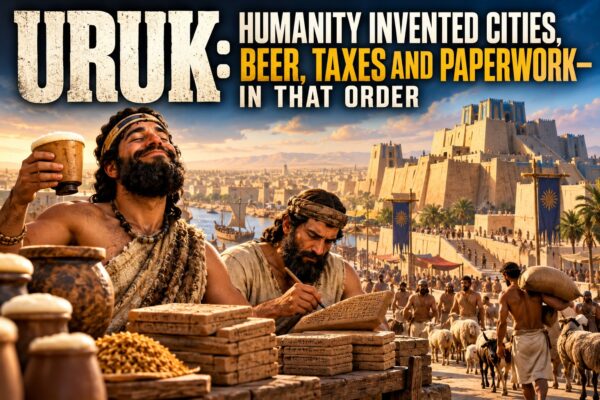
About 5,500 years ago, somebody in Mesopotamia had a brilliant idea.
“What if instead of living in little villages where everybody knows everybody, we cram tens of thousands of people together, build giant government buildings, collect taxes, create bureaucrats, fight with the neighbors, drink beer, and complain about where all the money went?”
And civilization was born.
Welcome to Uruk.
What you didn’t learn in elementary school… Around 3500 BC, Uruk in southern Mesopotamia was becoming something the world had probably never seen before: a genuine city. Not a village with an ambitious chamber of commerce. A city. Tens of thousands of human beings living together, supported by farms, canals, trade, craftsmen, priests, administrators and enough bureaucracy to eventually require humanity to invent writing.
That last part is important.
We sometimes imagine the invention of writing as some wise ancient philosopher staring thoughtfully at the stars and deciding mankind needed a way to preserve poetry for future generations.
Nope.
Some bureaucrat apparently wanted to know where the barley went.
The earliest writing from Mesopotamia is overwhelmingly administrative: quantities, commodities, livestock, workers and rations. Somebody delivered grain. Somebody received grain. Somebody owed grain.
Civilization had immediately invented the paperwork.
Humanity hadn’t even figured out indoor plumbing yet, but apparently the quarterly barley report was already overdue.
Uruk itself would have been impressive. Most buildings were constructed from mud brick because southern Mesopotamia wasn’t exactly overflowing with forests and quarries. Narrow streets wound between houses while enormous religious complexes towered above the city.
Religion wasn’t something Uruk’s citizens squeezed into Sunday morning before brunch. Religion, government and economics were intertwined. Temples controlled land, organized labor, stored agricultural products and redistributed resources.
Imagine combining city hall, the Federal Reserve, Walmart, the Department of Agriculture and your local church into one giant mud-brick complex.
Welcome to Mesopotamia.
Most people were farmers, fishermen, shepherds, builders, textile workers and craftsmen. Irrigation canals transformed the dry plains between the Tigris and Euphrates into agricultural country capable of feeding an enormous population.
Which required organization.
Which required administrators.
Which required records.
Which required more administrators.
You can see where this is going.
Uruk also discovered another cornerstone of civilization: beer.
Barley beer was an important part of the Mesopotamian diet and economy. Workers could receive grain, oil and beer as rations. So apparently the world’s earliest civilization independently discovered the principle that employees become considerably more cooperative when management provides alcohol.
Some ideas really are timeless.
The city also participated in long-distance trade. Southern Mesopotamia possessed wonderful farmland but lacked many other useful resources, including quality timber, metals and stone. So merchants developed trading networks reaching toward Anatolia, Iran and the Persian Gulf.
Civilization was barely out of diapers and already had supply-chain problems.
Then there was social hierarchy.
Some people controlled land and resources. Priests and administrators occupied privileged positions. Skilled craftsmen had valuable specialties. Agricultural laborers did most of the hard work. Dependent labor and slavery existed.
Apparently humanity also discovered management shortly after discovering agriculture.
Life wasn’t easy.
Summers were brutally hot. Disease spread through crowded populations. Infant mortality was high. Flooding could destroy crops. Irrigation canals constantly needed maintenance. If the Euphrates decided to rearrange your neighborhood, there wasn’t exactly a FEMA website where you could apply for assistance.
Yet something extraordinary happened there.
Agricultural surplus allowed specialization.
For most of human history, nearly everybody had been directly involved in obtaining food. But when 100 farmers could produce enough food for 120 people, suddenly twenty people could do something else.
One could become a potter.
Another a metalworker.
Another a merchant.
Another a soldier.
Another a priest.
And, inevitably, somebody became Assistant Deputy Director of Barley Distribution. Most likely Nimrod’s cousin, nepotism wasn’t against HR policy yet.
That is civilization.
Uruk is also associated with Gilgamesh, the legendary king who later became the central figure of the Epic of Gilgamesh. There may have been a historical ruler behind the legend around 2700 BC, although by the time the stories reached us, Gilgamesh had become something considerably larger than your average municipal administrator. He was a giant.
His story deals with friendship, war, pride, death and mankind’s desperate search for immortality.
Which is remarkable because thousands of years later we’re still wrestling with exactly the same things.
That may be the most interesting lesson of Uruk.
Stand outside the city around 3200 BC and look toward those mud-brick walls. Inside are merchants arguing over prices, government officials counting somebody else’s barley, politicians and priests managing institutions, workers complaining about their rations, soldiers guarding the city, businessmen importing foreign goods and ordinary families trying to make it through another year.
Five thousand years later, we’ve got smartphones, nuclear weapons, artificial intelligence and DoorDash.
But the basic operating system hasn’t changed much.
We built cities.
We created government.
We invented taxes.
Then we invented writing so the government could keep track of the taxes.
And somewhere in Uruk, I guarantee there was a farmer staring at a clay tablet thinking:
“I don’t remember ordering this much government.”
Civilization had arrived.
If you enjoyed this article, then please REPOST or SHARE with others; encourage them to follow AFNN. If you’d like to become a citizen contributor for AFNN, contact us at managingeditor@afnn.us Help keep us ad-free by donating here.
Substack: American Free News Network Substack
Truth Social: @AFNN_USA
Facebook: https://m.facebook.
Telegram: https://t.me/
Twitter: https://twitter.com/AfnnUsa
GETTR: https://gettr.com/user/AFNN_
CloutHub: @AFNN_USA