For thousands of years, humans have been trying to make counting easier. We started with fingers, graduated to rocks, invented the abacus, and eventually built computers capable of performing billions of calculations per second. Not bad for a species that occasionally forgets where it parked the car.
But apparently, that wasn’t good enough.
Now we’re building quantum computers, machines that operate according to the bizarre rules of physics, where particles behave like waves, objects can exist in combinations of different states, and two particles can become connected in ways that made even Albert Einstein uncomfortable.
Welcome to quantum computing, where reality starts behaving like a science-fiction movie written by a mathematician who hasn’t slept in three days.
First, let’s understand regular computers.
Every computer you’ve ever used, from your smartphone to the supercomputers running military simulations, operates using something called binary. Binary is simply a fancy word for two choices: zero or one.
Think of a light switch.
Off is zero. On is one.
That’s it.
Your computer uses billions of microscopic switches called transistors. By turning them on and off in carefully organized patterns, it performs calculations, displays pictures, plays videos, and occasionally informs you that your printer is offline despite the printer sitting three feet away.
These zeros and ones are called bits.
A classical computer processes information by manipulating these bits according to mathematical instructions. Modern computers are astonishingly fast, but they still obey the same basic rules.
Now things get weird.
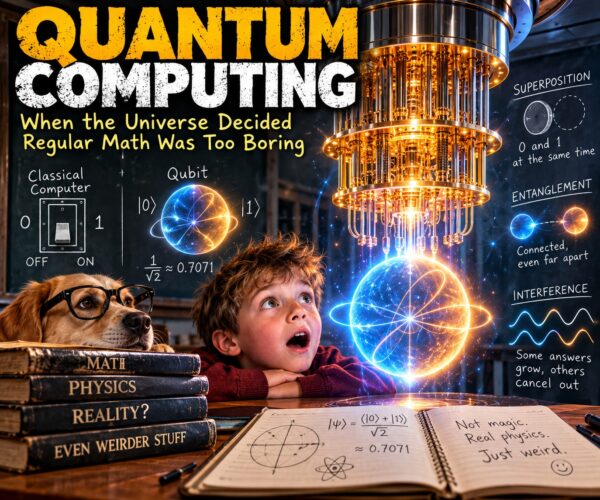
A quantum computer uses something called a qubit, short for quantum bit.
Unlike an ordinary bit, which must be either zero or one, a qubit can exist in a combination of both states simultaneously.
Physicists call this superposition.
Imagine flipping a coin.
When the coin lands, it’s either heads or tails. But while it’s spinning, we can use that image to imagine a combination of possibilities.
A qubit is somewhat like that spinning coin, except this isn’t merely because we don’t know the answer yet. Quantum physics actually describes the qubit as a combination of states until measurement produces a result.
And no, this doesn’t mean your computer can magically get every answer simultaneously.
That popular explanation is misleading.
Quantum computers manipulate these combinations using something called interference. Think about throwing two rocks into a pond. The ripples spread outward. Sometimes the waves reinforce each other, making bigger waves. Sometimes they cancel each other out.
Quantum algorithms use a similar principle to increase the probability of useful answers while suppressing others.
Essentially, we’re convincing the universe to help with the math.
Then there’s entanglement.
Imagine two magical coins that share a special connection. You separate them, take one to Michigan and the other to Florida, and discover their measurement results are related in ways ordinary coins cannot reproduce.
That’s a simplified picture of quantum entanglement.
Einstein famously disliked this phenomenon, calling it “spooky action at a distance.”
However, entanglement doesn’t allow us to send messages faster than light. Sorry, science-fiction writers. Physics still has rules, even when those rules appear to have been invented by a committee of drunken squirrels.
So why should anybody care?
Because certain mathematical problems are extraordinarily difficult for classical computers.
Consider encryption.
Much of today’s internet security depends on mathematical problems involving enormous numbers. Multiplying two giant prime numbers is relatively easy. Working backward to discover those primes can be extremely difficult.
A sufficiently powerful, error-corrected quantum computer could use Shor’s algorithm to break some widely used public-key encryption systems much faster than known classical methods.
That’s a serious national-security concern.
But don’t throw your laptop into Lake Huron just yet.
Today’s quantum computers are generally noisy, fragile, and limited. They haven’t demonstrated the ability to break modern, properly implemented large-key RSA encryption at the scale required for practical attacks.
Scientists are also developing quantum-resistant encryption, because apparently humanity enjoys inventing problems and then creating entire government agencies to solve them.
Quantum computers may also help scientists simulate molecules, discover new materials, improve chemical processes, and understand physics that ordinary computers struggle to model.
And here’s where things get particularly interesting.
Remember the number 0.7071?
That’s approximately one divided by the square root of two.
In quantum computing, it frequently appears when describing a qubit prepared with equal probabilities of producing zero or one.
The mathematical expression looks like this:
|ψ⟩ = (|0⟩ + |1⟩)/√2
Each possible outcome has an amplitude of approximately 0.7071. Square that number, and you get 0.5, or a 50% probability.
There you go. Fifth-grade fractions just wandered into quantum physics.
But there’s one final misunderstanding worth destroying.
Quantum computers aren’t replacements for ordinary computers.
You don’t need quantum physics to write an email, calculate your taxes, or watch cat videos. Classical computers are extraordinarily good at those jobs.
Quantum computers are specialized machines that may outperform classical computers on particular problems, not magical devices that make everything faster.
And building useful ones is enormously difficult because quantum states are incredibly sensitive to their surroundings. Heat, electromagnetic interference, and other disturbances can introduce errors.
Some quantum processors operate at temperatures colder than outer space.
Think about that.
We have constructed machines that must be refrigerated almost to absolute zero so we can persuade individual particles to perform mathematical tricks.
All because humans weren’t satisfied with counting on their fingers.
The truly remarkable part isn’t that quantum physics is strange. It’s that the universe has apparently been operating this way, long before humans arrived and started arguing about which political party invented electricity.
Classical computing taught us how to make machines calculate.
Quantum computing is teaching us how to make the laws of nature participate in the calculation.
And perhaps the greatest lesson is this:
The universe doesn’t have to make sense to a fifth grader. Or a Nobel Prize winner.
But understanding even a little of it reminds us how much we still don’t know.
Which is pretty impressive for a species that still needs instructions printed on shampoo bottles.
If you enjoyed this article, then please REPOST or SHARE with others; encourage them to follow AFNN. If you’d like to become a citizen contributor for AFNN, contact us at managingeditor@afnn.us Help keep us ad-free by donating here.
Substack: American Free News Network Substack
Truth Social: @AFNN_USA
Facebook: https://m.facebook.com/afnnusa
Telegram: https://t.me/joinchat/2_-GAzcXmIRjODNh
Twitter: https://twitter.com/AfnnUsa
GETTR: https://gettr.com/user/AFNN_USA
CloutHub: @AFNN_USA