The Ancients Weren’t Stupid: Pyramids, Mathematics, and the Great Year
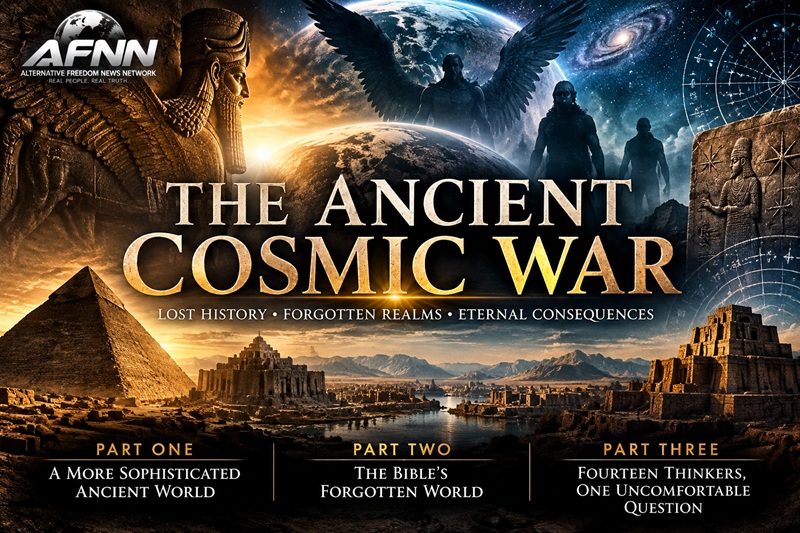
Part One of Three: The Ancient Cosmic War
Modern humanity suffers from a peculiar form of arrogance. We have smartphones, artificial intelligence, GPS satellites, and electric cars that occasionally catch fire. Naturally, we’ve concluded that everyone who lived before us was intellectually inferior.
Apparently, if you didn’t have Wi-Fi, you were an idiot.
There’s just one problem. Archaeology keeps uncovering evidence that our ancestors were considerably more sophisticated than we give them credit for. And the deeper we dig, the more uncomfortable some of our assumptions become.
Before we explore ancient biblical accounts of heavenly beings, giants, and cosmic warfare in this three-part series, we need to establish something fundamental: The people who recorded these ancient accounts were not stupid.
The Great Pyramid: An Engineering Problem
Consider the Great Pyramid of Giza, constructed approximately 4,500 years ago.
Originally standing about 481 feet tall, it was built using millions of stone blocks. Some weighed several tons, while certain granite components were considerably heavier.
Its builders accomplished something remarkable. The pyramid was aligned almost perfectly with the cardinal directions—north, south, east, and west. Modern surveys show that its orientation deviates from true north by only a few arcminutes.
That’s extraordinary precision for a civilization without satellites, laser surveying instruments, or computers.
But here’s something even more interesting.
Although the Great Pyramid appears to have four triangular faces, its surfaces exhibit a subtle concavity that can create the appearance of eight triangular facets under certain lighting conditions.
This feature has inspired considerable speculation about whether the builders intentionally incorporated sophisticated geometry into the monument. The concavity is real, although its original purpose remains uncertain.
Then there’s the pyramid’s relationship to the dimensions of Earth.
Some researchers have proposed that the ratio between the pyramid’s height and base perimeter approximates the relationship between Earth’s radius and circumference when multiplied by 43,200.
It’s an intriguing numerical relationship, although historians have not established that the ancient Egyptians deliberately encoded Earth’s dimensions into the structure. The calculation also depends upon which measurements and assumptions are selected.
Nevertheless, the pyramid’s verified engineering accomplishments are remarkable enough without adding unsupported claims.
These people understood geometry, surveying, logistics, and construction on an extraordinary scale.
And they accomplished it without a single PowerPoint presentation.
The Great Year: Measuring Time in Millennia
Now consider astronomy.
Most people understand that Earth rotates once approximately every 24 hours and revolves around the Sun once each year.
But Earth also experiences a much slower motion known as axial precession.
Imagine a spinning top. As it rotates, its axis slowly traces a circle.
Earth does something similar.
Its rotational axis gradually changes orientation, completing a cycle in approximately 25,772 years.
Astronomers call this the precession of the equinoxes, and the full cycle is sometimes called the Great Year.
The phenomenon changes which star appears closest to the north celestial pole and slowly shifts the positions of the equinoxes relative to the background stars.
The Greek astronomer Hipparchus is generally credited with identifying precession quantitatively during the second century BC by comparing his observations with earlier astronomical records.
Think about that.
Ancient astronomers were studying changes so gradual that a single human lifetime could reveal only a tiny portion of the cycle.
They weren’t simply staring at the night sky and inventing stories.
They were measuring, comparing, calculating, and preserving observations across generations.
Some modern writers argue that knowledge of the complete precessional cycle existed thousands of years before Hipparchus. Those claims remain debated and lack the same documentary foundation as the later Greek observations.
But the established accomplishments are impressive.
Our ancestors understood that the heavens operated according to mathematical patterns long before Newton explained gravity.
Why Does a Circle Have 360 Degrees?
Here’s a question most people never ask.
Why does a circle contain 360 degrees?
Why not 100? Or 1,000?
The answer takes us back to ancient Mesopotamia.
The Babylonians developed a sophisticated mathematical tradition using base 60, known as the sexagesimal system.
Sixty is an extraordinarily convenient number because it can be divided evenly by 2, 3, 4, 5, 6, 10, 12, 15, 20, and 30.
That makes it useful for fractions, measurements, and astronomical calculations.
The 360-degree circle developed through ancient mathematical and astronomical traditions associated with this system. A year of approximately 360 days also provided a useful idealized framework for some ancient calculations.
Today, we still divide an hour into 60 minutes, a minute into 60 seconds, and a circle into 360 degrees.
Thousands of years later, our supposedly advanced civilization continues using mathematical conventions inherited from people who wrote on clay tablets.
Let that sink in.
We landed men on the Moon using mathematics built partly upon foundations laid by civilizations that existed long before Rome.
The Babylonians weren’t primitive.
They were brilliant mathematicians working with different tools.
Göbekli Tepe: Archaeology Changes the Timeline
Now travel to southeastern Turkey.
At Göbekli Tepe, archaeologists have uncovered monumental stone structures dating to approximately 9600 BC.
That’s roughly 11,600 years ago.
Thousands of years before Stonehenge or the Egyptian pyramids, people were quarrying, transporting, carving, and erecting enormous limestone pillars.
Some feature detailed representations of animals and complex symbolic imagery.
The site demonstrates remarkable organizational abilities among early Neolithic communities.
For generations, archaeologists generally associated large monumental construction with established agricultural societies and increasingly complex settlements.
Göbekli Tepe complicated that picture.
Its builders belonged to communities undergoing the transition toward agriculture and permanent settlement. Their monuments demonstrate that large-scale cooperation and sophisticated symbolic traditions developed remarkably early.
What makes the discovery important isn’t evidence of extraterrestrial assistance or some mysterious vanished technological civilization.
It’s evidence that ancient human ingenuity was more capable than many earlier models anticipated.
And archaeological discoveries continue to refine our understanding of that period.
Ancient People Had the Same Brains We Do
Here’s the fundamental problem with modern arrogance.
Biologically, the people who built the pyramids were essentially the same species we are today, with comparable cognitive potential.
They possessed the same capacity for reasoning, creativity, problem-solving, observation, and imagination.
What they lacked was our accumulated technological infrastructure.
Give an ancient Egyptian engineer a modern education, and there’s no biological reason to assume he couldn’t become an aerospace engineer.
Give the average modern American a copper chisel, rope, stone tools, and instructions to build a pyramid, and we’d probably spend three weeks arguing about workplace safety before accomplishing anything.
We confuse technological inheritance with individual intelligence.
That’s a serious intellectual mistake.
Civilizations accumulate knowledge over generations. We stand upon discoveries made by countless people who lived before us.
Our technology is more advanced.
That doesn’t mean we’re inherently smarter.
What Else Did They Know?
Now we arrive at the uncomfortable question.
Ancient civilizations demonstrated sophisticated knowledge of mathematics, astronomy, architecture, and engineering.
They carefully observed the natural world and preserved information across generations.
But they also recorded extraordinary accounts of heavenly beings, giants, divine councils, supernatural rebellions, and catastrophic judgments.
Modern society generally treats their mathematical achievements with respect while dismissing their supernatural accounts as primitive mythology.
Perhaps those accounts were mythology.
Perhaps they reflected religious symbolism, cultural traditions, or attempts to explain natural phenomena.
Or perhaps some preserved experiences that modern readers have difficulty interpreting.
We cannot establish the answer simply by pointing to a pyramid or an ancient astronomical calculation.
Intelligence does not guarantee that every belief held by an intelligent person is correct.
But neither should antiquity automatically disqualify an account from serious examination.
That distinction matters.
Because the ancient Hebrews recorded a particularly fascinating narrative about the origins of humanity and the existence of intelligent beings before mankind.
In Job 38:4–7, God describes the foundations of Earth being laid while the morning stars sang together and the sons of God shouted for joy.
Genesis 6 describes the sons of God, the daughters of men, and the mysterious Nephilim.
Psalm 82 depicts God standing in a divine assembly.
These passages were written long before modern UFO culture, science fiction, or conspiracy podcasts.
And archaeological discoveries, including ancient Ugaritic tablets and the Dead Sea Scrolls, demonstrate that some of these supernatural concepts were deeply embedded in the religious worldview of the ancient Near East.
That doesn’t prove the supernatural events occurred.
But it does raise a legitimate historical and theological question.
What did the people who originally wrote and read these passages actually believe they were describing?
Perhaps modern humanity has become so impressed with its own technological accomplishments that we’ve confused our ability to build better machines with a superior understanding of reality.
Our ancestors weren’t stupid.
They were intelligent human beings attempting to understand the same universe we inhabit.
And before we dismiss their extraordinary accounts, perhaps we ought to understand what they actually said.
Because in Part Two, we’re going to open the Bible and examine something many modern Christians have barely considered.
What if humanity wasn’t God’s first intelligent creation—and what if the Bible describes a supernatural rebellion that began long before recorded human history?
Next: Part Two — The Bible’s Forgotten World: Angels, Giants, and the Divine Council.
⸻
Selected Sources and Further Reading
- W. M. Flinders Petrie, The Pyramids and Temples of Gizeh (1883). Foundational survey measurements of the Giza monuments.
- Glen Dash, archaeological surveying research on the Great Pyramid and its cardinal orientation.
- Otto Neugebauer, The Exact Sciences in Antiquity (1957). Ancient mathematics and astronomy.
- Alexander Jones, A Portable Cosmos: Revealing the Antikythera Mechanism, Scientific Wonder of the Ancient World (2017).
- UNESCO World Heritage Centre, Göbekli Tepe. Archaeological chronology and significance.
- NASA, educational materials on Earth’s axial precession.
- Michael S. Heiser, The Unseen Realm (2015). The supernatural worldview of the biblical authors.
- Douglas Van Dorn, Giants: Sons of the Gods. Ancient biblical interpretations of the Nephilim.
This article is part 1 of 3. Links to this and subsequent parts are listed below and go live on the dates indicated.
30 October: The Ancient Cosmic War, Part 1 of 3: What If We’ve Forgotten More Than We’ve Learned?
31 October: The Ancient Cosmic War, Part 2 of 3: The Bible’s Forgotten World: Angels, Giants, and the Divine Council
If you enjoyed this article, then please REPOST or SHARE with others; encourage them to follow AFNN. If you’d like to become a citizen contributor for AFNN, contact us at managingeditor@afnn.us Help keep us ad-free by donating here.
Substack: American Free News Network Substack
Truth Social: @AFNN_USA
Facebook: https://m.facebook.com/afnnusa
Telegram: https://t.me/joinchat/2_-GAzcXmIRjODNh
Twitter: https://twitter.com/AfnnUsa
GETTR: https://gettr.com/user/AFNN_USA
CloutHub: @AFNN_USA