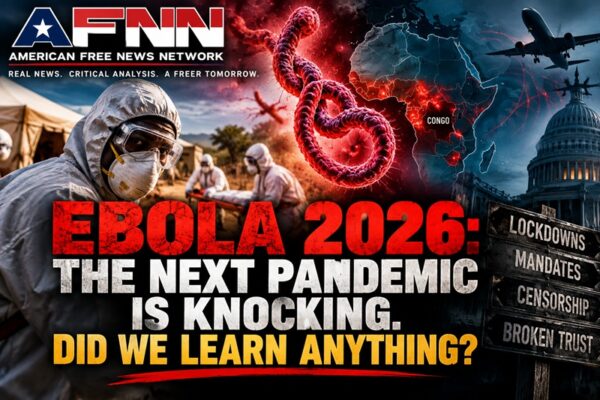
Well, congratulations, humanity. We survived COVID-19, destroyed countless small businesses, closed schools, surrendered constitutional liberties, turned neighbors against each other, and somehow managed to make pharmaceutical companies richer while convincing ourselves that questioning government policy was practically a criminal offense. Now, just when we thought the circus had packed up its tents, Ebola has decided to audition for the sequel.
And this time, the virus isn’t particularly interested in your political affiliation.
As of October 29, the Democratic Republic of the Congo has reported 10,274 confirmed Ebola infections and 4,992 deaths. That’s a case fatality ratio approaching 49 percent. Not exactly the seasonal sniffles. The outbreak has spread across eight Congolese provinces, with additional cases reported in Kenya and Nigeria. One infected patient was subsequently evacuated to Switzerland.
Apparently, international travel doesn’t require a virus to obtain a passport.
But here’s where things get interesting.
The outbreak involves Bundibugyo Ebola, a particularly nasty member of the Ebola family. Unlike the Zaire Ebola virus, against which we have a licensed vaccine, Bundibugyo currently has no licensed vaccine proven effective against it. Experimental vaccine trials began October 23.
Translation? The scientists are working on it, but the cavalry hasn’t arrived.
Now, before someone starts ordering industrial quantities of toilet paper, let’s establish something important. There is currently no confirmed evidence that this virus has developed sustained airborne transmission between humans.
That’s good news.
Ebola primarily spreads through direct contact with infected bodily fluids. But viruses don’t consult government regulations before evolving, and scientists shouldn’t dismiss legitimate questions about transmission simply because the answers might frighten people.
Which brings us to the uncomfortable elephant in the room.
Did we learn anything from COVID-19?
Remember when science became something you were supposed to obey rather than question? Remember when politicians suddenly became medical experts, social media companies became scientific referees, and ordinary citizens were told that asking inconvenient questions was dangerous?
Science isn’t a religion. It’s a process of challenging assumptions, examining evidence, and occasionally discovering that yesterday’s experts were spectacularly wrong.
That doesn’t mean every conspiracy theory deserves a Nobel Prize. It means scientific claims should survive scrutiny without requiring censorship as life support.
Meanwhile, Britain’s Parliament is revisiting COVID-era policies, vaccine injuries, informed consent, and the government’s responsibility to compensate people seriously harmed by medical interventions.
Imagine that. Accountability after the emergency.
What a revolutionary concept.
Here’s the problem: Governments love emergency powers. They’re easy to acquire, politically convenient, and remarkably difficult to surrender. Nothing expands bureaucracy faster than frightened citizens demanding somebody do something.
And nothing destroys public trust faster than officials refusing to admit mistakes.
From a military perspective, COVID exposed a catastrophic failure of institutional red-teaming. When leadership becomes convinced its strategy is flawless, dissent becomes disloyalty. Eventually, everyone agrees with the commander, right up until the operation collapses.
A competent military commander wants someone identifying weaknesses before the enemy exploits them.
Public-health leadership should operate the same way.
But there’s another lesson worth remembering.
Preparedness isn’t tyranny. Disease surveillance isn’t automatically government overreach. Quarantining someone with a highly lethal contagious infection isn’t equivalent to locking down an entire healthy population.
Different threats require different responses.
The objective should be proportionality: protect the vulnerable, preserve essential freedoms, communicate uncertainty honestly, and continuously reassess whether interventions are actually working.
And if government recommends or mandates medical interventions, it must accept responsibility when those interventions cause demonstrable harm.
No bureaucratic shell games. No endless investigations. No waiting until injured citizens are dead before acknowledging their existence.
Ebola is already demonstrating what happens when a deadly pathogen encounters fragile healthcare systems, inadequate resources, and international mobility.
The next pandemic doesn’t need to become another political loyalty test.
We need better surveillance, faster diagnostics, transparent scientific debate, accountable leadership, and emergency powers with expiration dates.
Most importantly, we need citizens capable of distinguishing legitimate public-health precautions from government officials enjoying their newfound authority.
Because here’s the strategic reality: The next pandemic won’t wait for us to finish arguing about the last one.
And if our response is another combination of panic, censorship, political theater, and bureaucratic incompetence, the virus won’t be our only problem.
The disease might threaten our lives. Our response must not unnecessarily destroy everything that makes those lives worth living.
If you enjoyed this article, then please REPOST or SHARE with others; encourage them to follow AFNN. If you’d like to become a citizen contributor for AFNN, contact us at managingeditor@afnn.us Help keep us ad-free by donating here.
Substack: American Free News Network Substack
Truth Social: @AFNN_USA
Facebook: https://m.facebook.com/afnnusa
Telegram: https://t.me/joinchat/2_-GAzcXmIRjODNh
Twitter: https://twitter.com/AfnnUsa
GETTR: https://gettr.com/user/AFNN_USA
CloutHub: @AFNN_USA