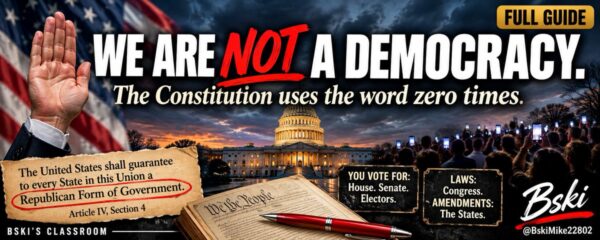
Again, we are not a democracy.
On November 7, Rep. Ayanna Pressley posted that her new majority must meet the moment by “defending our democracy.” The Constitution she swore to support uses that word exactly zero times. The word it DOES use is the one a rising socialist platform now wants to retire, one institution at a time. Here are the receipts.
She Raised Her Hand. Read What It Says.
Every member of Congress swears to support and defend the Constitution of the United States against all enemies, foreign and domestic. So does every soldier. I said those words myself, and nobody in the room asked me to swear to a democracy. Nobody could. The word is not in the document.
A woman asked Benjamin Franklin on September 18, 1787, as he left the Constitutional Convention, what the delegates had given the country: a republic or a monarchy. James McHenry wrote down the answer. A republic, Franklin said, if you can keep it. He had just spent the whole summer in a room with the authors, so he was in a position to know which noun they meant. We still recite it at ballgames: “and to the Republic for which it stands.” Not the democracy.
What the Document Actually Says
Search it. Democracy: zero. Democratic: zero. What you will find is Article IV, Section 4: the United States shall guarantee to every State in this Union a Republican Form of Government. That is a guarantee, not a mood.
I won’t even give you “democratic” as the adjective for the federal government. At the state level, I will buy it: plenty of states let voters decide laws directly through ballot initiatives and referendums. Federally, nobody votes on anything. You don’t vote for Congress. You vote for one representative, who joins a body called Congress, and THAT body does the voting. The Senate was built to be picked by state legislatures until the 17th Amendment handed it to the voters in 1913, and we messed that one up too. The president comes through the Electoral College… see why the left is trying to get rid of that! The people choose people, and the people never decide a single law. That is republican wiring, and the noun is where the fight lives. A democracy is the majority of the moment ruling directly. A republic is government by law, where the majority governs inside walls it cannot knock down on a Tuesday.
Madison drew that line in Federalist 10. Pure democracies, he wrote, have ever been “spectacles of turbulence and contention,” short in their lives and violent in their deaths. Hamilton, in Federalist 9, looked at the small Greek and Italian republics and saw “perpetual vibration between the extremes of tyranny and anarchy,” then listed the fixes: separated departments, legislative balances and checks, judges who keep their seats, representatives. Those fixes are the Senate, the veto, and the courts. John Adams, writing in 1814, was blunter: “Democracy never lasts long. It soon wastes, exhausts, and murders itself.”
Somebody always answers that the majority voted for it. That is argumentum ad populum, which is Latin for popular, therefore right, and the founders spent a summer building walls against exactly that sentence.
Which brings me to “moving aggressively.” Aggressive is a direction, not a plan. I wouldn’t trust anyone to run a lemonade stand on a business model of aggressive and responsive, much less a country.
Nobody Swears to a Person
Look at who gets sworn to. Article VI binds every member of Congress, every state legislator, and every executive and judicial officer, state and federal, by oath or affirmation to support this Constitution. The oath federal officers take is written into 5 U.S.C. 3331, and military officers swear essentially the same words: support and defend the Constitution of the United States against all enemies, foreign and domestic, and bear true faith and allegiance to the same. The president’s own oath sits in Article II, and he promises to preserve, protect and defend the Constitution. He swears it BEFORE he is president. The document comes first. The man comes second.
I took the enlisted version, and 10 U.S.C. 502 has it word for word: “I will support and defend the Constitution of the United States against all enemies, foreign and domestic; that I will bear true faith and allegiance to the same; and that I will obey the orders of the President of the United States and the orders of the officers appointed over me, according to regulations and the Uniform Code of Military Justice.” Read the order of that sentence. The Constitution is named first, and it is the thing I bear allegiance to. The obedience clause comes after it, and it is tied to regulations and the UCMJ, not to a mood and not to a man.
Compare that with August 2, 1934. German soldiers swore an oath of unconditional obedience to Adolf Hitler, personally, as Führer. Not to a constitution. To a person. Everything that followed in the Wehrmacht’s conscience, or the lack of one, rests on that one sentence.
A pure democracy cannot give a soldier anything to swear to except whoever currently speaks for the majority. That is the whole problem with the word. Our oath works because the thing we swear to does not change when the crowd does.
The Constitution Tells You How to Get Rid of It
Here is the part the “our democracy” crowd never mentions: the Constitution has a door marked EXIT, and the door has a lock. Article V says an amendment can be proposed two ways, by two thirds of both houses of Congress or by a convention called when two thirds of the state legislatures ask for one. Either way, it takes three fourths of the states to ratify. Twenty-seven times, that road has been walked. Every time, it took years of persuasion, and the voters never cast a ballot on any of them directly.
The president has no role in it. In Hollingsworth v. Virginia, 1798, the Supreme Court held that the president’s signature is not part of the amendment process. So no matter how large Pressley’s new majority turns out to be, it cannot change the document by itself. The document is the only thing that can change the document.
Think of Ulysses lashed to the mast. He didn’t tie himself up because he was stupid. He tied himself up because he knew exactly what he’d do once the song started. The people who wrote this country’s rules did the same thing to the rest of us, on purpose, before the song began.
And in 1866, in Ex parte Milligan, the Court said it plainly: the Constitution of the United States is a law for rulers and people, equally in war and in peace, and covers with the shield of its protection all classes of men, at all times, and under all circumstances. Notice “at all times.” Not “unless the crowd is angry enough.”
The text does allow one emergency, and it is a small one. Article I, Section 9 says the privilege of the writ of habeas corpus shall not be suspended unless when in Cases of Rebellion or Invasion the public Safety may require it. One right. Two named emergencies. And it sits in Article I, which is Congress’s article, not the president’s. The people who wrote that clause knew how emergencies get used, so they kept the keys away from the executive.
What You Actually Vote For
Let me save you some confusion, because I hear this one from people on every side. At the federal level, you do not vote for the president. You do not vote for laws. You do not vote for amendments. Here is the whole list.
You vote for one person in the House, every two years, under Article I, Section 2. You vote for senators, since the 17th Amendment moved that job from state legislatures to the voters in 1913. And you vote for a slate of presidential electors, who then vote for the president, under Article II, Section 1 and the 12th Amendment. The ballot has a candidate’s name on it, but the thing you’re choosing is the electors. The Constitution even says the state legislature decides how they are picked, and in McPherson v. Blacker, 1892, the Court said that power is broad.
Laws? Article I, Section 1: all legislative powers herein granted shall be vested in a Congress. Not in you. Amendments? The states. There is no federal ballot initiative and no national referendum anywhere in the Constitution. A state can run one for its own affairs. The country cannot.
So what are you buying with your vote? A trustee. Madison, in Federalist 10, described the job as refining and enlarging the public views by passing them through the medium of a chosen body of citizens, whose wisdom may best discern the true interest of their country. Edmund Burke said it more bluntly to his voters in Bristol in 1774: your representative owes you not his industry only but his judgment, and he betrays you instead of serving you if he sacrifices it to your opinion.
That is the job description. Vote for someone you trust to vote YOUR interests. Not their party’s. Not their own. Not even the mob that put them there on a hot Tuesday, because a mob has no interests. It has a mood.
When a Democracy Votes Itself Out of Its Own Rules
Now the history, because the people telling you democracy is the safe word never tell you the story.
In 406 BC, Athens, the original democracy, tried the generals who had won the naval battle at Arginusae but failed to rescue the shipwrecked sailors in a storm. The law required separate trials. The Assembly, worked up by the crowd, voted to try them all at once, and six of them were executed. According to Xenophon, Socrates, serving on the committee that presided that day, refused to put the motion to a vote. The Athenians came to regret what they had done. Their regret did not bring back the six.
In 1793, revolutionary France adopted a democratic constitution by plebiscite. Crowds pressed the Convention in September of that year, and on October 10 the government declared itself revolutionary until the peace, and the freshly approved constitution was shelved before it ever took effect. The Terror followed.
In 1933, Germany had a written constitution, an elected parliament, and a president, and Article 48 of the Weimar Constitution let the president rule by emergency decree. After the Reichstag fire on February 28, a decree under that article suspended civil liberties. On March 23, the Reichstag passed the Enabling Act 444 to 94, which handed lawmaking power to the chancellor, and it did so in a hall ringed with uniformed SA men. The vote was lawful under the rules on the page. That’s the lesson. The rules on the page included a way out.
Then in August 1934 came a plebiscite on combining the offices of chancellor and president. The official count was roughly 90 percent yes. A people can vote to give its power away, and it will call the result a mandate.
So when someone says “we’re a democratic republic” and thinks that settles it, ask which part is doing the work. The adjective doesn’t constrain anything. I notice the countries that put “Democratic” in the official name, East Germany, North Korea, the Democratic Republic of the Congo, tend to be the ones who need the help.
A constitutional republic is a different animal because the exit is narrow and the lock is heavy. You cannot suspend it by acclamation, and you cannot vote it away in an afternoon. You have to persuade two thirds of Congress and three fourths of the states, one legislature at a time, which means you have to do it with arguments and not with a crowd.
The Mob Is Not Your Neighbor
When I say mob, I don’t mean the guy down the street with the yard sign. I mean a mechanism: a majority with the votes and nothing to slow it down. Madison called the thing a faction, and his argument was that you cannot remove factions without removing liberty, so you build a government that makes them slow down, argue, and negotiate. The Senate does that. The veto does that. A court that can say no does that. Every one of them is annoying, which is how you know it works.
Madison put the cost in plain terms. In a pure democracy, he wrote in Federalist 10, there is nothing to check the inducements to sacrifice the weaker party or an obnoxious individual. Notice that the second half of that sentence is the one that gets people killed. The “obnoxious individual” is whoever the crowd decided, ten minutes ago, deserved it.
And in Federalist 55, in a line usually credited to Madison, comes the one I would tattoo on every classroom door: had every Athenian citizen been a Socrates, every Athenian assembly would still have been a mob. Read it again. It does not say the Athenians were stupid. It says that GOOD individual people do not add up to a good crowd. Remember Arginusae, where the one Socrates in the room refused to put the question and was outvoted anyway.
The Science of Not Feeling Responsible
I used to say the mob does not think. My followers read primary sources, so let me tell you what the research did to that sentence.
The old view comes from Gustave Le Bon, who published The Crowd in 1895 and said people in crowds lose their conscious personality and get swept along by contagion and suggestion. His contemporary Scipio Sighele wrote that the soul of the crowd causes the good to spoil and lets the potentially wicked and cruel realise themselves. Both ideas shaped a century of thinking about riots. Both are now widely criticized. A 2024 Maynooth University dissertation by Laura Baldwin points out that these theories carry classist undertones and that the research has moved on. I agree with her, because there is no group of people most likely to riot by class, race, or gender. The modern view says people in crowds keep reasoning. What changes is WHO they reason as.
A 2018 University of Manchester doctoral thesis by Dermot Barr studied the 2011 riots at two sites, Pendleton in Salford and Manchester city centre. The police tactics were different at each. In Salford, the crowd united against the police and drove them out. In the city centre, there was looting without the same confrontation. In both places, the crowd grew more unified and more aware of its own power as the police proved unable to control it. Rioters in Salford described being empowered in glowing terms, and the city-centre rioters reported less of it. The thesis rests on social identity theory, which says that people in a crowd start acting as members of a shared “we” and follow the “we’s” norms. The person doesn’t vanish. The person lets the group decide what’s normal.
Baldwin’s dissertation adds numbers from the 2011 English riots. In the first three days police were outnumbered at times by about 4 to 1, according to the official inspectorate she cites. Police deployment went from roughly 3,480 officers at first to about 16,000 on the last day, and the disorder dropped sharply. Within a year, about a third of the people involved had been cautioned, charged or summonsed, according to the research she cites. Her dissertation takes no side on whether the response was fair. She argues it was not ideal. I include these numbers for one reason: a crowd behaves according to what the situation allows, and where nobody is in charge, the crowd is.
So I am rewording my own line, and the conclusion stays. The mob does think. It thinks as a “we,” and a “we” is not a person you can ask a question. Nobody in it is the one who did it.
The lab work points the same way. In the 1950s, Solomon Asch put people in a room of strangers who had been told to give a wrong answer to a simple line-length question. About three quarters of the participants went along with the group’s wrong answer at least once. In 1968, John Darley and Bibb Latané had students sit in a room while smoke came through a vent. Students alone reported it far more often than students who sat with others who stayed calm. They called it diffusion of responsibility: the more people who could act, the less any one of them felt it was their job. A 2011 meta-analysis of more than a hundred studies found the effect real in ordinary situations and weaker when the emergency was plainly dangerous. I will leave out the famous Kitty Genovese story, because the early newspaper version of it was exaggerated. The lab work stands without it.
In 1976, a psychologist named Ed Diener and colleagues watched Halloween trick-or-treaters. Kids who were anonymous and in a group were more likely to take extra candy than kids who had been asked their names. Take away the name, and people take more. Put the name back, and they behave.
Later research narrowed that finding, and I would rather give you the narrower version. Tom Postmes and Russell Spears reviewed 60 studies in 1998 and found little support for the idea that anonymity makes people break all norms. What it does is make them follow the norm of the group in front of them. That’s worse, not better, because in a crowd the loudest voice gets to say what the local norm is. Sociologist Mark Granovetter added the mechanism in 1978 with his threshold model: one person throws something, a second joins after seeing one, a third joins after seeing several, and plenty of people keep refusing. The escalation doesn’t mean everyone arrived wanting violence. It means each person’s threshold got crossed by what the person next to them did.
Here is where it connects. Every one of those findings points at the same switch: responsibility. When the group is big enough and the names are gone, the person stops feeling like the author of what the group does. Not a single snowflake thinks it is responsible for the avalanche, and we have a lot of snowflakes.
That is the argument for a republic in one sentence. A republic puts a name on every decision. A representative has a face, a voting record, an office you can walk into, and a term that ends. A court puts a name on every defendant. A mob has none of that. A pure democracy, where the majority simply decides, is a machine for producing decisions that nobody owns.
The Mob Has Wi-Fi Now
I mean more than the people with torches. I mean the comment section, the quote-post, the reaction video, the thread of forty accounts repeating a caption none of them checked. YouTube, X, Bluesky, Facebook, Instagram, Reddit, all of it. The old mob had to leave the house. The new one joins with one tap, in a second, from the couch, at zero cost.
Think about what that does to the switch. Sharing is a vote that nobody counts and nobody answers for. The clip is 14 seconds long, the caption says what to feel, the share count says everyone else already felt it, and there it is: listening instead of checking. It doesn’t take a bad person. It takes a person who didn’t open the original, and didn’t look at the date, and didn’t read past the caption.
(This is why I try to put my sources in. My followers are not idiots, they DO factcheck me, and I welcome it and thank them for doing it!) The difference between a community and a mob is that a community can be wrong and then say so with a name attached. I have been corrected here, in public, and the correction made the post better. A mob can’t do that, because nobody inside it feels like the one who needs correcting.
And since I hold both sides to the same standard, I’ll say it plainly: this is not one party’s disease. I have watched accounts on my own side pass around a clipped video with no date inside an hour, and I have watched the other side do the same thing to the same degree. The snowflakes come in every color.
So before you hit share: open the original, find the date, read past the caption, and ask who gains if you believe it. Four steps. Takes about a minute. A republic can survive a nation of people who do that. A democracy, at its worst, is a nation of people who don’t.
What the Courts Said About Crowds
The American legal system has been writing about this problem for more than a century, usually after somebody died.
Start with United States v. Shipp, 1909. Ed Johnson, a Black man convicted in Chattanooga, had his case taken up by the Supreme Court, which halted his execution to review it. A mob lynched him anyway. The Court then took an unusual step: it held a contempt proceeding, and found Sheriff Joseph Shipp guilty after concluding he had facilitated the mob’s work. Other defendants were discharged. That was a contempt case, not a murder prosecution of everyone in the crowd. But look at what the Court was willing to say: the people with a duty to protect a prisoner are not just spectators.
In Frank v. Mangum, 1915, Leo Frank claimed that a hostile crowd had dominated his Georgia murder trial, and the Court turned him away. Holmes dissented, and wrote one of the best lines in American law: mob law does not become due process of law by securing the assent of a terrorized jury. In August 1915, a mob took Frank out of a prison farm and lynched him.
Eight years later, in Moore v. Dempsey, 1923, Black defendants in Elaine, Arkansas, were convicted of murder after the 1919 racial violence there, and they alleged that mob intimidation had made their trials a sham. Justice Holmes, writing for the Court, said that if the whole proceeding was a mask, with counsel, jury and judge swept to the fatal end by an irresistible wave of public passion, then the federal courts had to look. The Court did not decide the defendants’ innocence. It sent the case back so the facts could be examined, because a trial run under mob pressure may not be a trial at all.
Sheppard v. Maxwell, 1966, moves the problem out of the street and into the newsroom. Sam Sheppard’s Ohio murder trial was surrounded by prejudicial publicity and courtroom disruption, and the Court held that he was denied a fair trial and that the judge had not protected the proceeding. It was not a social media case, and it does not mean every viral accusation breaks the Constitution. But the lesson transfers: a publicly demanded verdict can walk into the courtroom without a single torch.
Now the fairness beat, because crowds are made of individuals and the law knows it. In NAACP v. Claiborne Hardware, 1982, the Court dealt with a civil-rights boycott in Mississippi that included both protected political activity and some violence. The Court refused to hold every participant liable for what a few did. Belonging to a group is not the same as committing the acts of its members. Liability has to attach to what a person actually did or authorized.
And in Brandenburg v. Ohio, 1969, a Klan leader’s conviction was reversed because the Court drew a line between abstract advocacy and speech directed to inciting imminent lawless action that is likely to produce it. Say what you want, but the minute your words are aimed at an immediate act, the law finds you.
Read those together and the shape is clear. Courts do the opposite of what mobs do. They take the “we” apart and ask who, specifically, did what. That is not a flaw in the system. It is the system.
Black Mirror Saw It Coming
I’m not offering fiction as evidence. I’m offering it as something worth watching because the writers noticed the mechanism first.
White Bear, from Series 2, follows a woman who wakes with no memory while strangers stand around filming her on their phones and masked hunters chase her. It is a punishment staged as a spectacle, and the paying crowd gets to feel righteous. The episode asks what happens when cruelty is entertainment and nobody in the audience feels like they’re doing anything.
Hated in the Nation, from Series 3, is the one I would show first to anyone who thinks a hashtag is harmless. People tweet
about whoever the internet is angry at this week, and the one with the most votes gets killed by a swarm of autonomous drone insects. The line the episode keeps asking is “it’s just a hashtag.” Every individual typed a hashtag. Nobody pulled a trigger. Look at how that lines up with the diffusion-of-responsibility research.
The National Anthem, the first episode of the series, has a kidnapper demand that a prime minister do something degrading on live television. The public’s view shifts, as the polls roll in, from horror to wanting the demand met, and nearly everyone watches. The crowd isn’t just the audience. It’s an active force that shapes the outcome.
Nosedive, in Series 3, builds a world where everyone rates everyone, and the score decides where you live and where you work. It’s a soft mob, with no riot, only constant group judgment that bends everybody toward conformity. Shut Up and Dance shows people forced into escalating acts under threat of public exposure, with shame as the whip. And The Waldo Moment shows a foul-mouthed cartoon bear turning a protest vote into a political force.
None of those episodes is about villains. They’re about ordinary people with a screen, a crowd, and no reason to feel responsible. That is the democracy problem in a different costume.
The Majority She Is Talking About
The midterms were November 3. The AP called the House for Democrats early Wednesday, November 4, after the party passed the 218-seat line, and ABC and others projected both chambers. Counting was still going as I wrote this, with outlets reporting well past 218 and some past 250, so I’ll leave the final number to the clerk. Pressley is right that she has a new majority. I’ll give her that.
Here is what the new majority runs into. A two-year term. A Senate with a 60-vote filibuster. A veto, which Trump has threatened to use. A Supreme Court. Those aren’t bugs. They’re the walls.
Now look at her own record on the walls. In July 2021, after the Court upheld Arizona’s voting restrictions, Pressley and Warren said Congress should end the filibuster. In May 2022 she called for ending it again, and for adding justices. In April 2023 she, Warren, and Markey called for expanding the Court. In July 2026 her endorsement of Abdul El-Sayed praised his promise to abolish the filibuster. Court size is set by statute, and Congress set it at nine in 1869, so expanding it would be legal. I’ll give her that too. Legal and wise are two different words. Ending the filibuster is whiskey and car keys for a teenage majority.
Same standard for my side, because I hold both parties to it. Trump has demanded that Senate Republicans kill the filibuster again and again, and on May 5 he said he was disappointed in Thune for refusing. Thune said the votes were not there. Good for Thune. Wrong ask from the president, and Fox News carried that story too.
The Platform With the Receipts
On July 14, 2026, the Democratic Socialists of America, a group of about 120,000 members according to AP’s account, released a platform called “Workers Deserve More.” Per the Washington Examiner, Fox News, and USA Today, it calls for abolishing the Senate in favor of an expanded House with proportional representation and ranked choice voting, abolishing the Electoral College, and replacing the president and the Supreme Court with an executive and judiciary chosen by and subordinate to Congress. Its stated goal is to draft a new constitution and create a democratic socialist republic. Notice the noun. Even they know which one they need.
What’s next, a 120,000-member group proposes writing a new constitution… wait, I’m being told they published it on July 14.
Their co-chair, Megan Romer, told Fox News the Senate is an anachronistic institution that comes from the British House of Lords. Quick history note for whoever wrote that talking point, you doddypoll: the Senate came out of the Connecticut Compromise, voted July 16, 1787, to give every state an equal vote. Senators were picked by state legislatures and, since 1913, by voters. Nobody in that building inherited a seat.
Try to abolish it and you meet Article V. Amendments need two thirds of both chambers and 38 states. And the text goes further: no State, without its Consent, shall be deprived of its equal Suffrage in the Senate. Same road for the Electoral College. Same road for replacing the presidency and the Court. And a president chosen by and subordinate to Congress has a name: a parliament. Fine system for Britain. Madison, in Federalist 47, called the gathering of all powers in the same hands the very definition of tyranny. I trust him over a press release.
I am not claiming Pressley signed that platform. USA Today asked Ocasio-Cortez, Mamdani, Tlaib, and others whether they support it, and I would love to hear where the Massachusetts Seventh stands on the part about abolishing the Senate, seeing as two of her home state’s senators work there. The platform is going at that institution like a cat on a fat rat, and so far the plan is a press tour.
The 1963 List, With the Caveat Up Front
On January 10, 1963, Rep. A.S. Herlong Jr., a Florida Democrat, entered a list called “Current Communist Goals” into the Congressional Record, Appendix, pages A34 and A35. A constituent, Patricia Nordman of De Land, asked him to, and she identified it as an excerpt from Cleon Skousen’s The Naked Communist. It went in as an extension of remarks under unanimous consent. It is not a committee finding and not an endorsement, and I want that on the record before somebody reaches for the fainting couch.
Goal 29 on the list: discredit the American Constitution by calling it inadequate, old-fashioned, out of step with modern needs. Goal 30: present the Founding Fathers as selfish aristocrats. I am not claiming anyone in DSA read the list. I am saying the sentences rhyme with a platform that wants to write a new constitution. I covered the rest of the list in a separate article:
https://x.com/i/article/2042315970920755200
How We Got Here, Both Parties’ Fingerprints
The Tenth Amendment reads: the powers not delegated to the United States by the Constitution, nor prohibited by it to the States, are reserved to the States respectively, or to the people. Then a century happened.
William Howard Taft, a Republican, asked Congress for the income tax amendment in 1909. The 16th was ratified February 3, 1913, and the 17th, which moved Senate elections from state legislatures to voters, on April 8, 1913. In Wickard v. Filburn, 1942, the Court said a farmer’s wheat grown for his own use could be regulated because of its combined effect on interstate commerce. In South Dakota v. Dole, 1987, it upheld a law that dangled highway money to push states toward a drinking age of 21, a law Ronald Reagan signed.
So has the left chipped at the republic for years? Yes, and I just showed you where. Has anyone finished the job? Read Article V again. Every wall is still standing because it is hard to move, which was the whole idea. If you want the longer tour, I wrote one on how short the document is and another on the amendment nobody enforces:
https://x.com/i/article/2071623258818875392
https://x.com/i/article/2047289539513688064
And my earlier run through Federalist 9 and 10:
https://x.com/i/article/2075362908750454784
The Civil Rights Act Detour
Somebody will bring up the Civil Rights Act of 1964 and the Voting Rights Act of 1965, so let me do it fairly. Both pushed federal power into ground the states used to hold. Title II rested on the Commerce Clause, upheld in Heart of Atlanta Motel v. United States on December 14, 1964. Section 5 preclearance was an extraordinary federal intrusion until Shelby County v. Holder, June 25, 2013, 5 to 4, struck down the Section 4 formula.
But both laws also rest on the 14th and 15th Amendments, which were passed the way the Constitution says to pass amendments, and which hand Congress the power to enforce them. That is the republic working, not breaking.
And look at who voted. The House passed the 1964 Act 290 to 130: Republicans 138 to 34, about 80 percent, Democrats 152 to 96, about 61 percent. The Senate passed it 73 to 27: Republicans 27 to 6, about 82 percent, Democrats 46 to 21, about 69 percent. Southern Democrats in the Senate voted against it 21 to 1. Robert Byrd, a Democrat, was one of the no votes, and so was Barry Goldwater, a Republican. I will defend the Tenth Amendment all day. I will not stand on segregation to do it.
When One Payer Holds Both Doors
Let me start with a sentence I made up. “I don’t think we will cure your child’s cancer, you rotted Republican.” Nobody in government has said that. I invented it in four seconds, so please don’t go looking for a source. The real question is why it sounds even slightly possible, and the answer comes from the people who said the real ones.
Here are the real ones, and I want to be exact about who said them. None was a federal official. Howard Stern told his radio audience in January 2022 that hospitals shouldn’t admit the unvaccinated, and the coverage quoted him telling them to go home and die. Jimmy Kimmel, in September 2021, said unvaccinated patients who turned to ivermectin shouldn’t get ICU beds, and signed off the bit with “Rest in peace, wheezy.” Don Lemon, on CNN in late August 2021, told the unvaccinated not to go to the hospital when they got sick and take up resources. More famous than wise, the lot of them, and not one has ever controlled a hospital’s budget. Hold on to that last part.
The closest to government is Illinois state Rep. Jonathan Carroll, a Democrat, who filed HB 4259 on December 6, 2021, to make the unvaccinated pay their own COVID hospital bills, then pulled it three days later citing violent threats. Those threats were wrong, and I’ll say so plainly. And in fairness, Alabama Gov. Kay Ivey, a Republican, told her state in July 2021 that it was time to start blaming the unvaccinated. Blame is not denial. Neither of them tried to lock a door.
A private doctor did. Dr. Jason Valentine of Mobile, Alabama, put up a sign in August 2021 saying he would stop seeing unvaccinated patients on October 1, and his office offered to transfer their records. I disagree with the rule. But his patients could call another doctor. That is the whole difference. A private doctor’s rule leaves a hundred other doors. A single payer’s rule leaves the payer’s door and nothing else.
Now the case where a government plan held the checkbook. In 2008, Barbara Wagner, 64, of Springfield, Oregon, got a letter from the Oregon Health Plan saying it would not cover Tarceva for her returning lung cancer but would cover comfort care, including doctor-assisted suicide. The commission chair called that an unfortunate reading of the letter and said no one was telling her the plan would only pay for her to die. He also said the drug cost about $4,000 a month while the assisted-death drugs cost under $100. The drug’s maker, Genentech, ended up supplying Tarceva free. That was Medicaid, not Medicare for All. It is the nearest working example I have of what happens when one payer has a budget and a list.
Canada’s version is a federal report. Health Canada’s sixth annual report on medical assistance in dying, released November 28, 2025, counted 16,499 deaths in 2024, 5.1 percent of all deaths in the country, with cancer cited in 63.6 percent of cases. I am not saying Canada denies cancer care to push anyone toward that door. I am saying that when one payer funds both the treatment and the exit, you had better know who holds the pen.
Pressley has backed Medicare for All. I believe she means well. Intent is not the question. The question is who holds the pen in the next crisis, and whether the pen has a conscience or a budget.
Picture the federal government as the only pizzeria in America. One pie per customer. Eleven-month wait for pepperoni. Pineapple banned for the common good. Nobody can open a second shop, because that would be unfair to the pizza that already exists. This is not a radical idea. It is just common sense.
The Part Where I Help
Great post, Congresswoman. Instead of promising to defend democracy on X, let me find out who in Washington could defend the Constitution. Looking… Looking… Oh. It’s you. You raised your hand and everything.
, two questions, and I’d welcome the answers in public. Do you support abolishing the Senate, abolishing the Electoral College, or replacing the presidency and the Court, as the DSA platform proposes? And if your party ever has to pass something through a Senate that needs 60 votes, do you still want the filibuster gone, or do the walls get more charming from this side?
A republic, if you can keep it. Notice the if. Franklin wasn’t predicting anything. He was handing over a chore, and every one of us picked it up the day we were born here.
But what do I know, I’m only a retired combat medic who swore an oath to the Constitution and, strangely, kept reading it after I put my hand down.
 Mike Borowski is a medically retired Army combat medic with 23 years of service, including a combat deployment to Iraq, and a high school Anatomy and Physics teacher at a high-need Career Technical district in Northeast Ohio — where he also wrote and published the textbooks for both courses. He runs “Bski’s Classroom,” a platform dedicated to cutting through political noise with data, history, and the kind of blunt honesty that comes from someone who has seen both war and the American classroom up close.
—
X (Twitter): x.com/BskiMike22802
Substack: substack.com/@bskimike22802
YouTube: www.youtube.com/@BskiMike22802
AFNN: https://afnn.us/author/mikeborowski/
If you enjoyed this article, then please REPOST or SHARE with others; encourage them to follow AFNN. If you’d like to become a citizen contributor for AFNN, contact us at managingeditor@afnn.us Help keep us ad-free by donating here.
Substack: American Free News Network Substack
Truth Social: @AFNN_USA
Facebook: https://m.facebook.com/afnnusa
Telegram: https://t.me/joinchat/2_-GAzcXmIRjODNh
Twitter: https://twitter.com/AfnnUsa
GETTR: https://gettr.com/user/AFNN_USA
CloutHub: @AFNN_USA