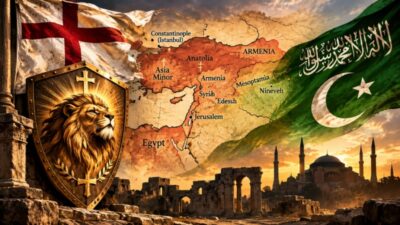
Christianity was born in the Middle East, survived Rome’s lions, became the faith of empires, and endured centuries of conquest. Its oldest communities are now fighting to survive in the very lands where the Church began.
Christianity wasn’t invented in Rome, imported from Europe, or discovered at a Baptist potluck in rural Alabama. It was born in the Middle East, where Jesus walked, the apostles preached, and early Christians discovered that proclaiming a resurrected king could be hazardous to one’s health.
The Romans were particularly enthusiastic about demonstrating this point.
Under Nero, Christians were executed as public spectacles. Under Diocletian, churches were destroyed, scriptures burned, and believers imprisoned or killed. Apparently, preaching love, forgiveness, and eternal salvation constituted a threat to imperial security.
Then history performed one of its spectacular reversals.
In 313 AD, Constantine legalized Christianity. By 380, Nicene Christianity enjoyed imperial endorsement. Constantinople, founded as Constantine’s new capital in 330, became the center of an increasingly Christian Eastern Roman Empire.
The lions hadn’t won. Christianity had outlived its persecutors.
And then came another empire.
Before the Crescent
By the sixth century, Christianity dominated much of the eastern Mediterranean. Egypt, Syria, Palestine, Anatolia, and Armenia supported flourishing Christian communities. Mesopotamia contained ancient churches whose roots reached back toward the apostolic age.
Armenia was especially remarkable. Traditionally dating its conversion to 301 AD, it became the first kingdom to adopt Christianity as its state religion.
Think about that. Armenia was officially Christian before Christianity was even legal throughout the Roman Empire.
Then, beginning in the seventh century, Arab-Muslim armies swept across the Middle East. Byzantine Syria, Palestine, and Egypt fell. Mesopotamia and Persia followed.
Military conquest came first. Religious transformation took centuries.
Christians often survived as protected but legally subordinate communities, subject to special taxation and restrictions that varied across rulers and periods. Some converted, some emigrated, and others maintained their faith despite enormous pressure.
Constantinople resisted successive Muslim sieges for centuries before finally falling to the Ottoman Turks in 1453.
The Christian East had not disappeared. But its political and religious landscape had fundamentally changed.
Armenia: The Christian Nation Marked for Destruction
By 1915, the Ottoman Empire was collapsing under the pressures of World War I, nationalism, and internal instability.
Its Armenian Christian population became a target of the ruling Committee of Union and Progress.
On April 24, 1915, Ottoman authorities arrested hundreds of Armenian intellectuals and community leaders in Constantinople. Mass deportations followed.
Families were marched into the Syrian desert. Men were executed. Women and children died from starvation, exposure, disease, and deliberate violence. Entire communities disappeared.
The Ottoman government claimed military necessity and Armenian disloyalty. But the deportations reached far beyond active battlefields, and historical documentation demonstrates a systematic campaign against Armenian civilians.
The United States Holocaust Memorial Museum estimates 664,000 to 1.2 million Armenian deaths during 1915–1916. Holocaust Encyclopedia +1
These weren’t simply unfortunate casualties of war. This was genocide.
And the Armenians weren’t alone.
Assyrian Christians suffered massacres and expulsions in what became known as the Sayfo. Ottoman Greek Christians also endured mass violence, forced labor, and deportations.
Three ancient Christian populations were devastated as the Ottoman Empire approached its end.
Here’s an uncomfortable historical footnote: Raphael Lemkin, the lawyer who developed the term genocide, was influenced partly by the Armenian catastrophe. The world eventually invented a legal name for a crime that had already destroyed countless lives. United States Holocaust Memorial Museum
Apparently, humanity needed a vocabulary lesson before recognizing the obvious.
The Twentieth Century Wasn’t Finished
In 1933, Iraqi forces and irregulars massacred Assyrian Christians around Simele.
Later decades brought additional upheaval. Following the 2003 invasion of Iraq, Christian communities suffered bombings, kidnappings, murders, and displacement amid insurgency and sectarian violence.
Then came ISIS.
In 2014, ISIS overran parts of Iraq and Syria, targeting ancient Christian communities in Mosul and the Nineveh Plains. Churches were destroyed, families fled, and religious minorities faced execution, captivity, or expulsion.
In 2016, Secretary of State John Kerry formally determined that ISIS had committed genocide against Christians, Yazidis, and Shiite Muslims. U.S. Department of State
Consider the historical absurdity.
The Assyrians had survived the fall of Nineveh, Persian domination, Roman and Byzantine struggles, Arab conquest, Mongol invasions, and the Ottoman Empire.
Then, in the twenty-first century, their descendants were again fleeing religious extremists intent on erasing their communities.
Two thousand years of survival, and the modern world still couldn’t guarantee them a safe place to worship.
The Forgotten Christian Middle East
Today, ancient Christian communities remain in Armenia, Iraq, Syria, Turkey, Egypt, and elsewhere. But many are dramatically smaller than they were a century ago.
War, persecution, economic collapse, discrimination, and emigration have all contributed.
This history is not an indictment of every Muslim. Muslims themselves have suffered terribly under extremist movements, and many have protected Christian neighbors. Nor were Christian rulers innocent of persecution.
But acknowledging those facts does not require pretending that religious conquest, discriminatory laws, and explicitly anti-Christian violence played no role in transforming the Middle East.
Christianity wasn’t a foreign visitor to the region.
It was there before the caliphates, before the Ottomans, and six centuries before Muhammad.
Americans learn about the Roman Empire, the Crusades, and the Holocaust. Yet many couldn’t identify the Assyrians, explain the Armenian genocide, or locate the ancient Christian communities of Mesopotamia.
Perhaps the greatest historical tragedy isn’t simply that these civilizations were repeatedly attacked.
It’s that after nearly two thousand years of survival, much of the modern world barely remembers they existed.
Rome had its lions. The caliphates had their armies. The Ottomans had their deportations. ISIS had its executioners.
The persecutors changed. The Christians endured.
And their history deserves more than a footnote.
Historical references: United States Holocaust Memorial Museum, The Armenian Genocide (1915–16); U.S. Department of State, Remarks on Daesh and Genocide, March 17, 2016. These sources document the Armenian genocide and the official U.S. determination regarding ISIS.
If you enjoyed this article, then please REPOST or SHARE with others; encourage them to follow AFNN. If you’d like to become a citizen contributor for AFNN, contact us at managingeditor@afnn.us Help keep us ad-free by donating here.
Substack: American Free News Network Substack
Truth Social: @AFNN_USA
Facebook: https://m.facebook.com/afnnusa
Telegram: https://t.me/joinchat/2_-GAzcXmIRjODNh
Twitter: https://twitter.com/AfnnUsa
GETTR: https://gettr.com/user/AFNN_USA
CloutHub: @AFNN_USA