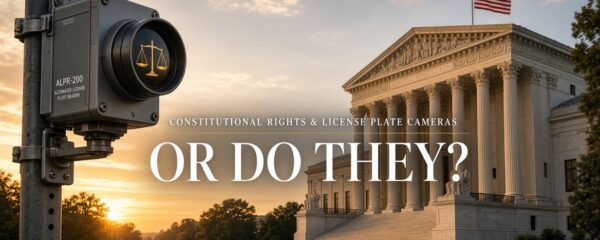
THE FULL CASE FILE ON AUTOMATED LICENSE PLATE READERS — EVERY COURT, EVERY YEAR, EVERY RECEIPT
I already told you about the letter. Twenty-three years in an Army uniform, a decade running an ambulance, four kids, and a piece of mail from the City of Cleveland accusing me of a hit and run I did not commit. I am not retelling that story here. I already spent an entire article on it, and if you missed it, go find it. What I will tell you is what happened after that article went up.
A few hundred of you agreed with me. A few thousand of you did not, and most of those arguments were honest ones, which I respect more than the compliments, because an honest disagreement is the only kind worth answering. One of you asked, calmly, what stops the county from using this exact infrastructure to tax your movements someday. Another said that no matter how you dress it up, collecting data on the general public is a Fourth Amendment problem, no exceptions, no asterisks. A third asked why my own logic would not also require a warrant every time an officer runs a plate or a business hands over a security tape.
Good questions get good answers. So here is the actual case file. Every citation I could find, organized by legal theory instead of by outrage level, so the next time somebody tells you Flock cameras are an unconstitutional surveillance state, you do not have to take my word for it. You can hand them the docket.
— THE ONE SENTENCE THAT ENDS MOST OF THIS ARGUMENT —
Start here, because almost everything else in this piece is just an application of two sentences the Supreme Court wrote decades before Flock Safety existed as a company.
“What a person knowingly exposes to the public, even in his own home or office, is not a subject of Fourth Amendment protection.” — Katz v. United States, 389 U.S. 347 (1967)
“A person traveling in an automobile on public thoroughfares has no reasonable expectation of privacy in his movements from one place to another.” — United States v. Knotts, 460 U.S. 276 (1983)
A license plate is not a secret. State law requires you to bolt a state-issued number to the outside of your vehicle for the specific purpose of letting other people, including the government, identify that vehicle. You cannot tint it. You cannot obscure it. You cannot legally frame it in a way that blocks the numbers. The state built an identification system, made your participation mandatory, and mounted the result at bumper height in broad daylight. If that is a secret, it is the worst-kept secret in American law.
— THREE THINGS BEFORE FLOCK EXISTED —
A beat officer sees a car peel away from a shooting. He does not need a law degree to write four numbers and a letter on a notepad and key his radio. Dispatch runs the plate. Every unit in the city hears the description inside of a minute. Nobody swears out a warrant for that, because the officer saw exactly what anyone standing on that sidewalk could have seen. Not one attorney ever showed up to argue the radio call itself was an unconstitutional search.
Somebody pumps gas, does not pay, and drives off. The station’s own camera catches a bad angle. So the officer walks next door, knocks, and asks the neighboring business politely for their parking lot footage. Most of the time the owner hands it over without being asked twice, because he does not want gas thieves working his block either. No warrant. No subpoena. Just a voluntary handoff of footage from one private business to a public officer, which the Supreme Court settled forty and fifty years ago in United States v. Miller and Smith v. Maryland: information you voluntarily give to a third party is not shielded from the government by the Fourth Amendment. A Flock camera does the identical job. The only difference is it does not need you to ask nicely.
Then there is the body camera clipped to the chest of nearly every patrol officer in this country. It records precisely what an officer could already see standing in that spot. The Ninth Circuit settled this in United States v. Taketa, 923 F.2d 665 (9th Cir. 1991): police may record what they may lawfully view with the naked eye. A body camera is an officer’s eyes with a hard drive attached. A Flock camera is a fixed officer who never blinks, never calls in sick, and never forgets what he saw at two in the morning. Same legal category. Public view, recorded.
— THE HOT SHEET YOUR GRANDFATHER CARRIED —
Now go back further than most of us in this argument can remember clearly.
- Denver. A police cadet named David Roberts gets handed a ten-page document at roll call, six columns, single-spaced: license plates of every stolen and wanted vehicle in the system. Every cop on shift thumbed through that stack of paper any time a car looked wrong. That was already mass, systematic comparison of public plates against a government list, more than fifty years before anyone had heard of Flock Safety. The International Association of Chiefs of Police has described automated readers as the efficient descendant of exactly that lookout sheet, not some brand-new legal power invented in a startup office in Atlanta. If the paper hot sheet was constitutional in 1970, and it was, then photographing the same plates and running them against the same kind of list in 2026 is not a revolution. It is typesetting.
— THE PRIVATE EYE ANGLE —
Private investigators have made a living doing exactly this for longer than Flock has existed. A licensed PI can sit in a parking lot, write down a tag, photograph a car, and follow it down a public road without asking a judge for permission, because none of that requires government authority in the first place. The Fourth Amendment restrains the government. It has never restrained the guy in the beat-up sedan across the street. Insurance investigators film claimants loading groceries into their trunk. Repo agents scan entire parking lots. Skip tracers buy commercial plate-read databases the same way police departments buy access to Flock. None of it triggers the Fourth Amendment, because none of it is the government, and the plate was sitting in public the entire time.
Two real fences exist here, and I am not going to pretend otherwise. The Driver’s Privacy Protection Act makes it a federal offense to pull a name and home address off a plate through DMV records without a legitimate, listed purpose. Seeing the plate is free. Turning it into somebody’s home address is regulated, and it should be. Bolting a GPS tracker to somebody’s bumper without a warrant is its own separate constitutional problem after United States v. Jones, which I am getting to next. Flock does neither. It does not query the DMV on its own, and it has never touched anybody’s car.
— THE SUPREME COURT’S ACTUAL FRAMEWORK —
Here is where I stop talking and let the Court talk.
Katz v. United States, 389 U.S. 347 (1967), moved the entire Fourth Amendment analysis away from property lines and toward reasonable expectations of privacy, but it kept the public-exposure rule fully intact. Display something to the world, and you cannot later claim it was a secret.
United States v. Knotts, 460 U.S. 276 (1983): officers hid a radio beeper inside a drum of chemicals and tracked it down public roads to a cabin. The defendant argued that was surveillance. The Court disagreed. Visual tailing from the street would have revealed the identical route, and technology that makes a lawful public observation more efficient does not become a new kind of search just because it is efficient.
New York v. Class, 475 U.S. 106 (1986): no reasonable expectation of privacy in a VIN visible from outside a vehicle. Cardwell v. Lewis, 417 U.S. 583 (1974): the exterior of an automobile is “thrust into the public eye.” A license plate is the VIN principle applied to the one number the state specifically designed to be read from twenty feet away.
United States v. Jones, 565 U.S. 400 (2012): this is the one that actually went the other direction, and it matters why. Officers physically attached a GPS unit to a suspect’s Jeep and tracked it for twenty-eight straight days. The Court required a warrant, but the reasoning was trespass. The government occupied private property, the vehicle itself, to gather information. A few justices in concurrence also worried about long-term “mosaic” tracking. Hold that thought, because it comes back later. Flock is Jones running backward. No installation. No physical contact with the car. No continuous tail.
Carpenter v. United States, 585 U.S. 296 (2018): this is the one everybody in my replies wants to throw at me, so let us read what it actually says instead of what a screenshot said it says. The government obtained seven days of historical cell-site location data without a warrant, and the Court called that a search, because a phone lives in your pocket, travels into your home, and produces something close to a perfect retrospective map of an entire life. Chief Justice Roberts called the holding narrow on purpose, then wrote a sentence that does most of the heavy lifting in this whole debate.
The decision does not “call into question conventional surveillance techniques and tools, such as security cameras.” — Carpenter v. United States, 585 U.S. 296 (2018)
Read that again. The opinion being waved around in my replies as proof that cameras are unconstitutional is the same opinion that expressly carved cameras out of its own holding. That is not a loophole I am exploiting. That is the Chief Justice of the United States telling you, in writing, exactly where the line sits.
— THE CIRCUIT COURTS SAID THE SAME THING, REPEATEDLY —
No United States Court of Appeals has held that a typical fixed automated license plate reader network requires a warrant. Not one. Here is the actual list, because “trust me” is not how I run a classroom and it is not how I run this account either.
United States v. Ellison, 462 F.3d 557 (6th Cir. 2006) — running a plate observed from a lawful vantage point is not a search.
Olabisiomotosho v. City of Houston, 185 F.3d 521 (5th Cir. 1999) — a motorist has no privacy interest in her own license plate number.
United States v. Walraven, 892 F.2d 972 (10th Cir. 1989) — a plate in plain view on a car’s exterior gets no Fourth Amendment protection.
People v. Bushey, 29 N.Y.3d 158 (2017) — New York’s highest court, same rule.
United States v. Yang, 958 F.3d 851 (9th Cir. 2020) — historical ALPR data on a rental car; the court declined to extend Carpenter to public-road plate reads.
United States v. Porter, 5th Cir., March 17, 2026 — periodic hits from roughly ten public-road cameras were not a search, since the system never continuously tailed the defendant or followed him into private space.
Schmidt v. City of Norfolk, E.D. Va., January 27, 2026 — a network of roughly 176 Flock cameras that photographed the plaintiffs hundreds of times still did not reconstruct “the whole of a person’s movements.”
ALPR networks could become too intrusive “at some point,” but “not today.” — Judge Mark S. Davis, Schmidt v. City of Norfolk (E.D. Va. 2026)
State v. Simonson, Wash. Ct. App., January 29, 2026 — a single Flock image on a public roadway is not a search under the Fourth Amendment or Washington’s own state constitution.
United States v. Martin, 753 F. Supp. 3d 454 (E.D. Va. 2024) — three Flock snapshots of a robbery suspect did not build the kind of mosaic Carpenter warned about.
Commonwealth v. Church, Va. Ct. App., October 14, 2025 — reversed a trial court’s warrant requirement because Flock “simply took pictures of the license plate and the vehicle as he drove it down public thoroughfares.”
Scholl v. Illinois State Police, N.D. Ill., 2025 — dismissed a constitutional challenge to a statewide ALPR network outright.
Commonwealth v. McCarthy, 484 Mass. 493 (2020) — a limited network of bridge cameras did not reveal the whole of a defendant’s movements, though the court left the door open a crack for a denser future network.
United States v. Sturdivant, N.D. Ohio, 2025 — denied suppression and noted a “nearly uniform consensus” among courts on this exact question, right here in my home state.
I am not asking you to take my word for a trend. I just gave you the docket numbers.
— THE ONE CASE THE OTHER SIDE KEEPS WAVING AROUND —
One decision keeps showing up in my replies as the supposed exception that breaks all of this: Commonwealth v. Bell, a 2024 Norfolk circuit court suppression order that treated the city’s Flock grid like a GPS-style dragnet. Fair enough. It exists. Cite it. What nobody citing it mentions is that later Virginia courts looked at the identical grid and went the other direction. Church reversed a similar warrant requirement months later. Schmidt rejected the civil version of the same theory in the same city. Bell is not the trend. Bell is the outlier the rest of the docket buried.
— WHAT FLOCK IS NOT, AND WHERE I AGREE WITH YOU —
I am not going to stand here and tell you every camera network in America is automatically fine forever, because that is not what the case law actually says, and pretending otherwise would make me no better than the people I am arguing with.
Flock is not Jones. Nobody trespassed onto your car to install anything on it.
Flock is not Carpenter’s cell-site data. Nothing lives in your pocket and follows you into your bedroom, and most departments retain footage for a matter of days, not months.
Flock is not the citywide aerial surveillance program the Fourth Circuit struck down in Leaders of a Beautiful Struggle v. Baltimore Police Department, 2 F.4th 330 (4th Cir. 2021), which photographed an entire city from the air for weeks at a stretch. Flock only sees a vehicle the moment it crosses a fixed point.
Flock is not a geofence warrant sweeping up everybody’s phone location, which is its own separate and tightening body of law after Chatrie v. United States. And Flock is not a search of your home. Drive into your own garage, and the curtilage cases still require a warrant to follow you in. Flock stops at the curb, the same place your Fourth Amendment rights start getting serious.
Here are the honest caveats, in writing, because a one-sided argument is not an argument. It is a sales pitch. Several courts, including Schmidt and McCarthy, have flagged that a sufficiently dense, sufficiently permanent, fully federated camera grid could someday cross the Carpenter line and reconstruct the whole of somebody’s life. “Not today” is a real legal standard, not a permanent hall pass. Officer misuse is documented and real; people have used systems like this one to check on ex-partners, and every one of them should be fired and prosecuted, the same as any officer who abused NCIC in 1995 without anybody arguing NCIC itself needed to be deleted. Retention length and interstate data sharing are legitimate policy fights that belong in a city council chamber, not decided by vibes on this app. And an alert without a visual confirmation is not reasonable suspicion for a stop; the constitutional event that actually needs care is the seizure of the driver, not the earlier photograph of the plate.
Write the rules. Cap the retention in statute. Log every query to a named officer and an open case number. Require a warrant before anybody builds a pattern-of-life file on a specific named person. Publish an annual report the way a school publishes a report card. Fire and prosecute misuse instead of writing a memo about it. That protects the wrongly accused driver and the missing child in the same sentence, and it costs the taxpayer close to nothing.
— ANSWERING THE THREAD —
Now for the actual arguments that showed up in my replies, addressed honestly, because that is the only kind of engagement worth having.
One version went something like this: the Constitution restrains what government may do, and it may not collect and archive data on the general public, warrant or no warrant. I understand the instinct. But that argument proves too much. It would also outlaw the beat officer’s radio call, the 1970 hot sheet, and every department’s own case file cabinet, none of which anyone has successfully challenged on those grounds. The Fourth Amendment restrains searches and seizures. Photographing something already sitting in public view has never met that definition, going back to Katz.
A related version said that, by my logic, we would need a warrant every time a cop runs a plate, or every time a business captures a crime on its own camera. Yes. That is exactly the point, offered as if it were a rebuttal. We do not require a warrant for either of those things, precisely because neither one is a Fourth Amendment search under sixty years of settled doctrine. You handed me my own argument and called it a gotcha.
Another raised an honest concern about warrant timing: getting a judge to sign off takes hours, sometimes days, and people can be hurt while the paperwork moves. This is where I bring up two cases nobody wants to sit with. DeShaney v. Winnebago County Social Services, 489 U.S. 189 (1989), and Town of Castle Rock v. Gonzales, 545 U.S. 748 (2005). Both hold, in plain language, that the government has no constitutionally enforceable duty to protect any specific individual from private harm, even when officials knew about the danger and did nothing. Jessica Gonzales called the police repeatedly over roughly ten hours while her estranged husband had their three daughters. The Supreme Court held she had no enforceable right to have that restraining order acted on. Ten hours. I ran a truck for years, and in my world we fight over minutes, not hours. So when the honest worry is what happens while everyone waits for a warrant, the answer already sitting in the case law is: often, nothing happens, because the state owes no individual a legal guarantee of rescue. A system that flags a plate on an Amber Alert automatically, with no officer deciding whether tonight’s emergency clears some internal bar, is not a threat to that child. It may be the only thing standing in the gap DeShaney and Castle Rock left wide open.
The strongest version of the pushback, and I will say so plainly, is the mosaic concern: enough cameras, stitched together over enough time, start to resemble the exact continuous tracking Jones and Carpenter worried about, even without a single trespass or a single phone. That argument deserves real courts and real statutes, not a shrug. It is also, notice, an argument for retention caps, audit trails, and warrants before pattern-of-life aggregation, which is precisely what I proposed two sections ago. It is not an argument for taking a crowbar to the pole.
Jim Quinn’s Sixteenth Law of Liberalism holds that liberals view the world the way they think it should be, not the way it actually is. Read the docket I just handed you and decide which side of this particular argument is doing that.
— THE COST OF GETTING THIS WRONG —
I spent enough of my life kneeling next to people I could not save to have an opinion about how fast help is allowed to move. DeShaney and Castle Rock are not abstractions to me. They are legal proof that when the system is slow, nobody official owes your family a guarantee, and the machine that flags a plate in under a second is not oppression. It is the one part of the system that does not get tired, does not have a bad night, and does not decide your call can wait until morning.
— FOR THE STUDENTS —
Hey
, print this one for your chapters, because the actual lesson here is a habit, not a topic. When somebody hands you a case, go read the case yourself before you retweet the outrage. Carpenter got quoted at me for months by people who never read the paragraph that carves out security cameras. That is not a gotcha against me. That is a gotcha against whoever handed them the quote and hoped nobody would check.
— THE BOTTOM LINE —
If your objection is “I do not want this many cameras in my town,” take it to a city council meeting, because that is a policy argument and you might even win it. If your objection is “this specific grid, in this specific city, has gotten dense enough to reconstruct my entire life,” that is a real Carpenter argument, and a future plaintiff with a thick enough record may actually win it someday. But if your argument is that photographing a license plate on a public road is, itself, always, a warrantless search, the answer, as of September 2026, sitting in every circuit that has actually looked at it, is no. Not maybe. No.
But what do I know. I am only a medically retired combat medic who spent a tour wishing somebody could tell me who was behind the wheel of the car coming up the road before it got close enough to matter, a paramedic who rode with patrol officers running plates the old-fashioned way, and a physics teacher who grades on evidence instead of volume. Come argue with the docket, not with me.
IF THIS ARTICLE MADE YOU THINK:
LIKE this article so the algorithm shows it to people who need to read it.
SHARE this — every share really helps get the word out. Use it.
COMMENT below with your take. Which case surprised you the most? Tell me.
And if you want MORE of this — the data, the history, the science, the stories — JOIN Bski’s Classroom community or follow me on YouTube. Even better, subscribe to my account; it is about the cost of a cup of coffee per month. That is it. Your support keeps this classroom open, and I promise I will never run out of material as long as the left keeps trying to out-dumb itself.
 Mike Borowski is a medically retired Army combat medic with 23 years of service, including a combat deployment to Iraq, and a high school Anatomy and Physics teacher at a high-need Career Technical district in Northeast Ohio — where he also wrote and published the textbooks for both courses. He runs “Bski’s Classroom,” a platform dedicated to cutting through political noise with data, history, and the kind of blunt honesty that comes from someone who has seen both war and the American classroom up close.
—
X (Twitter): x.com/BskiMike22802
Substack: substack.com/@bskimike22802
YouTube: www.youtube.com/@BskiMike22802
AFNN: https://afnn.us/author/mikeborowski/
If you enjoyed this article, then please REPOST or SHARE with others; encourage them to follow AFNN. If you’d like to become a citizen contributor for AFNN, contact us at managingeditor@afnn.us Help keep us ad-free by donating here.
Substack: American Free News Network Substack
Truth Social: @AFNN_USA
Facebook: https://m.facebook.com/afnnusa
Telegram: https://t.me/joinchat/2_-GAzcXmIRjODNh
Twitter: https://twitter.com/AfnnUsa
GETTR: https://gettr.com/user/AFNN_USA
CloutHub: @AFNN_USA