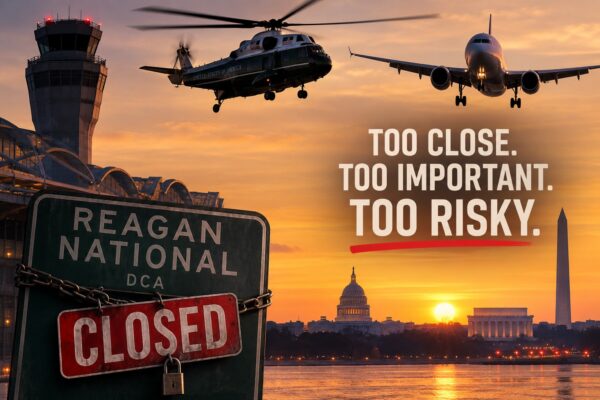
There comes a point in every engineering problem when you stop adding warning lights, procedures, antennas, memorandums, restrictions and additional layers of bureaucracy and finally ask the uncomfortable question:
Why are we still doing this?
Ronald Reagan Washington National Airport opened in 1941.
That was a perfectly reasonable place to put an airport when Franklin Roosevelt was president, the Pentagon wasn’t finished, commercial aviation involved propellers, nobody had invented a Black Hawk helicopter, and “continuity of government aviation” wasn’t sharing airspace with hundreds of daily airline departures.
Eighty-five years later, perhaps Washington should admit something government is genetically incapable of admitting:
The original idea may have exceeded its useful service life.
This isn’t an argument against aviation. It’s an argument for national security, risk management and the ancient engineering principle known as quit doing stupid things when the consequences become catastrophic.
On January 29, 2025, American Airlines Flight 5342 and an Army UH-60 Black Hawk collided near Reagan National. Sixty-seven people died.
The NTSB didn’t ultimately describe this as some freak accident that nobody could have anticipated. Its investigation identified systemic failures involving FAA airspace design, safety oversight and risk management, Army procedures, air-traffic-control workload and an overreliance on visual separation. The Board concluded that the helicopter route itself had been placed dangerously close to a runway approach path.
Even more troubling, investigators found that DCA’s arrival rate, increasing traffic and airline scheduling practices had regularly strained the tower workforce and degraded safety over time.
That’s bureaucratic language for something much simpler:
We stuffed too much aviation into too little sky.
After 67 people died, Washington did what Washington does.
It fixed things.
The FAA restricted helicopter operations. It eliminated mixed helicopter and fixed-wing traffic in critical areas. Route 4 was closed. Military ADS-B requirements changed. Pentagon departures were suspended until technical and procedural problems could be corrected. Visual separation was eliminated within five nautical miles of DCA. Staffing and oversight increased.
Good.
Except we apparently weren’t done learning.
On August 4, 2026, Marine One was preparing to carry the President from the Ellipse while an Envoy Air regional jet departed Reagan National.
There was supposed to be a three-minute notification before Marine One lifted off.
Marine One tried.
The tower didn’t receive it.
The helicopter crew tried an alternate communications path.
That didn’t work either.
The airliner departed.
Marine One and the regional jet came within roughly 0.82 nautical miles laterally and 700 feet vertically, below the required separation. The airline crew received a traffic warning after departure.
This wasn’t two guys in Cessnas arguing over who had the right-of-way at the Alpena County Regional airport.
This was Marine One carrying the President of the United States operating beside scheduled commercial airline traffic in the most politically sensitive airspace in America.
And here’s where the story moves from concerning to absurd.
The communications problem wasn’t completely unknown. Controllers and Marine One personnel had met before the August 4 incident to discuss reports that the tower wasn’t receiving those three-minute calls reliably. They devised an alternate procedure.
Then the alternate procedure failed too.
So the FAA moved an antenna and changed procedures.
Problem solved.
Everybody go home.
Except on August 27—about an hour after federal investigators released their preliminary findings explaining the previous incident—Marine One again attempted to communicate its departure warning with Reagan tower.
The controller couldn’t hear it.
Another helicopter relayed the message.
Marine One tried again.
Still couldn’t hear it.
A controller actually asked another helicopter to listen for Marine One and relay what it heard. Communications were restored before departure, and the flight proceeded normally.
At some point, the reasonable question stops being “How do we fix the next problem?”
It becomes:
“Why does this airport need to be here?”
Washington absolutely needs military aviation. It needs presidential transportation. It needs law-enforcement helicopters. It needs emergency medical aviation. Most importantly, it needs continuity-of-government aviation capable of functioning during exactly the sort of catastrophe when normal procedures may already be falling apart.
Those aren’t optional missions.
The FAA’s own permanent restrictions recognize that fact by specifically allowing essential operations involving national security, continuity of government, law enforcement, lifesaving missions and presidential transportation.
So which mission should bend?
Should Marine One stop flying?
Should continuity-of-government helicopters stop training?
Should law enforcement stop operating?
Or perhaps should the commercial airport sitting beside the Pentagon and across the river from Washington’s governmental core finally move?
We already built the alternative.
It’s called Dulles.
Dulles handled more than 29 million passengers in 2025 and continues expanding. Reagan handled about 24.9 million. Dulles is opening additional gates and expanding precisely because Washington’s aviation demand continues growing.
Yes, shutting Reagan National would be inconvenient.
People love landing practically within sight of their congressional office.
Airlines have routes, slots and infrastructure invested there. Moving roughly 25 million annual passengers would require years of planning, expansion at Dulles and BWI, additional ground transportation and probably major improvements to rail connectivity.
Fine.
Build it.
We are discussing the capital of the richest nation on Earth, not trying to establish an airstrip on Guadalcanal with bulldozers and pierced-steel planking.
We can engineer transportation.
What we cannot engineer back are 67 dead people.
And the national-security implications extend beyond another accidental collision.
Imagine an airliner colliding with Marine One over Washington.
For the first few minutes, nobody knows what happened.
Was it an accident?
Mechanical failure?
Pilot error?
Cyberattack?
Sabotage?
Terrorism?
An assassination attempt?
Those aren’t academic distinctions when the President is involved. National command authorities would be trying to establish what happened while television networks, social media, foreign intelligence services and potentially adversarial governments were simultaneously attempting to answer the same question.
That is precisely why risk surrounding national leadership should be minimized wherever reasonably possible.
DCA’s fundamental problem isn’t that airplanes are dangerous.
Commercial aviation is extraordinarily safe.
The problem is consequence concentration.
Airliners, military aircraft, presidential helicopters, law-enforcement aviation, restricted airspace, the Pentagon, the White House, Congress and America’s national command structure all exist within an astonishingly compressed geographic area.
We’ve spent decades developing increasingly complicated procedures to make all those things coexist.
Then 67 people died.
We redesigned the airspace.
Then Marine One lost required separation with an airliner.
We changed procedures and moved an antenna.
Then the communications problem appeared again.
Perhaps the universe is attempting to submit a maintenance request.
Maybe we should stop forcing commercial aviation and critical national-security aviation to thread increasingly sophisticated needles through the same tiny patch of sky simply because Washington enjoys getting downtown fifteen minutes faster.
The airport served America well.
For 85 years.
That’s not failure.
That’s retirement.
And after 67 deaths, permanent airspace restrictions, systemic failures identified by the NTSB, one presidential-helicopter separation incident and another communications failure following the supposed fix, continuing exactly as before isn’t prudence.
It’s institutional inertia with wings.
Shut down Reagan National. Build out Dulles. Give Washington’s national-security aviation the airspace it actually requires.
Because eventually “we fixed it” needs to mean something.
And convenience isn’t worth finding out what happens the next time we didn’t.
_________________________________
If you enjoyed this article, then please REPOST or SHARE with others; encourage them to follow AFNN. If you’d like to become a citizen contributor for AFNN, contact us at managingeditor@afnn.us Help keep us ad-free by donating here.
_________________________________
Substack: American Free News Network Substack
Truth Social: @AFNN_USA
Facebook: https://m.facebook.com/afnnusa
Telegram: https://t.me/joinchat/2_-GAzcXmIRjODNh
Twitter: https://twitter.com/AfnnUsa
GETTR: https://gettr.com/user/AFNN_USA
CloutHub: @AFNN_USA