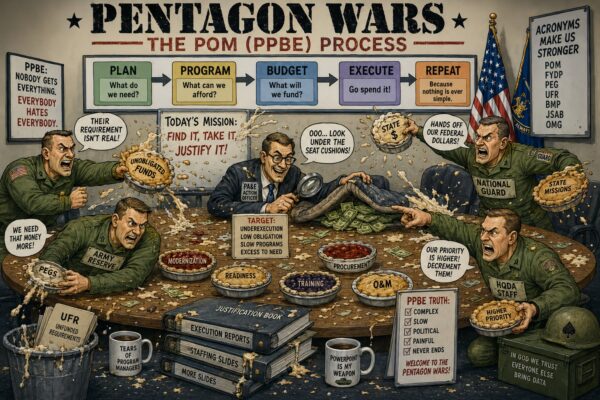
I suspect there are people in the Army National Guard who still hate me.
Not personally, mind you. I’m a delightful human being.
Professionally?
Oh, absolutely.
I spent part of my Army career in the strange priesthood known as Program Analysis and Evaluation, where otherwise normal officers were taught to stare at enormous spreadsheets until federal money revealed its hiding places.
And I was pretty good at it.
My particular superpower was looking under the Pentagon’s fiscal seat cushions and finding money somebody hadn’t spent yet.
Unfortunately for the National Guard, sometimes it was theirs.
Welcome to the Pentagon Wars.
Most Americans imagine the defense budget something like this: Congress gives the Army a gigantic pile of money. The Army buys tanks, ammunition, helicopters, boots, and perhaps one $600 government-approved toilet seat. Everybody salutes and goes home.
That’s adorable.
The actual system grew out of the Planning, Programming, and Budgeting System, introduced at the Department of Defense under Secretary of Defense Robert McNamara in the early 1960s. McNamara brought systems analysis into the Pentagon with the perfectly reasonable idea that perhaps the world’s largest military establishment should have some rational method for deciding how to spend mountains of taxpayer money.
The idea was almost beautiful.
Define your strategy. Identify requirements. Compare alternatives. Analyze costs. Establish priorities. Program resources over several years. Build a budget.
Science!
Then we gave it to the Pentagon.
Six decades later, the descendants of that system have evolved into an enormous bureaucratic ecosystem of plans, programs, budget drills, program reviews, issue papers, unfunded requirements, decrement lists, execution reviews, program evaluation groups, decision briefings, spreadsheets, databases, acronyms, meetings about meetings, and PowerPoint presentations explaining why somebody else’s money would be much happier living in your program.
At the center of this magnificent machine is the Program Objective Memorandum, or POM.
The POM is where the Army attempts to explain what it intends to buy, maintain, organize, modernize, and operate across several future years.
In theory, this is where Army strategy becomes resources.
In reality, somebody rings a bell and releases the Active Army, Army National Guard, Army Reserve, headquarters staffs, commands, proponents, and program managers into an enclosed arena armed with spreadsheets.
Let the food fight begin.
Every organization has requirements.
Every requirement is critical.
Every critical requirement is underfunded.
And absolutely nobody has any money they don’t need.
Ever.
You could walk into an organization that had spent twelve dollars of a $30 million program and ask whether they really needed the remaining $29,999,988.
The answer would arrive before you finished the question.
“YES!”
There would then be a 37-slide briefing explaining that removing even $500,000 would create unacceptable operational risk, damage readiness, imperil modernization, possibly embolden Vladimir Putin, and almost certainly kill somebody’s PowerPoint transition effect.
That was where people like me entered the picture.
Some senior leader would essentially say:
“Cloft, Go find money.”
That sounds impossible until you understand Pentagon programming.
Money leaves tracks.
Execution rates leave tracks.
Delayed programs leave tracks.
Requirements that sounded absolutely essential eighteen months ago sometimes aren’t executing as advertised.
So you start turning over rocks.
What’s obligated?
What’s unobligated?
What’s behind schedule?
What’s executing below plan?
What requirement changed?
What program has more money than it can realistically execute?
And—most importantly—
Who isn’t watching their wallet?
Then you find it.
There it is.
A beautiful little pile of federal dollars hiding behind some program that isn’t executing.
And somewhere in National Guard headquarters, an action officer suddenly feels a disturbance in the Force.
“Cloft found the money.”
Lock the doors.
Hide the spreadsheets.
Delete the execution report.
Tell everybody we’re fully funded and horribly underfunded simultaneously.
Because here’s the dirty little secret of Pentagon budgeting:
If you aren’t spending your money, somebody else can usually produce a very persuasive argument for why they should.
We didn’t call it stealing, of course.
This is the United States Department of Defense (now War).
We have professional terminology.
We were realigning resources toward higher-priority requirements.
Which is Pentagon English for:
“Thanks for the money, National Guard.”
The Guard wasn’t the only victim. Everybody played the game. Active Army, Army Reserve, National Guard, headquarters, commands, program managers—everybody defended their rice bowl while simultaneously inspecting everybody else’s rice bowl for leftovers.
Your brother in arms on Tuesday could become the guy whose program you were trying to decrement on Wednesday.
Then Thursday morning you’d sit beside him at a meeting and say:
“Morning, Chuck
Chuck knew.
You knew.
Chuck knew that you knew.
Nobody mentioned the $14 million.
This is how entire careers are made in the Pentagon.
People become extraordinarily skilled at navigating a resource-allocation system so complicated that understanding the system itself becomes a valuable military specialty.
And that creates the fundamental problem.
McNamara’s system was supposed to make defense spending more rational.
Instead, decades of accumulated processes, organizations, congressional requirements, internal controls, analytical structures, and institutional habits created something approaching a bureaucratic organism.
The system doesn’t merely allocate resources anymore.
The system consumes vast resources while deciding how to allocate resources.
Thousands of military personnel, civilians, contractors, analysts, programmers, budget officers, action officers, and senior leaders spend enormous amounts of time preparing submissions, defending submissions, challenging submissions, revising submissions, briefing submissions, and explaining why last week’s submission no longer resembles this week’s submission.
Then somebody announces another reform.
Every few years Washington discovers that defense budgeting is slow, cumbersome, inflexible, and poorly suited for rapidly changing technology.
A commission is formed.
Experts testify.
A report is published.
Everyone agrees the system must become faster and more agile.
The Pentagon then creates a working group to determine how to reduce bureaucracy.
The working group establishes several sub-working groups.
The sub-working groups produce briefing slides.
The slides require staffing.
The staffing generates comments.
The comments require adjudication.
Congratulations.
We just created another bureaucracy to study why we have too much bureaucracy.
And yet the monster survives because virtually everybody inside it has adapted to it.
Organizations know how to fight within it.
Staffs are structured around it.
Careers are built mastering it.
Commands know when to submit requirements.
Analysts know where to look for money.
Program managers know how to defend money.
Senior leaders know which meetings matter.
Congress knows how to influence it.
Industry knows how to navigate it.
The bureaucracy has developed its own ecosystem.
Changing it isn’t merely rewriting a regulation.
You’re trying to alter the terrain upon which thousands of people have spent decades learning how to wage war.
And make no mistake:
It is warfare.
Nobody gets shot.
Nobody gets blown up.
But programs die.
Organizations lose manpower.
Modernization gets delayed.
Requirements disappear.
Millions of dollars move across spreadsheets.
And somewhere in the Pentagon, an action officer walks out of a conference room carrying a folder and the unmistakable expression of a man who has just stolen somebody else’s lunch money without technically violating federal law.
I occasionally wonder whether some retired National Guard programmer still remembers me.
Maybe he’s sitting on his porch drinking coffee when suddenly he thinks:
“That Cloft bastard found our money.”
If so, sir, wherever you are:
It wasn’t personal.
You should have spent it faster.
Welcome to the Pentagon Wars.
_________________________________
If you enjoyed this article, then please REPOST or SHARE with others; encourage them to follow AFNN. If you’d like to become a citizen contributor for AFNN, contact us at managingeditor@afnn.us Help keep us ad-free by donating here.
_________________________________
Substack: American Free News Network Substack
Truth Social: @AFNN_USA
Facebook: https://m.facebook.com/afnnusa
Telegram: https://t.me/joinchat/2_-GAzcXmIRjODNh
Twitter: https://twitter.com/AfnnUsa
GETTR: https://gettr.com/user/AFNN_USA
CloutHub: @AFNN_USA
Having worked in Army Acquisition for many years, this article hits the mail in the head. The system is convoluted, bureaucratic, and cumbersome. The (mostly) civilian ‘engineers’ are do. It deserve that title. Decisions are often arbitrary and capricious. Efficiency and effectiveness are of little concern. Risk aversion – translated into inaction is better that action – is of biblical proportions.
Having said that, the money guys are part of the problem. When starting a program, there is a thing called the Independent Government Cost Estimate. Lots of smart folks do the best they can to determine the development, testing, procurement, and fielding costs of a system. The. The money guys show up and ferret out any reserve. In the military we are taught to maintain a reserve, but with the money fold that is a heinous sin. The. Everyone between you and the money takes a cut. In the end, a PM is expected to execute a $100M program with $80M after all the graft, taxes, overhead that is non value added, etc. and no reserve for unknowns, like when a key component is no longer available and you need to see another (invariable lore expensive) source. The. Each year the money folks show up and say they want 10% of your budget this year, which they will pay back next year. They never do, but even if they did, the future value of money, the math doesn’t work. So in the end, the PM is in an impossible position, and no one who ensured failure is standing next to the PM when he has to explain why he hs overrun. And a quick way to get hammered is to describe that he was not allowed reserve and that he was told to execute a $100M program with $75M.
Don’t get me started on the requirements process with its lvl of record, consistency, and realism. It goes a long way toward ensuring failure too. In the 1970’s there was real rigor in requirements, often viable by studies and analysis. Today it is just the opinion of some guy taking a couple years from what he thinks is important. And since requirements people change every couple of years, the PM is trying to hit a moving target.