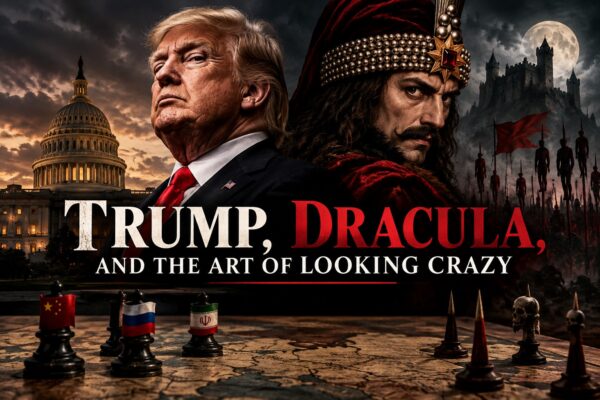
Maybe Donald Trump isn’t crazy.
Maybe looking a little crazy is the whole point.
Before somebody hyperventilates into a paper bag, I’m not suggesting Trump is secretly Dracula, sleeps in a coffin beneath Mar-a-Lago, or plans to impale political consultants on the White House lawn.
Although that would improve television ratings, and CNN would do cheetah-flips.
I’m talking about Vlad III of Wallachia—the historical Dracula—and something Vlad understood very well:
Reputation is a weapon.
Vlad lived with the enormous Ottoman Empire breathing down his neck. He couldn’t outspend it, outnumber it or outmuscle it.
So he weaponized fear.
His infamous impalements weren’t merely punishment. They were psychological warfare. Put thousands of bodies where an approaching army can see them and you’ve created medieval information operations without satellites, social media or PowerPoint.
The message was simple:
This guy might actually be nuts.
Which brings us, strangely enough, to Donald Trump.
Trump is routinely described as narcissistic, impulsive, vain, thin-skinned and unpredictable. I’m not a psychiatrist, and neither is half the internet despite apparently receiving medical degrees from Facebook University.
But perhaps we’re asking the wrong question.
Instead of asking whether Trump is irrational, ask whether appearing irrational can be perfectly rational.
Richard Nixon understood the concept. His administration became associated with the “madman theory”: make adversaries wonder whether the President might respond so violently or unpredictably that challenging him simply isn’t worth the gamble.
Predictable leaders are easy to game.
If Putin or Xi knows exactly where America’s red lines are, he doesn’t need to cross them. He operates one inch below them.
Trump screws up that calculation.
He threatens tariffs. Then negotiations. Then bombs. Then beautiful negotiations. Tremendous negotiations. Perhaps more bombs.
Washington calls it chaos.
An adversary has a different problem:
“What happens if we push him?”
Nobody knows.
And that uncertainty has immense value.
Game theory gives us the classic game of Chicken: two cars race toward one another until somebody swerves.
Now imagine one driver removes his steering wheel and throws it out the window.
Who’s irrational?
Technically, the lunatic without the steering wheel just improved his bargaining position.
The other guy suddenly has a powerful incentive to reconsider automotive diplomacy.
That’s where Trump and Vlad become interesting—not because Trump is Vlad the Impaler, but because both understand the usefulness of getting inside an opponent’s head.
Vlad couldn’t defeat the Ottoman Empire conventionally. But he could make invading Wallachia horrifying enough to make the Sultan think twice.
Trump’s stakes aren’t wooden.
They’re rhetorical.
Tweets. Speeches. Tariffs. Carrier groups. Insults. Flattery. Ultimatums. Sudden negotiations.
And underneath everything sits the sentence every successful deterrence strategy wants planted inside an adversary’s skull:
“He’s Cray, Cray… and he might actually do it.”
Trump’s fascination with monuments and legacy adds another layer. He clearly cares about how history remembers him.
Vlad understood memorialization too.
Six centuries later we’re still talking about the guy.
But madman theory is dangerous. If everyone realizes you’re bluffing, you’re no longer frightening. You’re just the drunk uncle threatening to wrestle the Thanksgiving turkey.
If they believe you too much, however, somebody might strike first.
That’s the razor’s edge.
Maybe some of what looks like Trump’s vanity, ego and unpredictability isn’t merely a weakness.
Maybe some of it is leverage.
Vlad planted stakes where Mehmed could see them.
Trump plants rhetorical stakes where Putin, Xi and Tehran can see them.
Different century. Different weapons. Same uncomfortable principle:
Sometimes the rational move is convincing the other guy that you might be just crazy enough to flip over the chessboard.
If you enjoyed this article, then please REPOST or SHARE with others; encourage them to follow AFNN. If you’d like to become a citizen contributor for AFNN, contact us at managingeditor@afnn.us Help keep us ad-free by donating here.
Substack: American Free News Network Substack
Truth Social: @AFNN_USA
Facebook: https://m.facebook.com/afnnusa
Telegram: https://t.me/joinchat/2_-GAzcXmIRjODNh
Twitter: https://twitter.com/AfnnUsa
GETTR: https://gettr.com/user/AFNN_USA
CloutHub: @AFNN_USA